

Capcom has quietly moved Pragmata up to April 17, 2026, backed by a new trailer and a polished demo. Here’s what the earlier release says about Capcom’s confidence, Hugh and Diana’s co-op systems, and where the game now fits in the 2026 lineup.
Capcom has finally given Pragmata something it has not had in years: a sense of certainty. After multiple delays and a long stretch of silence, the publisher has not only locked in a new launch date but moved it forward. Pragmata will now release on April 17, 2026, a full week earlier than its previously announced April 24 window, for PS5, Xbox Series X|S, Nintendo Switch 2 and PC.
The date change arrived alongside a fresh trailer that does more than restate the premise. It reframes Pragmata as a confident, systems driven sci fi action game with a clear gameplay identity instead of just a striking teaser. Taken together with a polished, hands on demo, Capcom’s decision to pull the game in rather than push it back suggests the project is not only back on track but ahead of schedule.
For a game that once felt like vaporware, that is a big shift in tone.
Why moving Pragmata forward matters
Release date moves are usually read one way. Delays spark concern about troubled development, and pushing a game forward is rare enough that it tends to send the opposite message. In Pragmata’s case, the new April 17 date signals several important things about where Capcom sees the project.
First, it suggests the team is far enough along that scheduling is being driven by strategy rather than necessity. Capcom has been willing to delay Pragmata in the past when it was not ready, so the choice to release earlier now indicates internal milestones are being hit or exceeded. Instead of buying extra time near launch, the publisher is committing to an earlier window while interest from the latest trailer is fresh.
Second, the move positions Pragmata more aggressively in the spring 2026 calendar. With Sony’s sci fi action game Saros set for April 30, Pragmata’s new date secures a two week head start. That buffer gives Capcom breathing room to establish its own identity and word of mouth before another high profile competitor enters the same space. A week might not sound like much on paper, but in a crowded release schedule an extra weekend of sales and social buzz can be the difference between being the conversation and merely joining it.
Finally, the revised date helps rebuild trust in the project. After years of uncertainty, the notion that Pragmata is stable enough to be moved up instead of delayed again makes it easier for players to believe the game they saw in the original announcement has actually coalesced into a coherent experience. It turns the narrative from “Will this ever come out?” into “What does this actually play like?”
The new trailer: a clearer look at Hugh and Diana
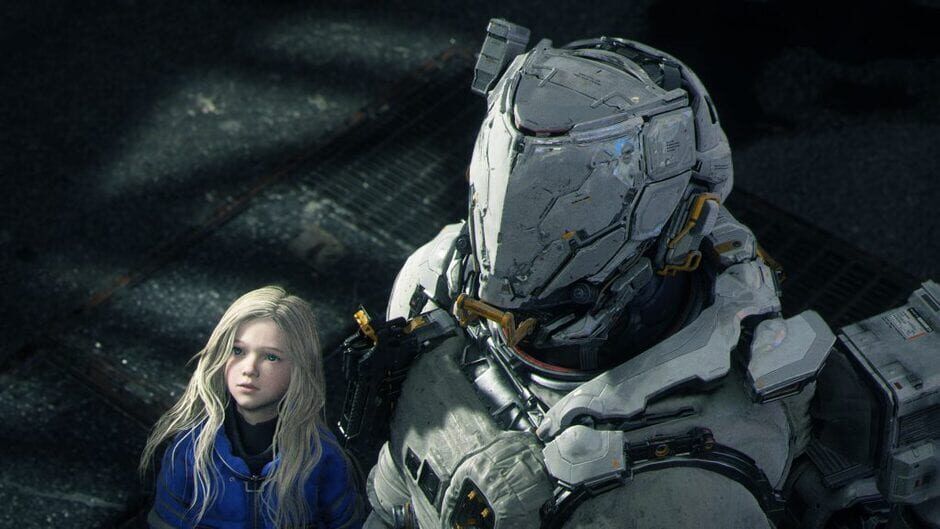
The latest trailer leans hard into that question, focusing less on abstract imagery and more on how Hugh and Diana share space in combat and exploration. Visually, it reinforces the cold isolation of the lunar research station, with sterile corridors, open vacuum walks and stark white labs broken up by crackling holographic interfaces. But it is the interplay between the two leads that stands out.
Hugh is the grounded presence, a suited human operative moving with deliberate weight, trading fire with floating drones and bipedal security bots. Diana, by contrast, comes across as the game’s wildcard. As an android companion, she shifts between uncanny stillness and sudden, almost ethereal motion, phasing through digital overlays or tapping directly into enemy networks.
The trailer uses framing to sell that partnership. Shots show Hugh pinned down in standard third person shooter fashion while Diana hovers at the edge of the frame, projecting holographic sigils toward enemy units. In other moments she appears as a ghostly presence in the environment, altering camera feeds or manipulating doors just as Hugh reaches them. It is a visual shorthand for what Capcom has been calling the hacking twist, and it finally gives that phrase some weight.
What comes across most clearly is that Diana is not a passive AI that barks tips while Hugh does all the work. She is a mechanical and narrative focal point, the lens through which the game’s more experimental systems run.
Co op mechanics without traditional co op
Capcom has pitched Pragmata as a single player experience, but the latest footage makes it obvious that it is built around a co op dynamic between Hugh and Diana. Rather than two human players, it is a duet between direct action and mediated control.
In combat sequences, Hugh takes on the straightforward role players expect from a third person action game. He moves between cover, lines up shots, and uses gadgets to control space in and around the lunar base. The twist arrives when Diana steps in as an overlapping layer of interaction. As Hugh engages enemies, the game cuts or overlays into a distinct hacking view, where Diana’s presence manifests as wireframe models, node based security meshes and glowing weak points.
The co op loop looks something like this. Hugh opens an encounter by drawing fire and exposing enemies. As their defenses ramp up, Diana hijacks their systems through a timed puzzle or rhythm of inputs, forcing players to shift cognitive gears. The better you perform in Diana’s sequences, the more vulnerable those enemies become when control snaps back fully to Hugh. A successful hack might drop shields, desynchronize a formation, or temporarily turn a hostile drone into a friendly turret.
The partnership continues outside of battle. Environmental traversal sequences show Hugh navigating precarious surface walks while Diana manipulates gravity fields and platform routes, effectively placing one character in the world and the other in its underlying logic. It is a kind of co op by design, where the player must think in two layers: the physical layout Hugh inhabits and the digital architecture Diana inhabits.
What the new trailer adds to earlier teases is a sense of rhythm. You are not just occasionally solving a hacking puzzle between firefights. Instead, the footage implies a constant cadence of swapping perspectives, carrying momentum from one character’s strengths into the other’s. If Capcom can keep that flow smooth, Pragmata could stand out as more than just another third person shooter in a sci fi setting.
The playable demo and Capcom’s confidence
Previews referencing a recent hands on demo back up what the new trailer promises. Early impressions call the slice of Pragmata that has been shown “unique, polished, and promising,” with the hacking twist feeling like an integral pillar rather than a bolt on mini game. That polish is important in understanding why Capcom might be comfortable nudging the release up.
A playable demo strong enough to impress press and early testers is usually a sign that core systems are locked. Combat, camera behavior, and the swapping between Hugh’s action and Diana’s hacking all appear to be in the refinement stage rather than basic construction. Building a demo takes time and resources, and publishers rarely invest in one unless they are confident it will sell the game instead of exposing flaws.
In this context, the decision to move from April 24 to April 17 looks less like a gamble and more like a statement: Pragmata is not in crisis mode, it is approaching the finish line. That confidence also opens the door to a public demo closer to launch, a tactic Capcom has used with Resident Evil and other franchises to good effect. A well timed, polished demo on consoles and PC could give players a first hand feel for the Hugh and Diana dynamic and build grassroots hype beyond trailers and previews.
Reading the hacking twist from the latest footage
The heart of Pragmata’s pitch sits in that blend of shooting and hacking. The latest footage reveals a few key lessons about how Capcom wants players to interact with its lunar research station.
First is the idea that enemies are more than health bars. Each robot and security system appears wired into a broader network, with nodes that Diana can access. In practice, this seems to manifest as quick, self contained puzzle sequences where players reroute power, overload logic gates, or stack pattern matches under pressure. Crucially, these hacking segments are still tethered to the immediacy of a firefight. Timers tick down, Hugh’s health bar remains visible in overlays, and the environment continues to shift as alarms escalate.
Second, the station itself behaves like a giant, multi layer dungeon. Locked doors and sealed research wings are not just keycard problems, they are network barriers. The trailer hints at sequences where Diana must hack cameras to create blind spots that Hugh can slip through, or where she manipulates life support and gravity to reshape navigation routes. This design aligns the narrative theme of a cold, inhuman facility with the mechanical reality that every inch of progress has to be unlocked.
Finally, the Hugh Diana partnership appears to extend into story choice and characterization. Dialogue snatches and visual storytelling suggest that Diana’s grasp of her own identity is incomplete, and that hacking into the station’s archives is as much about her past as it is about survival. That gives the co op mechanics emotional weight. Each system you crack is not just a door or a turret, it is potentially another fragment of who Diana is and why she was left in this desolate place.
Where Pragmata fits in Capcom’s 2026 lineup
Zooming out, the new date changes how Pragmata sits in Capcom’s broader plans for 2026. The publisher has leaned heavily on established giants like Resident Evil, Monster Hunter, and Street Fighter in recent years. Pragmata represents something different, a new sci fi IP that blends third person action with puzzle like hacking and a companion focused narrative.
By giving it a mid April slot, Capcom is effectively crowning Pragmata as a core pillar for the early 2026 window. It will not have to share the stage with the sort of massive evergreen releases that usually dominate the publisher’s calendar. Instead, it becomes a tone setter for the year, a statement that Capcom is still interested in taking risks outside its established comfort zones.
The timing also keeps the door open for other big projects later in 2026. An April flagship gives Capcom room to position another major title in the autumn without cannibalizing attention. If Pragmata can secure a strong launch and build positive word of mouth across PS5, Xbox Series X|S, Nintendo’s next hardware and PC, it could help anchor Capcom’s reputation as a studio that can juggle high profile sequels and fresh ideas in the same year.
Most importantly, moving the game forward suggests Capcom is not just trying to clear Pragmata off its slate. It is positioning the game as something it believes in. With a playable demo drawing praise, a new trailer clarifying Hugh and Diana’s co op mechanics, and a firm April 17 date now locked, Pragmata has shifted from curious question mark to one of 2026’s most intriguing sci fi experiments.
If Capcom’s confidence is well placed, April on the lunar frontier could be crowded for all the right reasons.