
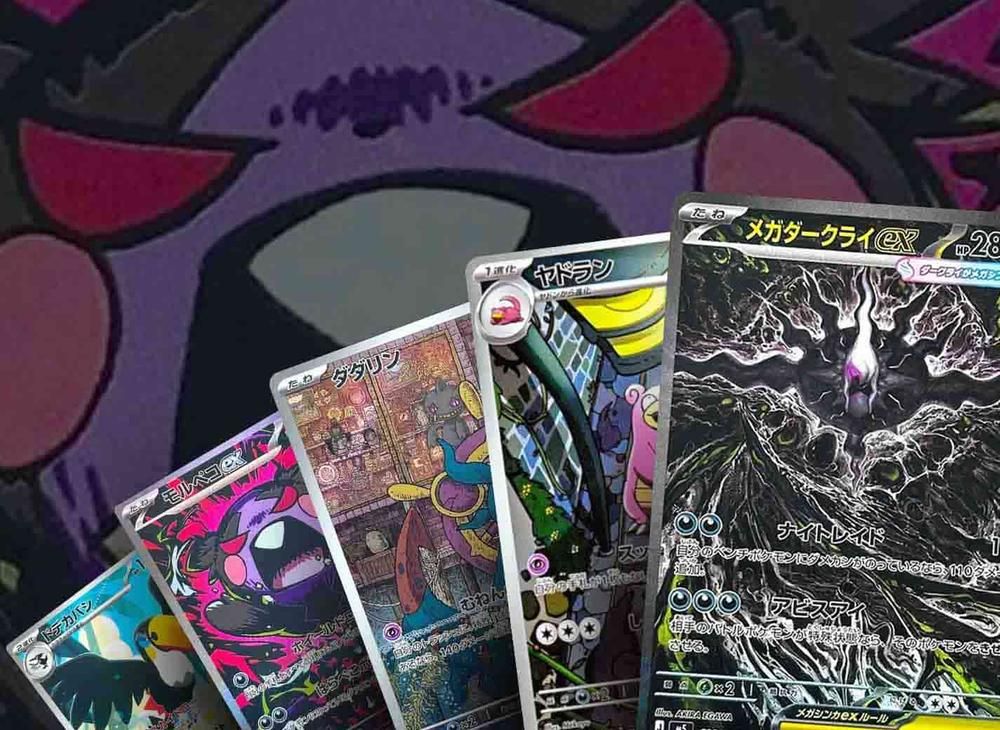

A source-grounded breakdown of early Pokemon TCG Pitch Black card values, the top collector chases, and which cards may actually matter for decks.
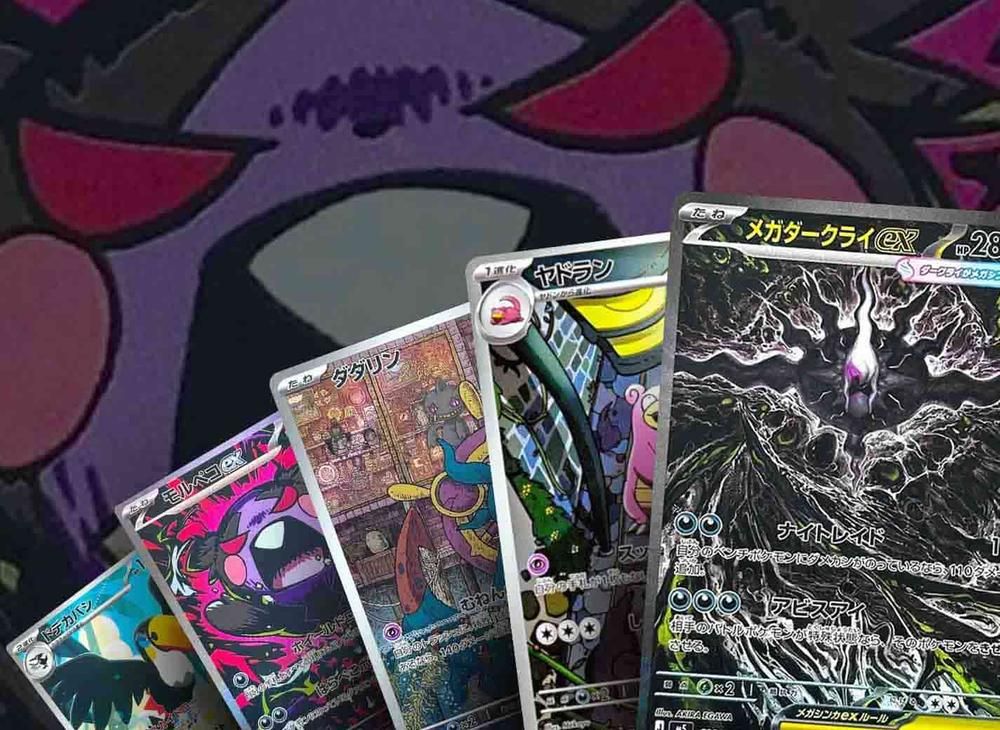
Image: tcgplayer.com
Early Pitch Black prices are already telling two different stories
Pokemon TCG: Mega Evolution: Pitch Black released on July 17, 2026, according to IGN and TCG Watchtower, and its first weekend market has already produced the useful kind of chaos: big chase prices, conflicting listings, and a sharp split between collector demand and playable value.
That split is the story of the set right now. IGN’s early TCGPlayer-linked roundup listed Mega Darkrai ex 120/084 at $996.69, Mega Darkrai ex 116/084 at $520.27, Morpeko ex 117/084 at $192.98, and Mega Zeraora ex 114/084 at $171.34. TCG Watchtower’s daily chase-card tracker, by contrast, currently ranks Mega Darkrai ex 116/084 at $297.75, Mega Darkrai ex 120/084 at $202.54, Morpeko ex 117/084 at $91.84, and Mega Zeraora ex 114/084 at $65.53. Joseph Writer Anderson’s market guide shows the same $297.75 and $202.54 figures for the two top Darkrai versions, matching TCG Watchtower’s order.
Those gaps are too large to treat as normal rounding differences. They are early-market signals, not settled Pitch Black card values. They also show why readers searching for Pokemon Pitch Black valuable cards should check timestamps, card numbers, and rarity labels before assuming a card has a stable price. IGN’s article also lists Mega Darkrai ex 116/084 twice at very different price points, once at $27.05 and later at $520.27, while TCG Watchtower identifies #116 as the Special Illustration Rare and #101 as the Ultra Rare. That kind of early listing confusion can make a chase card look like a bargain or a spike depending on which entry a buyer sees first.
The safe conclusion is narrower but stronger: Pitch Black has a clear collector leader in Mega Darkrai ex, and the first public price snapshots are moving fast enough that buying on headline numbers is risky.
Mega Darkrai is the mascot chase, but its value is mostly collector-led
The set’s top-end market revolves around Mega Darkrai ex. TCG Watchtower calls Pitch Black the fifth set in the Pokemon TCG Mega Evolution series, based on the Japanese Abyss Eye set, and says it is headlined by Mega Darkrai ex alongside Mega Zeraora ex, Mega Chandelure ex, and Mega Excadrill ex. That framing lines up with how the market is behaving: the two most expensive listings in TCG Watchtower’s chase-card ranking are both Mega Darkrai versions.
The key distinction is that there are two separate premium Darkrai chases. TCG Watchtower and Joseph Writer Anderson rank Mega Darkrai ex 116/084, the Special Illustration Rare, first at $297.75. They rank Mega Darkrai ex 120/084, the Mega Hyper Rare, second at $202.54. Joseph Writer Anderson argues that the SIR has the stronger collector appeal because of its darker artwork, while the Mega Hyper Rare still benefits from being a difficult-to-pull card featuring a major Pokemon.
From a strategy angle, that does not automatically make Darkrai the best deck card in Pitch Black. IGN says competitive players are watching Mega Darkrai ex because its Pitch Black attack can secure an instant Knock Out if the defending Pokemon is asleep or poisoned. Siliconera’s assessment is more cautious: it notes that Morpeko ex and Mega Darkrai ex are present among the set’s Darkness Pokemon, but says their attacks are “fine” and “probably not worth building around.”
That disagreement is useful. A card can be one of the best Pitch Black cards for collectors because it is rare, visually distinctive, and attached to the set’s identity. The same card can be much less compelling for tournament players if its strongest line requires too much setup, too many condition-enabling pieces, or a game plan that folds when the opponent avoids sleep and poison pressure. Until results show otherwise, Mega Darkrai ex should be treated as Pitch Black’s headline chase card first and a conditional deck prospect second.
The middle of the market is driven by art, rarity, and character gravity
Below Darkrai, the early Pokemon TCG chase cards in Pitch Black are clustering around Special Illustration Rares, Illustration Rares, and prominent Trainer cards. TCG Watchtower currently lists Morpeko ex 117/084 at $91.84, Mega Zeraora ex 114/084 at $65.53, Mega Chandelure ex 115/084 at $55.24, Gwynn 119/084 at $39.92, Misty’s Vitality 111/084 at $32.55, and Gladion’s Final Battle 118/084 at $31.35. IGN’s earlier prices were higher for several of those same cards, with Morpeko ex at $192.98, Mega Zeraora ex at $171.34, Misty’s Vitality at $60.36, Primarina at $44.67, and Gladion’s Final Battle at $29.24.
The pattern is familiar to anyone who watches modern Pokemon singles. The premium version of a recognizable Pokemon tends to carry collector weight even before players decide whether it belongs in a real list. Morpeko ex is especially telling because Siliconera is skeptical of it as a deck centerpiece, while TCG Watchtower still places its SIR third by market price. That is chase-card demand doing its own work.
The lower Illustration Rare tier shows the same effect at smaller numbers. TCG Watchtower lists Slowbro 090/084 at $20.13, Goldeen 087/084 at $14.34, Dhelmise 091/084 at $7.88, Primarina 088/084 at $7.63, Armarouge 086/084 at $6.30, and Silvally 095/084 at $5.31. TCGplayer’s own Pitch Black feature highlights Goldeen’s appeal as a full-art treatment and points to collector fondness for water-and-light artwork, while also noting that cards featuring Misty have historically commanded attention. Siliconera singles out the Slowpoke and Illustration Rare Slowbro pairing as a small city-wandering story, which helps explain why a non-obvious competitive card can still become a binder target.
For buyers, the lesson is that the best Pitch Black cards are not all fighting for the same wallet. Darkrai, Morpeko, Zeraora, and Chandelure are collector-led premium pulls. Slowbro and Goldeen are art-led pulls. Misty’s Vitality sits in the dangerous middle, where character appeal and possible deck utility can reinforce each other.
The playable watchlist starts with Energy and setup, not the biggest price tags
If the question is deck value rather than display value, Siliconera’s read of the set points away from the most expensive singles and toward cards that change sequencing. Voltaic Lightning Energy is the cleanest example. Siliconera says it could make competitive decks because, in a Lightning-focused build, it boosts damage by 20. That kind of effect is easy to underestimate in the opening market because it lacks the visual drama of a Special Illustration Rare, but damage math is often where a format quietly moves.
Misty’s Vitality is the other card players should test seriously. Siliconera says it lets a player search for and attach four Water Energy to a Pokemon in exchange for ending the turn. The same source adds that Pitch Black itself may not contain an obvious partner, but older Water attackers could benefit from reaching a six-energy attack on their second turn in play. That is the sort of card that can look slow in isolation and still become relevant if the right attacker already exists in the card pool.
Among the Mega Evolutions, Siliconera identifies Delphox, Chandelure, and Zeraora as the biggest splashes. Delphox can pull Pokemon from the deck onto the bench through Trick Portal, Chandelure pressures the opponent through retreat-cost-based damage, and Zeraora offers straightforward energy-multiplied damage. Those are playable hooks, but each asks a different deck-building question. Delphox asks whether bench setup is worth the Mega slot. Chandelure asks whether retreat-cost manipulation can be made consistent. Zeraora asks whether Lightning acceleration and Voltaic Lightning Energy can turn simple scaling into efficient prizes.
The Darkness support is less obviously format-breaking from the available analysis. Siliconera counts 12 Darkness Pokemon in Pitch Black and says that was fewer than expected for a set with this theme. It describes Dark Bell as a card that confuses both Active Pokemon while Darkness types are immune, and Shadowy Darkness Energy as protection from bench damage for its wielder. Those are real tools, but Siliconera is unsure whether they move a deck’s potency enough. That is the right level of caution for week-one testing.
Speculative mechanics are fun, but consistency decides deck value
Pitch Black also contains cards that look interesting because they create strange game states, not because they are guaranteed to win events. Siliconera points to Annihilape’s Durable Body ability as mechanically unusual: on a coin flip, it can prevent a Knock Out and leave Annihilape with 10 HP. The dream version is obvious. Annihilape survives turn after turn, wasting the opponent’s attacks and bending the prize race. The competitive version is less romantic. Coin flips are hard to build a tournament plan around unless the payoff is enormous or the deck has ways to stack the odds.
Silvally is closer to practical relevance. Siliconera says its Call a Buddy power lets a player search the deck for a Supporter each turn, provided they have no hand at the time. That creates a real puzzle. Empty-hand decks can convert a drawback into controlled access, and repeatable Supporter search is the kind of text that deserves testing. The constraint is severe, though. A deck that intentionally empties its hand every turn must avoid bricking, must still find energy attachments and attackers, and must not lose tempo while setting up its engine.
This is where chase-card hype and deck value separate cleanly. Collectors can evaluate a card by rarity, artwork, Pokemon popularity, and scarcity. Players need to ask whether a card improves opening consistency, fixes damage numbers, accelerates energy, increases prize efficiency, or gives a deck a matchup it lacked. By that framework, Voltaic Lightning Energy and Misty’s Vitality may be more strategically important than several cards currently priced above them. Conversely, a $90 Morpeko ex SIR can be a great collector card while offering little reason for a competitive player to buy anything beyond the cheapest playable version, if the card sees play at all.
How to read early Pitch Black card values without getting trapped
TCG Watchtower says Pitch Black has 120 total cards, with 36 secret rares and a 204-card master set when reverse holos are included. Its chase page defines chase cards as the highest-rarity pulls, including Mega Hyper Rare, Special Illustration Rare, Ultra Rare, and Illustration Rare, and says those cards are the main driver of booster box resale value. That is important because box economics and deck economics are different systems.
A collector opening sealed product is chasing scarcity. A player building for locals or regionals is chasing function. The collector cares whether Mega Darkrai ex is the SIR or the Mega Hyper Rare. The player cares whether the lowest-rarity Mega Darkrai ex does the same job in a sleeve. That is why a premium version can crash or spike while the playable version stays affordable, and why a Trainer with real utility can become annoying to buy even if its fanciest version is not the top chase.
The community reaction already reflects that tension. In a Reddit thread on r/PokemonTCGCollectors, several commenters said release prices looked lower than expected, with one comparing the trajectory to Chaos Rising and another saying they planned to wait on singles. Another commenter claimed Primarina had already fallen to about $7, which lines up directionally with TCG Watchtower’s current $7.63 listing for Primarina 088/084, though Reddit comments should be treated as anecdotal sentiment rather than verified market data.
The practical approach is simple. If you are buying for a deck, identify the cheapest legal printing and ignore the premium-art premium unless you specifically want it. If you are buying for a collection, verify the exact card number, rarity, and current market source before paying early-weekend prices. If you are opening sealed product, understand that the box is being priced around a small number of high-rarity outcomes, especially the two Mega Darkrai cards. And if you are trying to time the market, the visible gap between IGN’s early TCGPlayer-linked numbers and TCG Watchtower’s later tracker prices is a warning that Pitch Black card values are still settling.
For now, the early standout collector cards are Mega Darkrai ex 116/084, Mega Darkrai ex 120/084, Morpeko ex 117/084, Mega Zeraora ex 114/084, and Mega Chandelure ex 115/084. The early playable watchlist is less glamorous: Voltaic Lightning Energy, Misty’s Vitality, the Mega Zeraora and Chandelure shells, Silvally’s empty-hand Supporter engine, and the Darkness support package if testing proves that confusion and bench protection matter. Those are two different lists, and confusing them is the fastest way to overpay.