
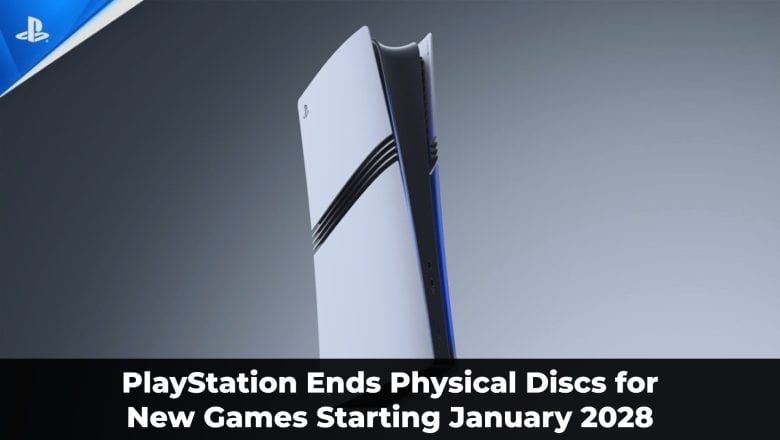

Sony’s latest clarification changes the risk calculation for players who still buy PS5 physical games, but it does not reverse the shift away from new PlayStation discs after January 2028.
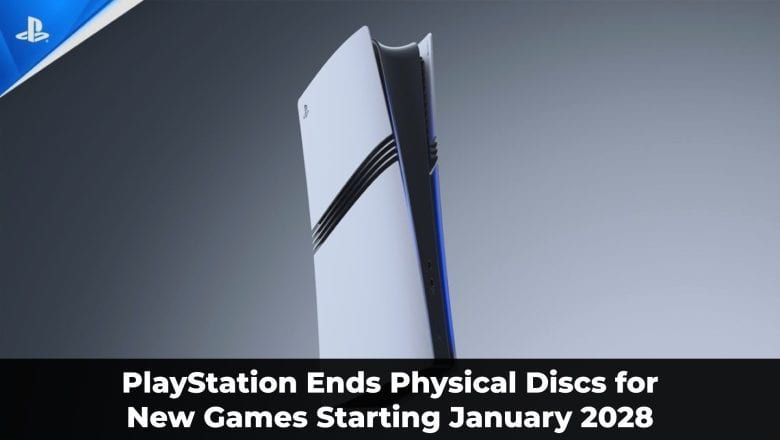
Image: keengamer.com
Sony’s clarification keeps old disc runs alive, but the cutoff still stands
Sony has clarified to developers and publishers that they will be able to re-order existing PlayStation disc games after the January 2028 cutoff, according to GamesIndustry.biz, which cites a partner-facing update reported by Game File. That is the strongest practical change since Sony’s July 1 PlayStation Blog announcement, because it means the January 2028 date is not a hard stop for every PS5 physical game or PS4 disc already in the retail ecosystem.
The tension is that Sony has not reversed the main policy. On the PlayStation Blog, Sid Shuman, Sony Interactive Entertainment’s senior director of content communications, said physical game disc production for all new games releasing on PlayStation consoles will be discontinued starting January 2028. After that date, new games will be available through PlayStation Store and at retailers in digital formats only.
That leaves players with two different markets to think about. Existing and pre-cutoff disc titles may continue to receive reorders, depending on publisher action and Sony’s revised process. New PlayStation releases after January 2028 remain digital-only under Sony’s public statement. For anyone searching around PlayStation discs 2028, the short version is simple: the back catalog gets a lifeline, but the future release pipeline still changes direction.
The important distinction is release timing, not whether a store still has boxes
Sony’s original public post said the transition would have “no impact” on games that already released, or will be releasing, before January 2028 in disc format. GamesIndustry.biz now reports that Sony has expanded that point for partners by confirming that publishers can place reorders for existing PlayStation discs beyond the end-of-production date for new disc releases.
That wording matters for buyers because it separates eligibility from availability. A game released on disc before January 2028 may remain eligible for future reprints. That does not mean every eligible game will be reprinted, stocked broadly, or kept in circulation at standard pricing. A publisher still has to decide that demand justifies another production run, and retailers still have to order or allocate shelf space.
For players, the cutoff should be read as a line between title categories. A PS5 or PS4 game that has a disc release before January 2028 is in the pool Sony says will not be affected by the shift, with GamesIndustry.biz reporting that reorders can continue. A game that launches on PlayStation after January 2028 is outside that pool under the public policy. The box may survive at retail, but for new games Sony says that retail format will be digital.
Retail stock becomes a supply problem, not a yes-or-no policy question
The clarification reduces the immediate fear that existing PlayStation discs will become impossible to manufacture the moment January 2028 arrives. It does not guarantee long-term shelf stability. GamesIndustry.biz reports that Sony also told partners the disc ordering process will change, while Tech Edition notes that Sony has not disclosed how the revised process may affect timelines, production quantities, or manufacturing capacity.
That uncertainty is where the real strategy problem sits. Physical availability depends on several gates lining up at once: publisher interest, eligibility under Sony’s rules, the new order process, manufacturing capacity, and retailer demand. If any one of those weakens, a game can remain technically reorderable while still becoming hard to find.
GamingBolt, writing from Game File’s reporting, raises the same capacity question in light of reports that Sony has begun repurposing its PlayStation disc production facilities in Thalgau, Austria. GamesIndustry.biz also points to reporting that Sony has started repurposing its last physical disc factory in Austria, describing the all-digital transition as already underway. Those reports do not prove that reorders will be scarce, but they explain why players should not treat reorder support as the same thing as unlimited future print runs.
The practical read is that high-demand evergreen titles have a better chance of staying visible at retailers than niche releases, collector-oriented games, or titles that depend on small batches. Sony’s clarification protects the possibility of reprints. It does not create an obligation for publishers to keep every disc edition alive.
New releases after January 2028 are still the unresolved break point
Sony’s public PlayStation Blog post is firm on new games: physical disc production for all new games releasing on PlayStation consoles will be discontinued starting January 2028. GamesIndustry.biz reports that publishers will have the opportunity to release new games at retail using digital codes, and Gadgetbridge similarly frames post-cutoff retail releases as code-based rather than disc-based.
That preserves a role for physical stores but changes what customers receive. A code in a box can be sold by a retailer, gifted, discounted, or placed on a shelf, but it is still a digital entitlement. It does not offer the same offline installation path, resale value, lending use case, or collecting function that many players associate with PlayStation game ownership.
Sony has not publicly answered several edge cases in the source material. The most obvious is the delayed-game problem. If a publisher planned a disc release before January 2028 but the game slips past the cutoff, the current public language points toward digital-only because the rule is based on new games releasing after the date. GamingBolt specifically flags the question of what happens to developers whose titles face a sudden delay past the deadline. No source provided here reports a Sony exception for that scenario.
There is also no announced pricing tradeoff. Explainx notes that Sony did not announce lower digital MSRPs tied to the removal of manufacturing, packaging, or freight. Sony’s stated rationale is consumer preference, not a new price model. Until publishers and Sony detail post-2028 retail code programs, buyers should assume that the main change is format, not necessarily cost.
Preservation and ownership concerns have not been settled by reorders
Sony frames the move as a response to shifting consumer preference and the broader entertainment industry. In its PlayStation Blog post, the company said the general preference for digital media “significantly outpaces” physical discs and that the transition aligns with how most of its community prefers to access and play games today.
Industry reaction in the supplied sources shows why that explanation has not closed the debate. GamesIndustry.biz reports that several game companies expressed disappointment with Sony’s decision. Iam8bit said physical games are vital to game preservation, ownership, and consumer choice. Atari told GamesIndustry.biz it remains committed to game preservation and to products for fans who value collecting physical editions. UK publisher Silver Lining Interactive said there is still a large community of customers who prefer and cherish physical game collections.
Those objections are not answered fully by reorder support because they are aimed at future availability and control. Existing PS5 physical games may have a longer retail tail than feared, but new games after January 2028 will not enter that same ownership model on PlayStation under Sony’s announced policy. For preservation-minded players, the clarification softens the back-catalog impact while leaving the forward-looking concern intact.
The timing also lands near another Sony digital-access story. GamesIndustry.biz notes that Sony announced it will close the PlayStation Store on PS3 and PS Vita by July 2027. The source material does not say that closure changes PS5 disc policy, but the proximity reinforces why players are connecting physical media, storefront longevity, and access rights in the same conversation.
How physical PlayStation buyers should plan before and after the cutoff
For players who still buy PS5 physical games, the best near-term move is to treat 2026 and 2027 as the final window for new PlayStation games to enter the disc ecosystem. If a game launches on disc before January 2028, Sony’s public statement says the transition has no impact on that release category, and GamesIndustry.biz reports that publishers can keep reordering those existing discs afterward.
That does not mean panic-buying every disc is rational. Reorder support gives popular pre-cutoff games a path to remain available, especially if retailers continue seeing demand. The smarter distinction is between mass-market titles likely to receive restocks and limited, boutique, or publisher-specific editions where another print run was never guaranteed even before Sony’s policy change.
After January 2028, players should look closely at product listings. A boxed PlayStation product at retail may contain a digital code rather than a disc, according to Sony’s reported partner guidance via GamesIndustry.biz. For buyers who care about resale, lending, installation from physical media, or display collections, that difference is central. The presence of a case on a shelf will no longer be enough to confirm disc ownership for new releases.
Sony’s clarification changes the immediate forecast from a total freeze to a managed decline. Existing PlayStation disc reorders can continue, but the new-release supply line is still being cut. The key unanswered questions now are operational rather than philosophical: how restrictive the new ordering process becomes, how much disc capacity remains, which publishers keep reprinting eligible games, and whether any exception appears for titles caught on the wrong side of January 2028.