
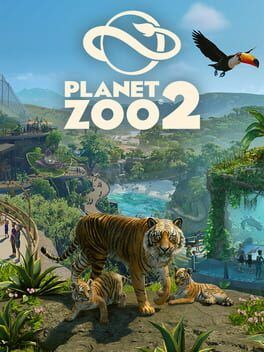

Planet Zoo 2 launches on PC, PS5 and Xbox Series X|S with aquariums, aviaries, Wildlife Reserves and a 130-plus animal roster. Here is what returning management sim players should understand before building.
Image: IGDB
Store links: Planet Zoo 2 on Steam
Planet Zoo 2 launches with a bigger design problem than a bigger roster
Planet Zoo 2 is out today, October 13, 2026, on PC, PlayStation 5 and Xbox Series X|S, and Frontier Developments is using the sequel to widen the basic shape of zoo management. Launch coverage from This Is Level Up and Invision Community states that the game arrives with more than 130 animals, fully customizable aquariums, aviaries for flying species and Wildlife Reserves that extend conservation beyond public exhibits.
The immediate tension for returning players is simple: the headline additions are attractive, but they also change the planning economy of a zoo. Aquariums are not ordinary enclosures with water in them. Aviaries are not a cosmetic variant of habitat fencing. Wildlife Reserves add an end point for animal care after the exhibit stage, shifting conservation from a background value into a management track that can compete with guest flow, construction budgets and species welfare.
Frontier is both developer and publisher, according to launch reports from This Is Level Up and Invision Community. Those reports also describe the player role as a Conservation Coordinator working with the Fauna and Ecosystems Network, or FEN. That framing matters because Planet Zoo 2 is being sold as a sequel where the zoo is part of a broader conservation network, rather than a closed financial machine built only around ticket sales and donations.
For players searching for a Planet Zoo 2 launch overview, the confirmed platform picture is clear. The game is available digitally on PC, PS5 and Xbox Series X|S. A fan-run information site, PlanetZoo2Animals, says Frontier announced a 3 PM BST unlock on Steam for October 13, with disc editions for PS5 and Xbox Series X|S following on October 20. The same site says its launch, price and platform answers come from Frontier’s own site and Steam notices. Frontier has not announced Game Pass or PS Plus availability in the provided material.
Aquariums add a new layer of habitat math
The most consequential new construction system is Planet Zoo 2 aquariums. Invision Community reports that players can build fully customizable aquariums for aquatic species, while This Is Level Up frames them as one of the first major series additions alongside aviaries. IGN’s review gives the clearest sense of why that matters in practice: aquariums allow fine control over shape, appearance and depth, and the reviewer says they were able to build glass tunnels through aquarium exhibits.
That is not a small shift for a Frontier management sim. The original Planet Zoo already made terrain, barriers, viewing angles and animal welfare pull against one another. Aquariums add vertical and environmental constraints that can ripple through an entire park plan. IGN specifically notes that aquatic and semi-aquatic animals can have different water temperature and salinity needs, and that freshwater and saltwater exhibits require different filtration networks. For a player who treats zoo design like a throughput puzzle, that turns water infrastructure into a strategic layer, not a decoration choice.
The returning-player risk is overbuilding early. A glass tunnel aquarium sounds like a prestige attraction, but it also implies higher planning complexity around guest routes, staff access and compatible species. IGN reports that some animals will fight or try to eat each other if placed together, continuing a compatibility concern from the first game. The practical read is that aquariums are best approached as networked systems. Temperature, salinity, filtration, visibility and animal compatibility all need to resolve before the exhibit becomes a reliable money-maker.
Aviaries appear to serve a similar design purpose on the vertical side of the zoo. Frontier’s launch materials, as summarized by Invision Community and This Is Level Up, say flying species are now supported through customizable aviaries. The fan-made Planet Zoo 2 Wiki, which says it tracks confirmed information and labels unannounced details, lists 12 flying species in a birds guide. Because that is a community source rather than a direct Frontier database in the provided material, the safer confirmed claim is that flying animals and aviaries are in at launch, while exact public roster counts should be checked against Frontier’s in-game Zoopedia or official listings.
The animal count is large, but the useful roster depends on enclosure type
The Planet Zoo 2 animals list is being described slightly differently across sources. This Is Level Up, Invision Community and IGN all refer to a roster of over 130 creatures or more than 130 animals. The fan-made Planet Zoo 2 Wiki says it counted 130 confirmed species on October 7, 2026, split across enclosure types, and says the reveal campaign was still running ahead of launch. That is a small but important distinction: launch articles are reporting a 130-plus roster, while one community tracker’s pre-launch count was 130 confirmed species at a specific date.
For management players, the more important question is not only how many animals exist, but how many meaningfully plug into each system. IGN reports that some animals are exhibit-based, meaning they live in smaller terrarium-style spaces and do not have all the same features as larger habitat animals. IGN also says only around half of the species list is eligible to eventually be released into the wild. That qualification directly affects Wildlife Reserves, because a large roster does not translate one-to-one into release candidates.
The fan-made Planet Zoo 2 Wiki offers more granular counts, saying its aquatic animals page tracks 34 fully aquatic species and its birds page tracks 12 flying species. Those figures are useful as community guidance, but they should be treated as tracker data unless matched against the in-game Zoopedia or Frontier’s official animal pages. The site itself presents itself as a wiki that labels what remains unannounced, which is a healthier standard than pretending every pre-launch count is permanent.
Edition structure also affects the roster. PlanetZoo2Animals reports that the Standard Edition is priced at $49.99 and the Deluxe Edition at $64.99 in the U.S., with the Deluxe Edition adding six animal species and exclusive animal signs. Invision Community gives the UK prices as £39.99 for Standard and £54.99 for Deluxe. The relevant buyer question is whether those six animals are worth paying for at launch. The provided sources confirm they exist as Deluxe content, but they do not provide enough detail here to judge their strategic value in Franchise, Sandbox or conservation play.
Wildlife Reserves turn conservation into a second map layer
Wildlife Reserves are the sequel’s clearest attempt to expand Planet Zoo’s long-term loop. Invision Community reports that conservation projects focus on restoring wildlife reserves, nurturing animals and releasing them into thriving ecosystems. This Is Level Up says players work through FEN on projects that restore wildlife populations and support ecosystems around the world. That gives Planet Zoo 2 a broader strategic arc: breed and care for animals in zoos, then move some of them into appropriate reserve environments.
Push Square’s Planet Zoo 2 PS5 review describes the split in practical terms. According to the review, the game has two main zones: zoos, where players build exhibits for the visiting public, and Wildlife Reserves, where animals released from zoos can live in wild habitats. Push Square says reserves can be explored on foot or by buggy, and that players can observe and photograph released animals. The same review says reserves are customizable through terrain and vegetation editing, with players designing specific biomes for different species.
That adds a new timing question for experienced players. In the first game’s style of management, the animal’s value often sat inside the zoo economy through welfare, appeal, education, breeding and market decisions. With reserves, an animal may become part of a longer conservation plan after the public exhibit phase. If the system is deep enough, it could change how players prioritize breeding pairs, habitat investment and surplus management. If it is shallow, it could become a thematic endpoint rather than a strategic one.
The early review evidence is mixed in a useful way. IGN praises the sequel’s deeper conservation emphasis but says some pieces, including Wildlife Reserves, feel less fleshed out than they could be. Push Square, by contrast, describes reserve exploration and photography as surprisingly engaging, especially when observing released animals in wild habitats. Those impressions do not contradict each other. They suggest reserves may succeed as an atmosphere and progression feature while still leaving room for Frontier to expand mechanical depth after launch.
Career, Franchise and Sandbox now orbit a wider operation
Planet Zoo 2 carries forward three major ways to play. Launch coverage from This Is Level Up and Invision Community names Career, Franchise and Sandbox modes. Career places players inside FEN’s global conservation efforts and presents challenges across locations. Franchise focuses on a connected network of zoos and reserves, including animal trading and community goals. Sandbox gives players wider creative freedom to build wildlife attractions with fewer restrictions, depending on settings.
The new Planet Hub, reported by Invision Community and discussed in Push Square’s review, appears designed to make that operation feel connected. Push Square says the hub let the reviewer revisit previous campaign locations without going back through the main menu, creating the sense of an interconnected organization. That matters for a management sim because a hub can reduce friction between scenario play, long-term planning and network management.
Franchise Mode is the mode with the most obvious long-tail potential. Push Square describes it as an online experience where players build an interconnected network of zoos and trade animals globally, with a dynamic animal marketplace and regular community goals. In a Frontier economy, that kind of marketplace can become the real metagame if animal availability, breeding quality and conservation rewards are tuned tightly. The provided sources do not confirm launch balance, market behavior or reward cadence, so the sensible expectation is potential rather than certainty.
The familiar tools also return. This Is Level Up and Invision Community mention Frontier’s piece-by-piece construction, terrain tools, the Frontier Workshop, downloadable community creations and a first-person camera. For veteran builders, Workshop support is a major retention system because it converts player creativity into a shared supply of blueprints and design solutions. For new players, it can soften the learning curve by letting them borrow functional or decorative structures instead of mastering every tool immediately.
Console players get same-day access, with clear technical tradeoffs
Planet Zoo 2 launching on PS5 and Xbox Series X|S the same day as PC is significant for a series whose depth has historically been associated with mouse-heavy construction. PlanetZoo2Animals says Planet Zoo 2 supports both controller and keyboard and mouse on every platform, attributing its answers to Frontier’s site. That is the right move for a management sim that lives or dies on precision building, because controller support alone cannot satisfy every player who wants to place paths, scenery and habitat pieces at high speed.
For readers specifically looking for Planet Zoo 2 PS5 review guidance, Push Square’s review is the most relevant provided console source. It says the console version includes a complexity meter, similar to Planet Coaster, as a tradeoff to ensure good performance. The reviewer says they personally did not get close to the limit. That is reassuring, but it is still a real constraint for the most ambitious builders. A player who wants one enormous, hyper-detailed mega-zoo should treat the meter as part of the platform decision.
IGN’s review also emphasizes that Planet Zoo 2 remains an economic simulation with teeth. The reviewer says Sandbox can disable many pressures, including money, staff happiness and animal aging, but describes the difficulty of keeping the lights on as part of the experience when those systems are active. That is useful context for anyone expecting the sequel to be a pure creative toy. Planet Zoo 2 still appears to be a tycoon game where welfare, infrastructure and finances can punish lazy expansion.
Availability is also narrower than some players may hope. PlanetZoo2Animals says Frontier has no plans for Nintendo Switch or Switch 2, macOS, PS4, Xbox One, mobile or VR, and that Steam lists the game as Windows only. It also says Frontier has nothing to share about Xbox Game Pass or PS Plus. Those are reported platform statements from a site citing Frontier’s own materials, and none of the other provided sources contradict them.
Who should jump in at launch, and who should wait
The strongest case for buying at launch is clear: if you wanted aquariums, aviaries and a conservation layer that reaches outside the zoo gate, Planet Zoo 2 delivers those systems on day one according to multiple launch sources and early reviews. The aquarium details reported by IGN, especially depth control, glass tunnels, water temperature, salinity and filtration networks, sound like the most mechanically substantial addition for advanced planners. Wildlife Reserves add a broader progression path, even if IGN’s review suggests they may not yet be as deep as the core zoo systems.
Returning players who care about strategy should start carefully. The optimal early zoo in Planet Zoo 2 is unlikely to be the prettiest one. Aquatic habitats introduce infrastructure dependencies. Flying species require new enclosure thinking. Release eligibility means not every animal contributes equally to reserve goals. Franchise Mode may develop its own economy through trading and community objectives, but the provided sources do not yet establish how balanced or rewarding that market will be after thousands of players enter it.
New players have a cleaner route. Career mode’s early objectives function as a tutorial, according to Push Square, while Sandbox can loosen or disable many pressures for builders who want to learn without financial collapse. Players who prefer structured goals should begin with Career. Players who want to test aquarium construction, aviary layouts or terrain-heavy reserve designs without worrying about cash flow should use Sandbox first. Franchise is likely better after understanding welfare, staff routing, species compatibility and habitat infrastructure.
The unresolved questions are the ones that will shape Planet Zoo 2’s first months. Frontier’s launch materials, as represented in the provided sources, confirm platforms, modes, aquariums, aviaries, reserves and the broad animal count. They do not answer how aggressive post-launch support will be, how the Franchise marketplace will settle, whether console complexity limits will bother elite builders, or whether Wildlife Reserves will expand beyond their launch form. As a launch package, though, Planet Zoo 2 appears to give returning management sim players new systems that interact with the old ones instead of simply adding another stack of animals to place.