
CD Projekt Red says Cyberpunk 2077: Phantom Liberty's Chimera tank boss took two years of iteration, four major tank revisions, and a careful balance of gameplay, narrative, art, and worldbuilding.
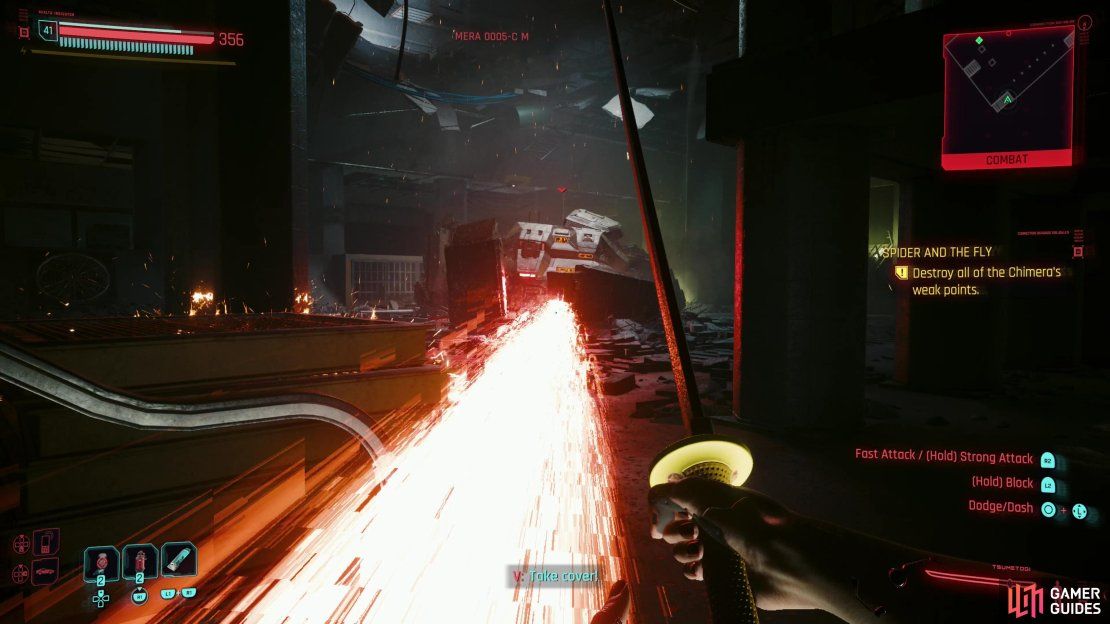
Image: gamerguides.com
CD Projekt Red spent two years wrestling the Chimera into shape
Cyberpunk 2077: Phantom Liberty's Chimera tank fight took roughly two years of iteration to make work, according to comments from CD Projekt Red developers on the studio's official AnsweRED podcast, as reported by Eurogamer, Rock Paper Shotgun, and PC Gamer.
That is the concrete development behind one of the expansion's loudest early set pieces: a massive Cyberpunk 2077 Chimera tank encounter that throws V and President Myers into a fight against a military machine in the bowels of a Barghest facility. The striking part is not only the length of production, but what CD Projekt Red says kept pulling the encounter apart. This was not described as a single boss model needing polish. Game director Gabe Amatangelo called the Chimera “a nexus point of different disciplines,” naming gameplay, narrative, art, and worldbuilding as pieces that all had to lock together.
Art director Paweł Mielniczuk, who co-hosted the podcast discussion, put the production timeline plainly: “I think when we were iterating, it was two years to make this boss fight work,” according to Eurogamer's transcription. Rock Paper Shotgun similarly quotes him saying the team was “reiterating over and over.” Later in the conversation, Mielniczuk said CD Projekt Red effectively did the tank four times, changing its equipment and weapons. Creative director Igor Sarzyński added that it was “one of the most expensive art assets I think ever.”
For a fight that many players remember as a sudden escalation in Phantom Liberty's opening act, those comments explain why the Chimera feels unusually authored. It had to be a monster, a plot beat, a combat puzzle, and an art showcase in the same stretch of play. The tension in the developers' comments is that the team kept finding versions that leaned too far in one direction.
The Chimera had to terrify before it became a boss fight
Amatangelo's explanation makes clear that the Phantom Liberty Chimera boss was designed around sensation before it was fully solved as a playable encounter. He recalled working with Mielniczuk on military equipment references, specifically heavy weapons with the overwhelming “brrrr” quality of a minigun. Rock Paper Shotgun reports the pair were sharing YouTube videos of military equipment, while Eurogamer transcribes the exchange as emails about reference material. The exact medium differs across reports, but the shared point is consistent: CD Projekt Red was chasing the look and sound of a machine that would intimidate players the moment it rose into view.
That matters for how the sequence plays. The Chimera is introduced as a spectacle first, a machine whose scale and weaponry are meant to push the player backward before the fight settles into readable patterns. The source material describes it as a Ghost in the Shell-esque or Ghost in the Shell-inspired spider-tank, a comparison that fits the visual language of a walking armored platform with too many guns and too much presence for the room around it.
From a set-piece design perspective, that opening impression is the fight's first job. A boss like the Chimera cannot arrive like a normal enemy with a bigger health bar. It has to bend the camera, the space, and the pacing around itself. CD Projekt Red's developers describe the process as a balance problem because terror alone is not playable. Once the machine has made its entrance, the player still needs cover, windows to return fire, attack tells, and enough control to feel responsible for survival.
The fight became a discipline-by-discipline negotiation
The most revealing quote from Amatangelo is his description of the encounter shifting between different priorities. “Sometimes it was too gameplay, sometimes it was too narrative, sometimes too art demonstration,” he said, according to Rock Paper Shotgun and Eurogamer. His solution was to break the sequence down “beat by beat.”
That language is important. In action-adventure terms, a “beat” is where the craft shows. A chase has a beat where the player understands the threat. A boss arena has a beat where the combat rules become clear. A narrative scene has a beat where the stakes crystallize. The Chimera had to pass through all of those functions without feeling like several disconnected scenes stitched together.
If the fight went too far toward gameplay, it risked becoming a conventional arena battle with an expensive model parked in the center. If it went too far toward narrative, player input could become secondary to staging. If it became too much of an art demonstration, the machine would be impressive to look at but thin to fight. CD Projekt Red's account suggests the final version was the result of repeatedly pushing those sliders back into alignment.
That also explains why the Cyberpunk 2077 Phantom Liberty sequence has such a pronounced rhythm: pursuit, pressure, containment, then a more readable battle against the disabled tank. The sources do not provide a full production breakdown of every discarded version, but Mielniczuk's comment that the team did the tank around four times, changing equipment and weapons, points to a boss whose identity was rebuilt through practical combat needs as much as visual ambition.
A defining set piece, but not an uncontested one
The developer comments help explain why the CD Projekt Chimera fight became one of Phantom Liberty's most recognizable action sequences, but reception in the supplied reporting is not unanimous. Eurogamer describes the encounter as “fantastic” and says the cost proved worth it, placing the boss among the expansion's standout moments. Rock Paper Shotgun is more skeptical, praising the look of the lead-up while arguing that the playable boss phase takes place in a relatively open arena where the tank does not move much. PC Gamer, in text mirrored by 7MMO, calls the fight memorable but says slowly blasting it apart could feel gruelling and unexpectedly punishing.
That split is useful because it maps directly onto the balance problem CD Projekt Red described. Players who value staging, scale, and cinematic escalation are likely to see the two-year investment on-screen. Players who judge the encounter primarily by mobility, tactical variety, and boss behavior may come away colder. The Chimera is imposing, loud, and expensive-looking, but some criticism centers on how much agency the player has during the spectacle-heavy lead-in and how dynamic the eventual arena fight feels.
Both readings can be true without contradiction. The confirmed development story is that the Chimera required years of cross-discipline iteration and multiple tank revisions. The interpretation is that this labor produced a set piece whose power comes from choreography and presence as much as mechanical depth. For Phantom Liberty, that tradeoff is central to the encounter's identity.
Phantom Liberty's opening act needed a machine that changed the tempo
Within the context provided by PC Gamer's description, the Chimera fight lands early in Cyberpunk 2077: Phantom Liberty, with V and President Myers facing the tank in a Barghest facility. That placement gives the boss a structural purpose. It is not only a late-game skill check. It is part of the expansion's opening argument that Dogtown operates at a different tempo from the base game's usual street-level jobs and fixer work.
The fight forces an abrupt change in scale. One moment the player is moving through a political thriller setup involving Myers; the next, the room belongs to a spider-tank. Amatangelo's “nexus point” phrasing fits because the scene needs to convert narrative momentum into physical danger. The president cannot simply be important in dialogue. The game has to make the player feel that importance through the amount of hardware suddenly trying to kill them.
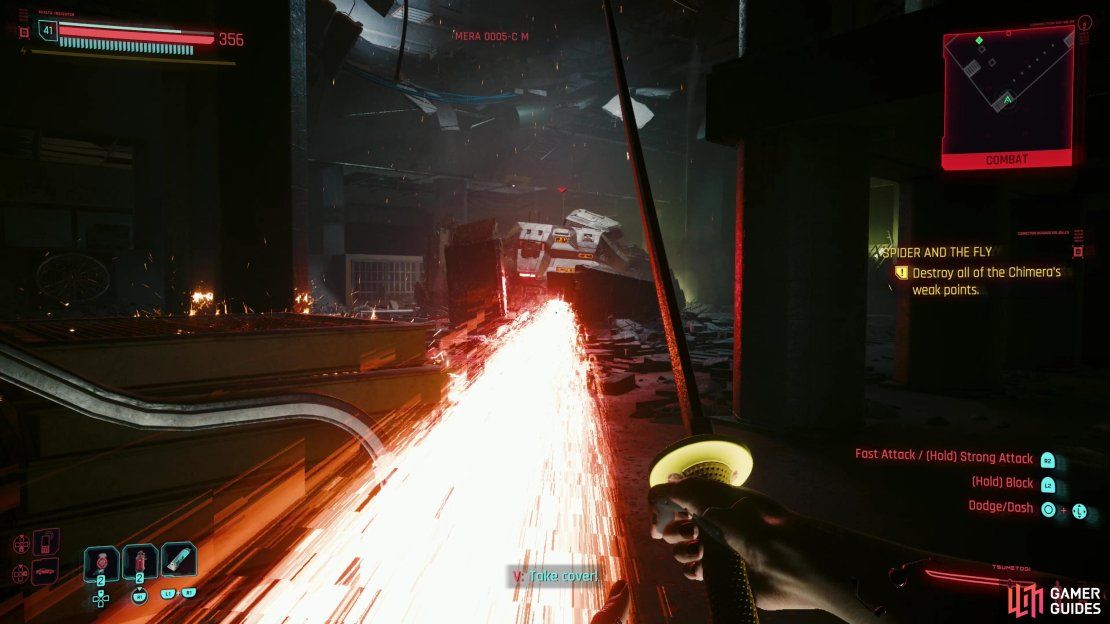
That is where the Chimera's set-piece design earns its place in the expansion's memory. Its attacks, sound, and mass turn the environment into a pressure chamber. The required media image for this story highlights the beam sweep attack, a move that demands either cover or precise movement such as dashing through. Even without a full mechanical teardown from CD Projekt Red in the cited material, the published gameplay guidance around that attack reflects the broader design goal: the tank should overwhelm, but its danger has to be legible enough for players to answer.
What the two-year timeline tells players, and what it does not
The practical takeaway for players is not that Cyberpunk 2077: Phantom Liberty has changed, or that a new version of the Chimera fight has been announced. The sources describe developer comments about how the existing boss was made. There is no sourced information here about a patch, rework, price change, platform expansion, or new content tied to the Chimera.
For players approaching Phantom Liberty now, the comments are still useful. Expect one of the expansion's most deliberately staged action encounters, built to sell the terror of a military machine before settling into a boss fight. Also expect the possibility of friction. The supplied reporting includes praise for the encounter's spectacle and criticism of its arena structure and pacing, so the safest expectation is a memorable set piece rather than a universally agreed masterpiece of boss mechanics.
For readers interested in Phantom Liberty boss design, the Chimera is a rare case where CD Projekt Red has put a number on the hidden cost of one sequence: roughly two years of iteration, about four major passes on the tank, and a final asset Sarzyński described as one of the studio's most expensive. That does not automatically make the fight successful for every player, but it clarifies why it feels so singular. The Chimera was built at the point where combat design, cinematic timing, art direction, and worldbuilding all had to hit at once.