
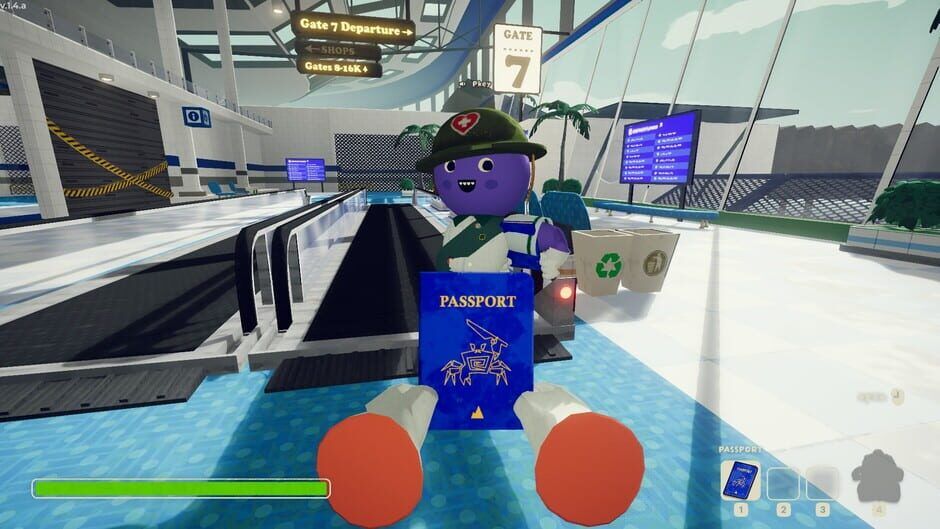
Peak is a brutally funny, deeply cooperative “friendslop” where shared mistakes matter more than monsters. Here is how its climbing systems force real teamwork, why it works without horror or party-game gimmicks, and what Aggro Crab’s defense of the genre says about modern co‑op design.
Peak does not start like a horror game. There is no grainy VHS filter, no voice on the radio warning you about what lurks in the dark. It starts with a group of scouts standing in the wreckage of a plane, staring up at a mountain that might as well be a wall. The only way off this island is to climb it together.
That pitch alone makes Peak stand out in a co op landscape crowded with shrieking monsters and party game chaos. Developer Aggro Crab calls it a “friendslop” a proudly messy, social kind of co op where the appeal is less about mastery and more about what you and your friends get up to on the way. What makes Peak special is that it grounds that social mess in sharp, readable systems. There are jokes, pratfalls and banana peels, but they sit on top of a genuinely demanding climbing sim that understands what cooperation actually feels like.
How Peak’s co op climbing really works
Peak is an online co op climbing game for up to four players. You play as lost nature scouts trying to reach the summit so a rescue team can spot you. Structurally it is a series of runs up the mountain, each one a little more informed by what you learned last time. There are no missions to tick off, just a huge vertical problem to solve as a group.
The first decision happens before you ever touch rock. Everyone stands around the crash site arguing over what to bring. The backpack is heavy. Food keeps you alive but slows you down. Ropes, pitons and camping gear open safer routes but chew through your limited carrying capacity. Someone will insist on dragging along Bing Bong, the unsettlingly chipper mascot statue, because they cannot bear to leave it behind. The game does not tell you the right answer, only that you will live or die by what you decide together.
Once you are on the mountain, Peak’s movement model does most of the heavy lifting. Every climb is a negotiation between stamina, handholds and risk. Your scout can scramble up low rocks, mantle ledges and commit to longer climbs as long as there is enough stamina left in the tank to finish the move. Run yourself dry halfway up a face and you will peel off into a ragdolling slide that might end with a broken limb or worse.
Reading the terrain becomes a shared language. One player spots an overhanging lip that looks just within reach, another points out a safer switchback route that will cost more time and food. A better climber can go first, hammering pitons into the wall and securing ropes so the rest of the team can follow with smaller stamina demands. That asymmetry of skill is built into the design. You are not four identical action heroes. You are a little group working out whose strengths fit which section of the climb.
Crucially, Peak enforces that group identity. Wander too far away and the game does not reward you with secret loot or bonus progress. It punishes you. A skeletal creature appears, hoists the straggler and hurls them into the void. It is not positioned as a horror antagonist so much as a design tool, a theatrical way of saying “stick together.” The real antagonist in Peak is still the mountain, the weather and your own bad calls. The monster is mostly there to keep your story from fragmenting into four solo runs.
The power of one shared stamina bar
Peak’s smartest trick is how much tension it wrings out of a single resource. Almost everything that can go wrong feeds into your stamina bar. Fall damage, poison from misidentified berries, hunger, carrying too much weight, cold nights spent without shelter all shave chunks off the same meter you spend on climbing.
The result is a survival system that is incredibly easy to read. You do not have to track separate hunger, health and fatigue bars, then mentally combine them before you decide whether to push for the next ledge. You just look at stamina and feel the consequences of every choice. Did you overpack? The bar shrinks. Did you skip lunch to save food for later? The bar shrinks. Did you slip on a friend’s banana peel and slam into the rock? The bar shrinks again, and suddenly that shortcut you were eyeing looks suicidal.
Because the entire group is living inside that same logic, conversations on voice chat naturally revolve around it. Someone calls out that their stamina is half gone already. Someone else suggests rerouting to an easier incline to save juice. When you gamble on a harder vertical push and barely scrape over the lip with a sliver of meter left, it is not just a mechanical success. It feels like the payoff to an argument you all just had.
This is where Peak quietly distances itself from a lot of modern co op design. Instead of drowning you in overlapping systems, it uses one clear, legible mechanic as the anchor for everything. That clarity leaves room for players to focus on each other. You remember who insisted on carrying extra food, who wasted half their stamina sprinting around for mushrooms, who clutched a rescue by dropping a rope at the perfect moment. The systems stay simple so the social dynamics can get complicated.
Friendslop without the horror crutch
Aggro Crab and publisher Landfall have been very open about Peak sitting in the same broad space as games like Lethal Company or Phasmophobia. It is a co op title built for stories, screaming and group chat highlights. But where much of that “friendslop” wave leans on horror tropes and jump scares, Peak proves the genre does not need a haunted moon or a murderous ghost to work.
Fear still exists here, it is just fear of the fall. Instead of creeping around dim corridors listening for audio cues, you are squinting at rock faces and cloud cover, worrying that the weather might turn or that you misjudged a foothold. The tension comes from physical stakes you can see and understand. When things go wrong, it is not because some invisible monster rolled a dice behind the scenes. It is because you left camp too late, or you were greedy with loot, or someone placed a piton just slightly too low.
That difference changes the tone of the entire session. Horror co op often ends up with one player wandering off to trigger scares while everyone else death spirals between fear and boredom. Peak’s togetherness rule kills that pattern outright. If you split the party, the game literally yeets you off the mountain. It is funny when it happens, but it also drives home that this is not four individual power fantasies running in parallel. It is a single fragile expedition that only works if you move as a unit.
Even Peak’s slapstick is grounded in this shared vulnerability. Dropping banana peels near a ledge to send a friend flying is hilarious, but it also costs the group time, supplies and maybe the run. The best moments are not the pure trolls, but the ones that spiral into responsibility. You push someone, they go down hard, and suddenly you are organizing a rescue and hauling their unconscious body upward because you cannot leave them behind.
That mix of mischief and obligation is the heart of friendslop at its best. It is about giving players permission to be idiots, then forcing them to deal with the fallout together. Peak nails that balance without midnight jump scares or novelty minigames. The mountain is plenty scary on its own.
Aggro Crab’s quiet defense of the genre
Aggro Crab has a reputation for loud, opinionated games that wear their politics and their jokes on their sleeve. What is interesting about Peak is that its biggest argument is encoded in structure, not dialogue. By building a serious, mechanically rich friendslop about climbing rather than about running from monsters, the studio is pushing back on a growing assumption that co op breakout hits have to be horror flavored.
Look at the current co op charts and you will see a pattern. Intense, repeatable games that turn your friend group into content, almost all dressed up as some kind of spooky gig economy. You clock in, you loot, you get chased by something with long arms, you scream, you clip it and move on. There is nothing wrong with that loop, but it can feel narrow.
Peak widens the lane. It takes the same social curve shared discovery, escalating risk, desperate retreats and puts it in a context that is more about connection than terror. You are still telling stories afterward, but they sound like “remember that time we bivouacked on a tiny ledge and almost froze” instead of “remember when the monster got us again.” The difference seems subtle on paper. In play, it is huge.
By refusing to chase Game of the Year prestige or pile on trend chasing features, Aggro Crab positions Peak as a defense of co op as a space for all kinds of fantasies, not just haunted ones. It respects the genre enough to trust that a focused ruleset and a strong theme are enough. You can see that in the absence of grindy progression, in the small scale of the scouts, in the way the climbing itself is allowed to be the star.
Why Peak is resonating
For all its clever design talk, the reason Peak is landing so hard with players and critics is simple. It generates good nights. Its runs have a natural three act shape. First there is the planning, with everyone talking over each other about gear and routes. Then there is the push, full of close calls, miraculous saves and minor disasters. Finally there is the comedown where you either stand on the summit, laughing in disbelief, or pick through the wreckage of another doomed attempt, already plotting the next one.
Because the stakes are so visible and shared, everyone feels involved regardless of skill. The person who never quite nails the hard jumps might be the one who remembers which berries are safe. The loud planner might also be the first to panic sprint and burn all their stamina. The quiet friend who hung back at the crash site thinking through loadouts can end up the unsung hero who packed the one item that saves the day.
None of this needs a ghost in the dark. Peak’s drama comes from gravity, weather, limited food and the simple fact that your friends are human. When you finally piece together a clean, disciplined climb and watch the sunrise from nowhere in particular, it feels earned in a way that many novelty co ops struggle to match.
Peak might not be trying to win Game of the Year plaques, but it is staking out something just as valuable. It is proof that friendslop can be about more than being scared together. It can be about being capable together, or trying to be, and laughing when that falls apart. In a co op scene dominated by horror and hyperactive party games, that makes Peak feel like its own small summit.