
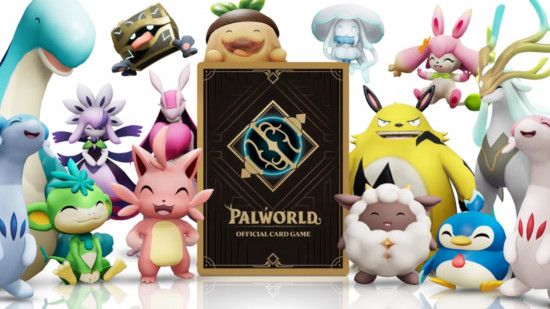

Palworld cards sold out fast, and early resale listings are already volatile. Here is what the first eBay prices do and do not prove for buyers.
Image: wargamer.com
A one-day-old card game is already in the scalper phase
The Palworld Official Card Game is barely through its launch window, and the resale market has already become the main story for many would-be buyers. Pocketpair and Bushiroad released the first booster set, Dawn of Palpagos, on July 30, according to Dexerto, and within roughly a day cards tied to Pals such as Cattiva, Chillet, and Jormuntide were appearing in four-figure resale territory across eBay and early community price trackers.
That creates an immediate problem for fans who wanted Palworld card packs to open, play, or collect at normal retail pace. Polygon reports that many local card shops are already sold out of the Palworld TCG, despite Pocketpair’s official card game site having announced 3.5 million Dawn of Palpagos booster packs sold worldwide ahead of launch in early July. In other words, this is not a tiny launch being overwhelmed by a niche collector crowd. It is a large first wave meeting a market trained to treat first-edition sealed product and early chase cards as short-term financial instruments.
For buyers searching Palworld TCG prices today, the most important distinction is this: the confirmed launch demand is real, but the first resale numbers are not yet a stable market. They are a snapshot of scarcity, fear of missing out, and incomplete price data colliding during the messiest possible week.
Dawn of Palpagos had scale, but retail access is still uneven
Dexerto reports that Dawn of Palpagos contains 100 standard card types and 61 parallels, with original illustrations of Pals and characters from the survival game. That gives the debut set the shape collectors expect from a modern TCG launch: a base checklist for ordinary completion, plus rarer parallel treatments that can become the economic center of the set almost immediately.
The supply figure matters because 3.5 million booster packs is a serious number for a first set. Bushiroad announced that figure on July 9, according to Dexerto, before players could officially open the product. Polygon also cites the 3.5 million pack figure while noting that many local card shops are sold out. Those two facts sit awkwardly together, but they are not contradictory. A product can have a large global print or presale number and still be difficult to buy at street level if allocation is uneven, sealed boxes are being held, early buyers are ordering heavily, or shops simply received less stock than local demand required.
For the average buyer, the practical effect is simple: Palworld cards sold out at many shops before the market had time to establish normal trading behavior. That is exactly the environment scalpers want. If a fan cannot find packs at retail, every eBay listing starts to look like a price signal, even when it may only be one seller testing how high launch-week panic can go.
The headline prices are real, but the data is still thin
The loudest number attached to the Palworld TCG launch is the Cattiva Gold Soul card. GamesRadar reported that the card sold for $4,000 before launch, and both Polygon and egamers.io point to that figure as the clearest example of how quickly the resale market overheated. TechTimes similarly describes a pre-launch Cattiva Gold Soul sale at nearly $4,000.
Dexerto adds useful caution around the eBay data. The outlet says eBay results it viewed showed eight Cattiva copies marked sold on July 30 with displayed prices ranging from $600 to $2,999.99, plus another marked sold on July 27 at a displayed price of $3,997.98. Dexerto also notes that most of those listings accepted Best Offer, meaning the visible number may reflect the original listing price rather than the final amount paid. Two fixed-price results cited by Dexerto showed Cattiva copies selling for $849 and $999.
That does not make the Palworld TCG scalpers story fake. It makes the market noisy. A sold listing with a public fixed price is stronger evidence than a Best Offer listing where the accepted amount is hidden. A community-reported transaction can be useful, but it needs volume before it becomes a reliable benchmark. Dexerto reports that fan-made tracker Palify lists the SSS Soul card at $2,000 based on a single reviewed community sale, while also listing Chillet – Dragon Whisperer SSP at $1,400 and Jormuntide Ignis – Savage Lava Dragon SSP at $800. Palify itself says the game is too new to have a public sold-price feed, according to Dexerto, and many values currently rest on only one reviewed report.
That is the key buyer warning. Early Palworld TCG prices are high enough to demand caution, but not mature enough to justify panic buying.
First-edition pressure is doing exactly what TCG economics predicts
The first few weeks of any new trading card game are structurally unstable because collectors, players, speculators, and scalpers all want the same sealed product for different reasons. Polygon and egamers.io both note that everything currently hitting shelves comes from the inaugural first-edition stock. That status gives sealed boxes and early high-rarity cards extra gravity before the market knows how scarce any particular card will remain.
From a strategy angle, this is a classic launch-window squeeze. The player who wants playable cards, the collector who wants a clean first-edition binder, and the reseller who wants to flip sealed product quickly all compete during the same short window. The product does not need to be underprinted in absolute terms for prices to spike. It only needs enough uncertainty around availability, rarity, and restocks for buyers to start treating today’s listing as tomorrow’s missed opportunity.
Polygon compares this to early price behavior around Pokémon releases, citing the Morpeko special illustration card from a July Pokémon set. According to Polygon, that card was selling for $200 before retail release and fell by roughly 35 percent to about $127 a couple of weeks later. That comparison is useful because it frames launch-week prices as momentum data, not settled value. If Palworld follows that pattern, the first wave of four-figure listings may age badly once more packs enter circulation and buyers can compare a larger number of real sales.
Cattiva’s fast correction is the clearest warning to wait
The Cattiva Gold Soul card already shows how violent the early correction can be. GamesRadar reported the pre-launch $4,000 sale, while Polygon and egamers.io note that a Cattiva Gold Soul with perfect centering was later available for $999. That is still an extraordinary amount for a new card from a brand-new game, but the move from $4,000 to $999 is the part buyers should study.
A 75 percent drop from the reported pre-launch high does not prove where the card will settle. It does show that the first number was heavily influenced by timing. The first buyer paid for being early in a market with almost no price history. Later buyers gained more information, more listings, and more leverage. That is how launch scarcity turns into a tax on impatience.
For Palworld fans, the risk is especially sharp because the game’s tabletop identity is still being formed. Dexerto reports that Cattiva’s all-gold Soul card carries the previously unannounced SSS rarity and has become the set’s biggest chase card. Premium treatments like gold foil text and borders can attract collectors quickly, as Dexerto notes in relation to Chillet – Dragon Whisperer SSP sales discussed by community accounts. But until buyers know actual pull rates, sustained supply, grading demand, and reprint policy, it is hard to separate long-term collector value from first-week spectacle.
Should fans buy Palworld card packs now or wait?
If you are trying to play or casually collect Pocketpair Palworld TCG cards, the reported evidence points toward waiting unless you find product at or near normal retail pricing. The sources show real demand, widespread shop-level sellouts, and high resale activity, but they also show immediate price correction and weak early data. That combination favors patience over chasing eBay listings one day after launch.
Buying sealed Palworld card packs at inflated resale prices is a different calculation from buying a specific single card. With sealed packs, you are paying the scalper premium before you even face normal pack randomness. With singles, you at least know what card you are receiving, but current high-end prices are still being shaped by limited public sales information. Dexerto’s Best Offer caveat is especially important here, because displayed eBay prices can make the market look firmer than it is.
The safest short-term rule is to separate desire from urgency. If a local card shop has stock at standard pricing, buying a few packs is a normal fan purchase. If the only available option is a steep resale markup, the first Cattiva correction suggests waiting for broader supply or clearer price history. No source in the provided reporting confirms a reprint date or a detailed restock plan from Pocketpair or Bushiroad, so buyers should treat any confident claims about imminent restocks as unconfirmed unless they come from an official listing or announcement.
The supply question now belongs to Pocketpair and Bushiroad
The long-term health of the Palworld TCG will depend less on one wild eBay week and more on how Pocketpair and Bushiroad manage availability after the launch rush. TechTimes states that Pocketpair has offered no reprint plan, and the other reports provided here do not cite an official restock schedule. That leaves the market guessing at the exact moment when clear supply communication would matter most.
A brand-new card game needs collectors, but it also needs people opening packs without feeling punished for arriving after the first shipment. If sealed product remains scarce, scalpers stay in control of the entry point. If supply broadens, early inflated listings have to compete with actual packs, actual pull data, and a larger pool of sellers. That is when Palworld TCG prices can start behaving like a market instead of a launch-day auction.
For now, the confirmed story is narrow but important: Dawn of Palpagos launched July 30, 3.5 million booster packs had been sold worldwide ahead of release according to the official card game announcement cited by outlets, many shops are reportedly sold out, and early resale listings have reached four figures while some headline prices have already fallen sharply. The best buyer strategy is to avoid treating the first week as the only chance to participate. In TCG economies, the player who waits for better information often beats the player who pays for the privilege of being first.