
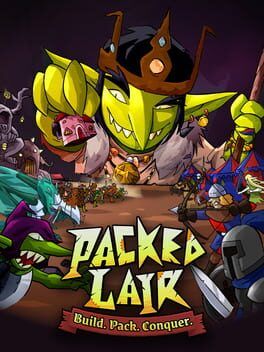

Packed Lair launches on Steam as a compact evil lair builder that turns cramped grids, roguelike drafts, and auto-battler combat into a sharp strategy hook.
Image: IGDB
Store links: Packed Lair on Steam, Yooka-Laylee and the Impossible Lair: Trowzer's Top Tonic Pack on Steam
Packed Lair launches on Steam with a deliberately cramped strategy pitch
Packed Lair is out today on Steam, according to Rock Paper Shotgun and launch coverage from HappyGamer, turning a familiar base-building fantasy into a tighter, more spatially demanding problem: you are an evil lord trying to squeeze an empire into a tiny underground lair while heroes keep invading. Mystic Forge and indie developer Fables of Wits previously announced through a Pirate PR press release that the game would launch for PC via Steam on September 22, 2026.
That launch pitch gives Packed Lair a useful point of contrast in a crowded Steam strategy game market. Many base builders sell expansion as the reward. Packed Lair sells constraint. Its lair begins small, buildings occupy grid space, and the player has to draft, rotate, and arrange those structures so the army outside the lair can survive waves of heroes. Rock Paper Shotgun describes it as a fusion of base building, auto battling, roguelike structure, and Tetris-like placement logic, with the important caveat that its Tetris influence is not about falling blocks. It is about spatial pressure, rotation, and the permanent cost of inefficient placement.
For strategy and puzzle players, that is the heart of the hook. Packed Lair appears to ask the same kind of question every strong compact strategy game asks: how much value can you extract from one tile before the system punishes waste?
The Tetris comparison is about opportunity cost, not reflexes
Calling Packed Lair a Tetris base builder is useful only if the comparison is kept precise. Based on Rock Paper Shotgun’s description and Mystic Forge’s launch materials, buildings do not fall from above at speed. Instead, players receive building options, rotate them, and fit them into a limited grid. The pressure comes from opportunity cost rather than reaction time.
That distinction matters because it changes who the game is speaking to. This is less a test of dexterity and more a drafting and layout problem. The Pirate PR announcement describes the game as “part spatial puzzle, part base builder, and part roguelike auto-battler,” built around making every piece of limited space count. HappyGamer’s launch article quotes the Steam page’s own framing: “Draft buildings, rotate them into place, and pack every available tile of your cramped lair. Smart positioning creates powerful synergies, generates resources, and helps you build an increasingly ridiculous army of monsters. Every tile matters. Every placement shapes your strategy.”
The word “synergies” is doing real work here. In a pure packing puzzle, a perfect fit is the goal. In Packed Lair, fitting the piece is only the first layer. Rock Paper Shotgun reports that some buildings add to the army count, while others increase strength or HP when placed in close proximity. Rogueliker, writing after playing with access provided by the developer and publisher, says buildings can provide troops, spells, or positive effects for existing units and buildings, with some effects linked to shrine positioning.
That suggests a layout economy where empty space, adjacency, shape, and future flexibility are all competing resources. The best-looking fit may be strategically wrong if it blocks a later combo. The ugliest arrangement may be correct if it turns one stat bonus into a run-defining multiplier. That is a strong pitch for puzzle players who like optimization and strategy players who enjoy extracting compounding advantage from limited systems.
Drafting turns each lair into a run, not a blueprint
Packed Lair’s roguelike layer is the mechanism that keeps its tile puzzle from becoming a solved floor plan. Rock Paper Shotgun reports that buildings are drafted randomly, offering a choice of three to add to the lair. The Pirate PR announcement similarly says each roguelike run offers new opportunities to experiment, unlock new buildings, discover synergies, expand options, and optimize the evil empire.
That drafting structure has an important design consequence. If the player could always select the same building sequence, Packed Lair would risk collapsing into a best-layout problem, especially in a grid-based game where optimal patterns spread quickly through community guides. Randomized offers make the player solve the current run instead of reproducing a memorized answer. In strategy terms, it pushes the game toward adaptation rather than build-order execution.
Rogueliker adds that after every round, the player drafts from a randomized selection of three buildings, and that between campaigns credits can be spent to unlock new buildings for the drafting pool. That detail is important because unlocks can change the shape of the metagame over time. A small early pool may make synergies easier to understand, while a broader pool can add power and volatility. The long-term balance question for Packed Lair is whether new unlocks widen viable strategies or simply dilute the odds of seeing the pieces a player wants.
The sources do not provide full details on progression pacing, difficulty scaling, or the size of the building pool at launch, so that remains an open question rather than a settled strength. Still, the structure is clear enough: Packed Lair is trying to make the lair itself the draft board, with every room placement serving as both infrastructure and combat preparation.
Auto-battler combat makes the build phase the main battlefield
Packed Lair’s combat is mostly automated, according to multiple sources, but the game does not appear to be fully hands-off. The Pirate PR release says that once the lair is packed and the army is ready, minions battle waves of invading heroes, while players can cast spells during fights to influence the outcome. Rock Paper Shotgun also reports that the army does most of the work, with the player retaining some abilities. Rogueliker says battles are automated for the most part, but special attacks operate on cooldown timers and can be directed manually.
That split gives Packed Lair a clear strategic rhythm. The meaningful decisions begin in the draft, continue through spatial placement, and are then stress-tested in a short combat phase. If the lair was built well, the army carries the fight. If the build is underpowered or poorly supported, spells become emergency leverage rather than the main plan.
For auto-battler players, this is familiar territory. Success usually comes from assembling a composition before the fight, then watching whether the underlying math holds. Packed Lair’s difference is that composition is tied to physical shape. A unit upgrade is not merely purchased, slotted, or equipped. It must live somewhere on the grid, possibly near the right support structure, while leaving enough room for the next draft. That is where the evil lair builder theme becomes mechanically useful instead of decorative.
The risk is also visible. If auto-battles are too opaque, players may struggle to understand whether they lost because of poor placement, unlucky drafting, weak spell timing, or simple stat deficiency. The source material does not confirm how much combat feedback, tooltips, or post-wave diagnosis Packed Lair provides. For a game built around optimization, clarity after failure may matter as much as the charm of the premise.
The compact lair fantasy gives strategy players a different kind of scaling
Most base-building games make expansion feel like relief. Packed Lair appears to make expansion another optimization problem. Rock Paper Shotgun reports that between battles players spend coin to dig out more lair space, allowing them to place and unlock more buildings. Rogueliker also says expanding into the rock around the lair lets players bring new units into battle and upgrade existing ones.
That matters because space is not simply a reward. More room creates more possible adjacencies, more drafting commitments, and more ways to trap yourself with awkward shapes. In a conventional economic strategy game, scaling often means increasing production until the numbers overwhelm the opposition. In Packed Lair, scaling appears to mean turning a cramped grid into a more efficient monster-making machine without losing the adjacency logic that made the army work in the first place.
The publisher’s own description, via the Pirate PR release, emphasizes generating resources, improving forces, and building a monster army through clever positioning. HappyGamer’s launch article frames the result as a chain reaction where the right nearby buildings can multiply resource flow and monster count. Those claims come from launch coverage and store-page language rather than independent GameLoop testing, so they should be read as the game’s pitch, not a review verdict.
Still, the appeal is easy to identify. Strategy players who like economy engines may find the lair grid a compact version of a production chain. Puzzle players may focus on rotation, fit, and adjacency. Auto-battler fans may care about whether those optimizations survive contact with hero waves. Packed Lair’s promise is that all three audiences are solving the same board from different angles.
Practical launch details: platform, demo, and what remains unconfirmed
The confirmed launch target in the provided materials is PC via Steam. Mystic Forge and Fables of Wits announced a September 22, 2026 Steam launch in the Pirate PR release, and Rock Paper Shotgun reports that Packed Lair is out today. Rogueliker describes it as out now on PC (Win), which is the only operating-system-specific detail present in the source material.
A free demo is also available on Steam, according to Rock Paper Shotgun and Rogueliker. That is the most useful recommendation for anyone on the fence, especially because the provided sources do not include a launch price, Steam Deck status, system requirements, or performance notes. There is also no supported source here for console versions, Mac, Linux, or a subscription-service release.
That leaves a simple buyer’s question. If the idea of a compact evil lair builder built around drafting, rotation, adjacency bonuses, and automated battles sounds appealing, the demo is the safest first step. If you need confirmed platform support beyond Windows PC, verified performance data, or detailed late-game progression impressions, the current source record does not answer those questions yet.
Packed Lair’s launch pitch is strongest when understood as a constraint-driven strategy game rather than a broad dungeon sim. It is selling the pleasure of making bad real estate work, one rotated building at a time, then watching that layout become an army. For players who enjoy squeezing maximum value from limited space, that is a cleaner hook than another promise of endless expansion.