
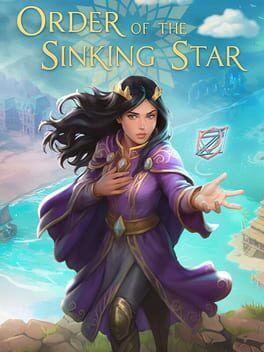

How Jonathan Blow is stretching the logic of Braid and the structure of The Witness into a 1,000‑plus puzzle "super collider" in Order of the Sinking Star, arriving on PC in 2026.
Jonathan Blow has never really repeated himself. Braid turned time into a toy, then a weapon. The Witness turned an island into a silent lecture about seeing and understanding. With Order of the Sinking Star, due on PC in 2026, he is trying something stranger: taking entire self‑contained puzzle games and smashing them together until the edges blur.
On paper, Order of the Sinking Star is a top‑down, grid‑based fantasy adventure about a Queen who cheats death and washes up in a magical realm. In motion, it looks more like a puzzle super collider. Four far‑flung territories, each with its own characters and rules, begin as separate “mini‑games.” Dozens of hours later those worlds have literally crashed into each other, their mechanics intertwined in what might be the most structurally ambitious puzzle game anyone is attempting.
A world built out of 1,000+ handcrafted puzzles
Blow describes Order of the Sinking Star as the biggest game of his career, and not in the marketing‑department sense. Across its four cardinal biomes and the spaces between, the game contains literally thousands of hand‑built puzzles. That scale matters because of how the structure works.
The overworld starts as a fog‑shrouded map, viewed from above, each tile a crisp square. You roam as the Queen, stepping onto stars embedded in the ground. Each star is a doorway into a bite‑sized level with its own rules, layout, and sometimes its own protagonist. Solve the level, and the world nudges forward: a path opens, a power is unlocked, a new piece of the map appears.
From the start, the game expects you to pick your battles. Blow says a solid chunk of early puzzles, roughly a quarter, are skippable. If a particular star has you stumped, you are free to walk away and explore another route. Over time, that softens but never fully disappears. The more you opt out, the more what remains tilts toward the fiendishly difficult side. Optional challenge is not a side mode here; it is baked into the way the entire landscape is assembled.
What makes this feel different from The Witness is the density. Where that island often gave you air between panel clusters, Order of the Sinking Star is almost pure puzzle fabric. Nearly every screen is either a puzzle or a corridor that exists only because of the surrounding puzzles. The Queen’s journey is less a stroll through a theme park of ideas and more a trek across a continent that has been engineered for logic problems.
Territories that feel like different games
Blow has been clear that each territory in Order of the Sinking Star is designed as if it could have been its own puzzle game. The map is divided into four main directions, each biome anchored by a single, clean concept.
In the east, the Mirror Isles revolve around a traveler who steps through mirrors like doorways. Mirrors can be picked up and repositioned along the grid so that exits line up with distant ledges or islands. When you start chaining them, strange things happen. A character can emerge from multiple mirrors at once, effectively duplicating themselves, which opens up designs that feel like turn‑based co‑op with your own reflections.
To the west, a zone called The Promise follows a young adventurer strapped into an exoskeleton. Huge gemstones litter the landscape. Walking up to one lets you dematerialize it, then slot that stored gem into receivers elsewhere in the level, powering colored laser beams. Each color fuses with the exoskeleton in a different way, turning traversal into a layered logic problem. A yellow beam might let you shatter obstacles; red might allow passage through matching red barriers; green might let you phase through solid walls. When beams cross, powers combine, and what began as a simple on/off wiring puzzle graduates into a combinatorial playground.
Other territories have their own signature toys. One region plays with massive skipping stones that skim across water until they hit land, turning each push into a geometric prediction problem. Another leans more heavily into block pushing, but with twists like characters who can only pull objects when moving backward or who automatically swap places with nearby blocks.
Crucially, these mechanics are not confined to their home turf forever. As you clear the opening sequences of a territory, the Queen learns that territory’s central verb. Master mirrors, and she gains her own form of mirror teleportation in the overworld. Understand how gem‑lasers work, and the Queen can start routing that energy to open far‑off shortcuts. Order of the Sinking Star uses those “graduation” moments the way a Metroidvania uses new tools, except the tools are entire rule sets distilled into simple, reusable actions.
Perspective as a puzzle piece
If Braid was about time and The Witness was about line‑drawing and perspective, Order of the Sinking Star tries to make perspective itself more malleable. At a glance the game looks almost board‑game simple: a slightly tilted top‑down view of a tile grid, characters moving one square at a time. That clarity makes blow’s favorite trick possible: slowly introducing exceptions that force you to re‑evaluate what the camera is actually showing.
Some regions pull the camera down to emphasize height, revealing that those flat tiles were stacked at different elevations all along. Suddenly shadows, stairs, and bridges matter. Puzzles that might have been solvable by eyeballing a 2D route now demand that you track which tiles overlap which, or how a mirror’s exit aligns vertically with a ledge.
In other spaces, especially subterranean ruins and cathedral‑like interiors, the game leans into more traditional third‑person framing. You are still on the same underlying grid, but vertical structures occlude your view, and the sense of depth feels closer to a 3D adventure. Blow used the player’s line of sight as a mechanic in The Witness; here he is exploring what it means to keep grid purity while breaking the flatness that puzzle games often cling to.
Because every puzzle is handcrafted, these perspective shifts are not just aesthetic dressings. They are chances to explore new categories of logic: teleporters that behave differently when stacked above each other; beams that can pass over or under obstacles depending on height; clones that must occupy the same tile at different elevations. The consistent grid keeps things legible, while the camera and verticality keep you slightly off balance.
The puzzle “super collider” idea
The most intriguing pitch behind Order of the Sinking Star is how those separate territories eventually stop being separate. Blow describes the late game as if chunks of each biome are being smashed together. In practice, that means you will reach borderlands where Mirror Isles geometry abuts The Promise’s machinery, or where skipping‑stone lakes cut through block‑pushing fortresses.
In these crossover spaces, heroes from different territories meet and share the stage within the same level. A mirror‑walker might need to set up portals so that the exoskeleton adventurer can route lasers to otherwise unreachable sockets. A thief who pulls objects backward could drag a skipping stone into a precise launch position that another character then uses. The point is not to create flashy mashups for their own sake, but to make good on the idea that each territory’s rule set is complete enough to stand alone, then dig deeper by forcing those rules to interact.
Most puzzle games climb a design mountain until they reach a clean, satisfying peak for their core mechanic, then roll credits. Order of the Sinking Star asks what happens if the peak of one system is just the starting plateau for a higher mountain built out of several systems colliding. That is where the thousands of puzzles come in. To make those cross‑disciplinary levels feel earned rather than arbitrary, the game first has to teach you each grammar in isolation, then test your fluency in increasingly tangled sentences.
Gold rooms are the focal point for this escalation. Hidden around the world, these spaces contain larger puzzle complexes that lean heavily on combinations of mechanics. Inside, you solve smaller stars to charge a completion meter tied to a central emblem. Fill that meter and a teleporter in the room activates. There are six such teleporters overall; activating at least four is enough to unlock the path to the endgame, with the remaining ones serving as extra‑hard optional challenges for players who want to see every possible collision of ideas.
How it builds on Braid and The Witness
Order of the Sinking Star is not abandoning Blow’s earlier obsessions; it is compounding them.
From Braid, it inherits the fascination with simple, legible rules that break your intuition about time and causality. Here that impulse shows up in characters whose movement is constrained in unexpected ways or whose abilities do more than the grid initially suggests. A thief who can only pull objects when moving backward sounds straightforward until a level is arranged so that every move either locks you in or opens a new route for some other character later. Like Braid’s time rewinds, many of these moves are automatic, happening every time you press a direction, which lets the designer construct puzzles around inevitability rather than optional verbs.
From The Witness, it inherits the open, non‑linear structure and the belief that the best tutorial is a carefully arranged sequence of puzzles. There are almost no explicit lectures here. Instead, a territory might start you with a single mirror in a one‑screen room, then gradually add extra mirrors, angled walls, and height differences until you realize you are juggling half a dozen constraints at once. The island’s panel language has been replaced by a more spatial, character‑driven syntax, but the pedagogical approach feels familiar.
Where Order of the Sinking Star really diverges is in its narrative ambitions and its sheer breadth. The Queen’s story is more foregrounded than anything in Blow’s past work. Your route through the world, which territories you prioritize, and how deep you go into their optional challenges all shape the way the story is presented. Blow talks about three endings, all intended to feel genuinely positive. One is the conclusion most players will naturally find; the others require more exhaustive exploration and a fuller grasp of the world’s underlying mysteries.
Structurally, this is closer to a sprawling, mystery‑driven adventure like Elden Ring than to a lean puzzle anthology. There is no single golden path. Instead, the game leans into the pleasure of wandering, bumping into something strange, leaving when it gets too tough, and coming back later with new tools and understanding.
Looking ahead to the 2026 PC release
Order of the Sinking Star is currently announced for PC, with consoles not ruled out but not confirmed. It is being built in Blow’s own programming language, the same technical detour that partly explains why it has been nearly a decade since The Witness. That alone says something about the kind of control he wants over every layer of this project, from engine behavior down to puzzle layout.
On the surface it is another cerebral, solitary puzzle game from a designer who loves to make you feel slow before you feel brilliant. Underneath, it is an experiment in scale and composition, a test of whether you can take several complete, satisfying puzzle grammars and weld them into a single coherent experience.
For fans of Braid and The Witness, the appeal is obvious. Order of the Sinking Star is not content to iterate on a favorite trick. It wants to see what happens when you bend perspective, reinterpret the idea of a world map as a lattice of logic, and keep increasing complexity long after most games would roll credits. If the final release lands anywhere near the ambition of its design pitch, 2026’s PC puzzle scene is going to have one very large, very strange new star sinking into it.