
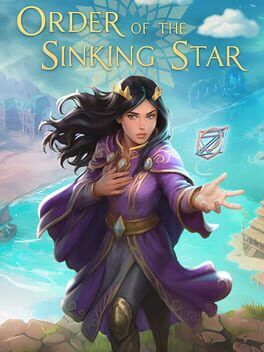

Breaking down the Game Awards reveal, the 1,000+ puzzle “super collider” pitch, and how Order of the Sinking Star pushes Braid and The Witness into a vast new structure for PC players in 2026.
Jonathan Blow has never made small puzzle games, but Order of the Sinking Star looks like the moment his design obsessions truly go off the deep end. Revealed at The Game Awards 2025 and targeting PC in 2026, it is pitched as a narrative puzzle adventure with more than a thousand hand‑crafted challenges and hundreds of hours of play. For a designer who already reshaped the modern puzzle scene with Braid and The Witness, this project reads like a deliberate escalation: a “game design super collider” that smashes together entire subgenres and collaborators to see what new structures emerge.
The Game Awards reveal: a puzzle epic quietly flexing scale
On The Game Awards stage, Order of the Sinking Star did not sell itself through flashy combat or big cinematic stunts. Instead, the reveal trailer leaned on a calm confidence in its premise. The setting is a strange, magical realm of floating structures and impossible contraptions, presented from an angled, grid‑based view that immediately evokes Sokoban‑style spatial puzzles more than first‑person wandering.
The key beats from the reveal and publisher messaging set the tone. The game is a PC‑first release, coming to Steam in 2026, with other platforms to be confirmed later. It has been in development for close to a decade inside Thekla, the studio Blow founded after Braid. And it is explicitly framed as a massive narrative puzzle adventure rather than a puzzle game with a story bolted on. The trailer suggests distinct regions, recurring characters and a through‑line mystery, but the marketing deliberately foregrounds the scale and construction of the puzzles themselves.
That emphasis matters. Blow’s previous reveals often relied on a single killer hook: time manipulation in Braid, line‑drawing panels in The Witness. Order of the Sinking Star instead sells you on magnitude and structure. You are not seeing a single mechanic showcased, but a whole grid of possibilities waiting to be discovered, recombined and pushed to their breaking point.
A 1,000+ puzzle “super collider”
The phrase that keeps surfacing around Order of the Sinking Star is “game design super collider,” and it is not empty flair. Blow and publisher Arc Games are clear that this is not just a big collection of levels. The game is built around more than one thousand hand‑crafted puzzles that have been iterated on for years and are designed to collide mechanically.
That collision happens on several levels. First there is the raw volume. Interviews and previews talk about hundreds of hours of play, with a main path measured in the low hundreds and full completion stretching toward the 400 to 500 hour mark for dedicated players. Those numbers only make sense if the game’s internal logic can keep unfolding without going stale. To sustain that, the designers are pulling in distinct puzzle “families” rather than permutations of a single trick.
Second, there is the roster of collaborators. Blow is no longer the lone auteur locked away tuning every puzzle himself. The project brings in some of the sharpest minds in modern puzzle design, including creators tied to Sokoban‑like games, recursive box puzzlers and spatial thinkers. Each brings their own sensibility about what a good puzzle feels like, how it teaches and how it surprises you. Order of the Sinking Star’s job is to take all of those traditions and smash them together into something coherent.
Finally, the super collider metaphor points to how these puzzle families interact. The intent is not to wall off each mechanic in its own themed world, but to let ideas leak, stack and reappear in new guises. A block‑pushing rule you first learn in a simple warehouse layout might resurface twenty hours later inside a different rule set, forcing you to re‑evaluate what you thought was fixed. The structure asks you to internalize systems and then watch as the game rewrites how they overlap.
From panels and time travel to grids and constraints
To see why Order of the Sinking Star feels like Blow’s wildest project, it helps to trace how it evolves his previous work.
Braid built its identity around discrete, tightly authored stages tied to specific time mechanics. Each world took a clear idea, such as rewinding time or having your past actions echo as a ghost, and explored it through a ladder of levels. The design philosophy was about revelatory understanding. You saw what the mechanic did, tried to apply it, failed, then finally clicked with how to bend it.
The Witness shifted perspective to a single large island, but underneath the 3D wandering it still revolved around one core interaction: drawing lines on panels. Blow then spun enormous variety from that foundation by encoding different rules into panel symbols and environmental cues. The island’s genius lay in how it taught those grammars non‑verbally, layering simple inferences into deep conceptual leaps.
Order of the Sinking Star moves away from a single dominant input toward a more abstract, grid‑centric language. The isometric, tile‑based presentation supports Sokoban‑style motion and object manipulation. Where Braid and The Witness were about your relationship to time and perspective, this new game is about your relationship to space under constraint. Every move risks locking you out of a solution. Every push has to be predicted several steps ahead.
Yet the philosophical through‑line is intact. Blow still wants you to confront the limits of your current understanding and then grow beyond them without explicit tutorials. Puzzles are crafted to look impossible until you realize you have misread the rules or missed a quiet detail. The difference is scale. In Braid, that realization might come after a handful of attempts. In Order of the Sinking Star, the same kind of epiphany may ripple across entire constellations of levels that share a logic.
A new structure, informed by Braid and The Witness
If Braid was a series of puzzle books and The Witness was a single dense encyclopedia, Order of the Sinking Star is shaping up to be a library. Structurally, it borrows ideas from both earlier games and stretches them across a larger frame.
From Braid, it seems to inherit the notion of worlds or regions that teach you a mechanic through curated sequences. The talk of “four distinct worlds” and an unlikely cast of heroes suggests you will be guided through self‑contained arcs that slowly raise the difficulty around a central rule. Each area acts as a curriculum with its own flavor.
From The Witness, it appears to reuse the open‑endedness and freedom to walk away from a problem. With more than a thousand puzzles on offer, the design almost has to let you sidestep one that stumps you and explore elsewhere. That player‑driven pacing was a key part of why The Witness felt generous even when it was brutally hard, and it should be even more critical in a game whose runtime is measured in hundreds of hours.
The key structural twist is how Order of the Sinking Star tries to bind all of this into a narrative spine. Where The Witness kept its story oblique and philosophical, this time Thekla and Arc are openly calling it a narrative adventure. The “unlikely heroes” and overarching mystery give a reason to traverse that vast grid of puzzles beyond pure completionism. If the writing and worldbuilding can keep up with the density of the design, this could be Blow’s first game where the story is not just a frame but a genuine motivator.
Why this is Blow’s wildest puzzle project yet
For PC players looking ahead to 2026, several factors make Order of the Sinking Star stand out even against the already imposing shadows of Braid and The Witness.
The first is ambition of scale. Braid was a compact handful of hours. The Witness sprawled but could still be wrapped up in a few dozen hours for focused players. Here the studio is talking openly about multi‑hundred hour commitments, thousands of interlocking puzzles and a project that has quietly occupied a decade of work. That level of dedication to a single, purely puzzle‑driven game is rare even in the indie space.
The second is the collaborative nature of the design. Blow has always been a strong central voice in his projects, but Order of the Sinking Star’s list of contributors reads like a best‑of modern puzzle design. Integrating those perspectives without losing coherence is inherently risky, but if it works it will give the game an internal variety his earlier work could not match.
Third, the structure itself is experimental. Using a grid‑based Sokoban foundation as the canvas for a multi‑world narrative adventure is unusual. These kinds of puzzles are traditionally seen in small, tightly bounded games where difficulty can spike brutally and then reset. Building an approachable, long‑form experience on top of them requires new thinking about difficulty curves, player fatigue and discovery.
Finally, the expectations are higher. Braid and The Witness are now touchstones for what minimalist, elegant puzzle design can look like. By promising higher puzzle quality, deeper mechanical layering and a far greater volume of content, Order of the Sinking Star is not just competing with the rest of the market. It is competing with Jonathan Blow’s own legacy.
What PC players should expect in 2026
When Order of the Sinking Star arrives on PC, it will not be the kind of puzzle game you dip into casually. Everything about the pitch suggests a title that wants to sit on your Steam library as a long‑term project, something you return to night after night to chip away at a sprawling mystery of rules and spaces. Steam Deck support and eventual ports may broaden where it can be played, but the design is clearly targeting the kind of PC audience that embraced The Witness: patient, curious and willing to be stumped.
In the end, calling it Jonathan Blow’s wildest puzzle project is less about raw size and more about what that size represents. This is a game that tries to synthesize a decade of puzzle innovation into one coherent adventure, then invites players to live inside it for months. If Braid asked what a platformer could teach you about time, and The Witness asked what a landscape of panels could teach you about perception, Order of the Sinking Star looks ready to ask a bigger question. What happens when you turn an entire world of constraints and collisions into a single, relentless puzzle about how you think?