
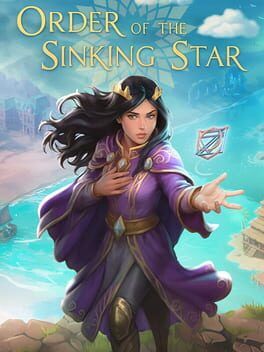

How Jonathan Blow’s Order of the Sinking Star uses 1,000-plus puzzles, interlocking sub-games, and a Switch 2 launch to push his philosophy of “pure” problem solving beyond Braid and The Witness.
A Thousand Puzzles, Zero Filler
Order of the Sinking Star is not a small follow-up to Braid or The Witness. Jonathan Blow and Thekla are positioning it as a gigantic “puzzle saga,” with well over 1,000 handcrafted puzzles spread across four major regions and a web of smaller sub-games tucked inside.
Blow has said in interviews that the scale is not about padding playtime, but about building a long, coherent arc of ideas. Where Braid used a compact set of time mechanics and The Witness built a few dozen rule sets into hundreds of panels, Order of the Sinking Star aims to stretch its concepts across hundreds of hours without repeating itself.
The game is a narrative-driven adventure in a magical world that is described as a “living puzzle.” The story and mechanics are tightly bound, and the size of the puzzle count is meant to give those ideas room to evolve instead of just remixing a handful of tricks.
Interconnected Worlds, Interconnected Sub-Games
Structurally, Order of the Sinking Star is closer to The Witness than Braid. You explore four distinct regions that gradually collide and overlap. Each region begins with its own set of rules and puzzle vocabulary, but as you progress, their systems bleed into each other.
This is where the “sub-game” angle comes in. Early on, each area feels almost like its own standalone puzzle game: one might concentrate on spatial manipulation, another on Sokoban-like block pushing, another on timing or path routing. They function like self-contained rule sets you can study in isolation.
As the worlds merge, those sub-games are forced to coexist. Solutions start to require you to think in two or three of those dialects at once. A push-block scenario might suddenly be constrained by a teleportation grid borrowed from another land, or a routing puzzle could be complicated by character abilities that originally belonged to a different protagonist.
That interlocking structure is the core new trick. In Braid, each world expressed one big idea about time. In The Witness, each area built on its own symbol language. Order of the Sinking Star takes that compartmentalized approach and then tears down the walls between compartments, asking players to synthesize everything they have learned.
A Cast Of Playable Puzzles
Unlike The Witness’s solitary wanderer, Order of the Sinking Star is built around multiple playable characters, including a queen, a thief, a warrior, a wizard, and even a talking boat. Each one carries a slightly different mechanical angle, and each is tied to a different part of the overall world.
The queen’s sections lean into big-picture planning and state management, as if you are moving pieces on a strategic board. The thief’s areas focus more on constraints and stealth-like spatial logic, where line of sight, timing, and limited movement options matter. The warrior evokes heavier, more physical interactions with the environment, while the wizard introduces rule-bending elements that border on programming puzzles.
Then there is the talking boat, which shifts perspective once again by treating traversal and route optimization as its own problem space. Sail paths, currents, and environmental hazards fold into a travel-focused puzzle layer that can intersect with what the landlocked characters are doing.
Early on, their worlds are separate and readable. As the story develops and characters meet, their mechanics start to overlap. It is not just that you unlock new avatars, but that the game slowly reveals how every “sub-game” was secretly part of a single overarching design.
Philosophical Throughline From Braid And The Witness
Underneath its high fantasy dressing, Order of the Sinking Star carries the same philosophy that defined Blow’s previous work: puzzles should teach through play, not through text, and the solution should feel like a genuine insight rather than busywork.
Braid used time manipulation to explore regret, obsession, and the impossibility of rewriting certain outcomes. The Witness stripped away nearly everything except its rules and environment to focus on pure, contemplative observation. Both games tried to remove fluff so that every challenge expressed an idea clearly.
Order of the Sinking Star tries to preserve that purity at a much larger scale. The risk of having more than a thousand puzzles is obvious: repetition, fatigue, or a bloated difficulty curve. To counter that, Blow is once again building a progression where each step is supposed to convey something new, either by gently extending a mechanic or by forcing you to reinterpret an old one under fresh constraints.
Where Braid was a compact, metaphor-heavy platformer and The Witness was a meditative, almost hermetic island, the new game leans more into a saga structure. Narrative is more pronounced, with characters, overlapping plotlines, and collectible notes that shed light on the world. Yet Blow is still framing it as a game where the primary “story” is the one you experience in your own head as you rewire how you think about its systems.
Philosophically, that is the connective tissue: each game is less about what the plot says and more about the mental habits it forces you to adopt.
Mechanical Evolution Beyond Time Loops And Line Mazes
On a mechanical level, Order of the Sinking Star looks like a deliberate move away from the highly visible gimmicks of Braid’s time rewinding and The Witness’s line drawing.
Instead of a single signature verb, it is built on dozens of interrelated mechanics. Sokoban-style pushing, grid routing, light programming logic, perspective shifts, environmental toggles, even character-specific power sets are all playing at once. Any one of those could have been the whole premise for a smaller indie puzzle game. Here they are treated as building blocks of a larger machine.
The core challenge is not just to master a mechanic, but to recognize how the rules of one system can serve as tools inside another. If The Witness was about reading a symbolic language, Order of the Sinking Star is about code-switching, constantly translating between different “languages” of puzzles.
Another distinction is pacing. Braid’s toughest levels lived or died on your execution once you understood the trick. The Witness leaned more heavily on the “aha” moment and less on dexterity. Early information suggests Order of the Sinking Star lands closer to The Witness, with controls that stay simple so the cognitive load can be high.
The idea is to keep focus on thinking through a network of rules, not fighting the input layer.
Why Switch 2 Might Be The Ideal Home
Order of the Sinking Star was first announced for PC, but it is now confirmed for Nintendo Switch 2, targeting a launch later this year. Blow has been clear about why he likes the platform: puzzle games thrive when you can dip in and out easily, and Switch-style hardware makes that natural.
A thousand-plus puzzles is a long-term relationship, not a weekend fling. Switch 2’s portability lets you tackle it in ten-minute chunks on a commute just as comfortably as in long sessions docked to a TV. That flexibility matters for a game that can demand intense concentration without always offering big audiovisual payoffs.
There is also a practical angle. Thekla has talked up the game’s size and the complexity of its interconnected worlds, which suggests a heavier technical footprint than The Witness. Switch 2’s expected jump in power should give the studio room to keep load times and visual clarity at a level that does not get in the way of problem solving.
From a market standpoint, Switch owners have already shown a strong appetite for slower, brainy experiences. The success of games like Baba Is You, The Talos Principle, and a steady diet of indie puzzlers has proven that there is an audience happy to play something demanding on a handheld.
Why Dense Puzzle Games Still Have A Dedicated Audience
Order of the Sinking Star is not chasing trends like live-service hooks or roguelite progression. It belongs to a narrower tradition of dense puzzle games that ask a lot and give very little hand-holding in return. Despite the industry’s overall tilt toward more accessible and content-driven releases, that niche is not going away.
One reason is that the audience for this kind of design is intensely loyal. Players who bounced off The Witness often did so immediately. Those who connected with it tend to speak about the experience in almost life-changing terms. Blow’s work aims squarely at that group: people who want a game to feel like a multi-month intellectual project instead of a consumable content stream.
Another reason is that in an era of algorithmic feeds and constant distraction, a game that simply asks you to stare at a problem for an hour can feel refreshing. The sharp boundaries of a hard puzzle are comforting. Either you understand it or you do not. When you finally see the answer, the satisfaction is both pure and personal.
Order of the Sinking Star is betting that by multiplying that feeling across a thousand-plus distinct challenges, players will treat it almost like a hobby. Something you return to night after night, pushing a little deeper into its structure, sharing discoveries with friends, and slowly internalizing how all its sub-games fit together.
In that sense, it is an escalation of everything Blow has been working on for nearly two decades. Braid showed he could wrap deep mechanics in a compact story. The Witness proved he could sustain a singular design idea across a large world. Order of the Sinking Star is where he tries to assemble a whole constellation of ideas into one, sprawling, interconnected puzzle.
If it works, Switch 2 might become the place where a lot of players choose to lose themselves inside it.