
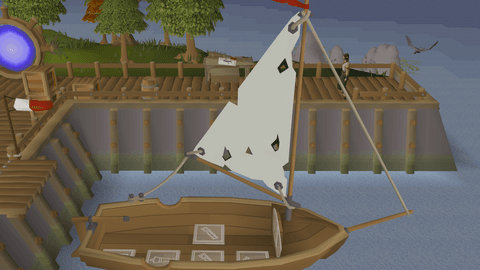

Jagex has revised Old School RuneScape Deep Sea Diving after feedback, changing jewellery banking, Abyssal progression, duplicate gland value, and lore details before polling.
Image: oldschool.runescape.wiki
Jagex has already softened Deep Sea Diving’s sharpest edges before the poll
Jagex’s latest Deep Sea Diving blog update changes several parts of the proposed Old School RuneScape expansion before players vote on it, with the biggest adjustment aimed at a familiar OSRS pressure point: convenience that risks looking too automatic. In the November 9 update on the official Old School RuneScape site, Jagex said it is replacing the proposed jewellery “auto-banking” functionality with a mermaid courier who will ferry crafted items for a fee that has not been finalized.
That is the clearest signal from the latest round of OSRS feedback. Deep Sea Diving is still a proposal, and Jagex’s own language keeps it there. MMOHuts previously reported that the update is headed to an in-game poll, with separate questions expected for the quest, jewellery and farming sites, Slayer areas, the Abyssal gland reward, and the Omnivorous Clams activity. In other words, this is not a single all-or-nothing content drop. Parts of the pitch can still change, pass, or fail independently.
The proposal itself is tied to Sailing. MMOHuts described Deep Sea Diving as a Sailing-linked activity that would arrive alongside Burial at Sea, an Experienced-tier quest and the second, final part of the story that began in Pandemonium. The stated requirements in that proposal were 42 Sailing, 38 Smithing, 32 Construction, completion of Pandemonium, and completion of Recipe for Disaster: Freeing Pirate Pete. Proposed rewards included 3 Quest Points, Sailing and Smithing XP, 10,000 coins, Deep Sea Diving gear, a Diving Bell, and access to the new diving activity.
The tension is easy to read if you have watched OSRS skilling proposals before. Deep Sea Diving wants to make Sailing feel like a framework for future areas, not a one-off skill island. At the same time, every convenience reward has to survive a player base that is highly sensitive to banking shortcuts, resource loops, and anything that might quietly rewrite established progression. Jagex’s first feedback pass does not remove that tension, but it does show the team is willing to sand down the most contentious assumptions before a vote locks the shape of the update.
The mermaid courier is a safer compromise than automatic jewellery banking
The original Deep Sea Diving pitch included jewellery production sites with silver, gold, gem rocks, and hydrothermal vents that could function as magical furnaces, according to MMOHuts’ summary of Jagex’s proposal. The same proposal included an upgrade that would bank smelted jewellery. Jagex now says players “weren’t fans” of the way that auto-banking was described, so the feature is being reframed as an NPC service: a mermaid courier who carries items away for a small fee.
That distinction matters for Old School RuneScape Deep Sea Diving because jewellery production touches several systems at once. It involves mining inputs, crafting outputs, furnace access, inventory pressure, travel time, and banking rhythm. A fully automatic output pipeline can look efficient on paper while feeling out of place in a game where many skilling methods are balanced around small frictions. A courier, by contrast, still offers a reason to use the site while giving Jagex an obvious balancing lever.
The unresolved part is the fee. Jagex said it is “not dead-set” on what the fee might be, floating either a simple gold cost or the occasional piece of jewellery for the courier’s own collection. That is not flavor text for planners. It is the difference between a predictable GP sink, a variable output tax, and a method that may feel substantially better or worse depending on what players craft there.
For now, the OSRS Deep Sea Diving changes make the jewellery site concept less alarming but still impossible to model cleanly. If the fee is a flat gold cost, high-value items may benefit disproportionately. If the fee consumes jewellery, the method’s value depends on the exact item mix and the rate at which the courier takes payment. Until Jagex publishes the fee, players should treat the jewellery loop as promising design space rather than a settled money-making or Crafting route.
Abyssal progression moves earlier, but the gland economy is still unfinished
The most progression-relevant change is to the Abyssal Arbalest. Jagex now plans to reduce its Slayer requirement from 79 to 73 so players can obtain the Abyssal Gland earlier. The official blog notes that players often reach 79 Slayer long before obtaining an Abyssal Lantern from Guardians of the Rift, but Jagex is still lowering the requirement.
That is a meaningful adjustment because the Abyssal Gland is proposed as a permanent Runecraft utility reward. In the original proposal summarized by MMOHuts, the Abyssal Arbalest would drop an untradeable Abyssal gland that players could bring to the Dark Mage in the Abyss to permanently triple Runecraft pouch durability. That places the reward in a very specific lane: not raw combat power, not a tradable jackpot, but a long-term account convenience for players who craft runes often enough to care about pouch degradation.
The feedback update also gives duplicate Abyssal Glands a use. Jagex says players will be able to take extras to Hagus in the Scar Essence Mine, requiring partial completion of Desert Treasure II, in exchange for Scarred Extracts. The number of extracts has not been decided. Jagex did clarify the value frame, saying each Extract is equivalent to 24,000 GP in savings if players use it to craft runes, while Hagus buys extracts back at 90% of their cost if a player is already stocked up.
This is a healthier shape than a duplicate untradeable dead drop, especially for players who spend time on Slayer after securing their first gland. It also introduces requirements and economic assumptions that are not fully pinned down. Partial Desert Treasure II completion adds a quest gate to the duplicate-value path, and the final extract quantity will decide whether duplicates feel like a meaningful consolation or a minor rebate. The reduced Slayer requirement makes the reward easier to plan toward, but the final efficiency math remains out of reach.
The farming clarification narrows expectations before they become promises
Jagex also used the November 9 update to clarify the proposed underwater farming area. The studio said the area sits in an air pocket lit by a strange Sunstone totem, tying the space to the “Wyrmscraig-y” mystery rather than asking players to accept ordinary crops growing freely on the sea floor. The original proposal, as summarized by MMOHuts, included an underwater cave farming area with Spirit Tree, Celastrus, Mushroom, and Hardwood Tree patches.
The more important systems clarification is what Jagex is not currently adding. The studio said there is potential to add more Coral or Seaweed patches to other locations in the future, but that is not planned for this update. Jagex specifically warned that new Coral patches would have a substantive effect on the Herblore meta, which explains why a seemingly modest extra patch type is being treated cautiously.
For a completion-minded player, this is where the proposal becomes easier to assess. Farming patches are account infrastructure. Extra patch access can change daily routes, supply flow, diary-style habits, and the long-term value of teleports or transportation unlocks around them. By saying Coral and Seaweed expansion is outside the current scope, Jagex is reducing the chance that Deep Sea Diving unexpectedly becomes a major Herblore or seaweed supply update rather than a Sailing-area expansion with selected farming utility.
The lore framing helps too. OSRS can absorb strange spaces, especially when they are deliberately odd, but the best odd spaces still tell players what rules they are bending. An air pocket and Sunstone totem give the farming zone a reason to exist without turning every underwater site into a blank cheque for surface-world mechanics. That makes the proposal feel more contained, which is useful before polling.
The jelly-fish change is small, but it shows what kind of feedback Jagex is taking
One of the lighter changes is also one of the most revealing. Jagex said the jellies found in the underwater Slayer area will use the appearance of “jelly-fish” instead of regular jellies, crediting a Reddit user suggestion and calling it classic OSRS humour. On its own, that does not rebalance a method or change an account plan. It does, however, show that this feedback pass is not limited to numbers.
The original Deep Sea Diving proposal included low and mid-level Slayer areas with Depth Crawlers, Drowned Mages, and regular Jellies, plus an Abyssal Slayer area with Abyssal Demons, Abyssal Rock Slugs, and the new Abyssal Arbalest. In systems terms, these areas are doing different jobs. The lower and mid-level sections give the activity a reason to exist before endgame accounts arrive. The Abyssal section creates a specific reward chase through the gland. The visual swap for jellies keeps the lower-tier space from feeling like a land monster list dropped underwater with minimal adaptation.
That matters because Deep Sea Diving is being pitched as a foundation for future area expansion. Jagex said in the official update that many players seemed excited by the idea of laying groundwork for a new type of area expansion that could be used later. If that is the ambition, small thematic decisions carry more weight than usual. A new expansion format needs mechanical value, but it also needs a readable identity so future sites do not feel interchangeable.
This is also where the Old School part of Old School RuneScape does real work. Pocket Gamer’s recent interview with creative director Kieren Charles framed his role as overseeing the game’s core strategy, content philosophy, and the way the team works with players. The jelly-fish change is a modest example of that philosophy in practice: player feedback shaping not only reward protection, but also whether the proposal sounds like OSRS when it leaves the blog page.
The poll structure protects players, but it also leaves planning gaps
The practical question for players is whether Jagex Deep Sea Diving now looks safe enough to plan around. The answer is yes for broad progression goals, no for supply speculation or route optimization.
The safer parts are the prerequisites and account direction described in the proposal. If a player wants to be ready for Burial at Sea as proposed, the published requirement list gives a reasonable preparation path: 42 Sailing, 38 Smithing, 32 Construction, Pandemonium, and Recipe for Disaster: Freeing Pirate Pete. If a player cares about the Abyssal Gland, the revised Slayer target of 73 is now the clearest combat-adjacent benchmark. If a player wants to benefit from duplicate glands through Hagus, partial Desert Treasure II completion appears relevant based on Jagex’s updated description.
The unsafe parts are anything dependent on final rates, fees, pass/fail polling, or reward quantities. The mermaid courier fee is undecided. The number of Scarred Extracts for duplicate glands is undecided. MMOHuts reported that the in-game poll will split major pieces into separate questions, so a player cannot assume the quest, jewellery sites, farming area, Slayer areas, gland reward, and Omnivorous Clams will all arrive together. The Omnivorous Clams activity itself was described in the original proposal as a hybrid Thieving and Magic activity with stackable loot, pearl drops for High Alchemy, and three proposed sail cosmetics, but the provided source material does not give final rates, reward values, or a confirmed release date.
There is useful recent context for caution. In a separate November 11 update covered by MMOHuts, Jagex walked back a Doom of Mokhaiotl change after player feedback and restored Lumbridge Castle’s classic layout following feedback on earlier tidy-up changes. Those examples are not Deep Sea Diving decisions, but they do show the current Old School RuneScape update cycle remains responsive after proposals or patches meet live player scrutiny.
For now, the best planning posture is conservative. Train toward the stated quest and Slayer requirements if those goals already fit your account. Avoid buying materials or reorganizing long-term skilling routes around the jewellery sites until the courier fee is known. Treat duplicate Abyssal Glands as potentially useful, not priced. Deep Sea Diving looks safer after this feedback pass because Jagex has reduced automation concerns, moved a key reward earlier, and clarified some scope boundaries. It is still a poll-bound proposal, and OSRS players should plan like voters, not like customers with a dated release already on the calendar.