
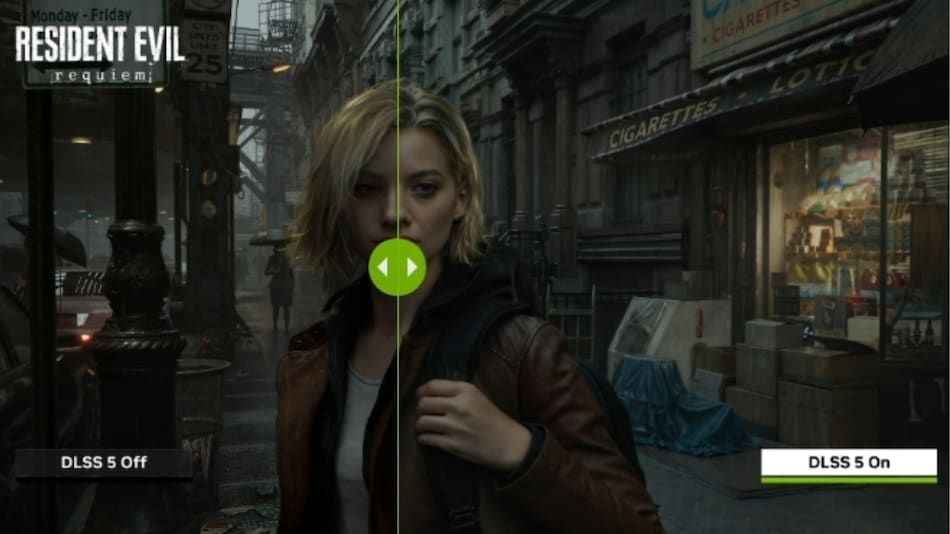

Modders have reportedly pulled Nvidia's unreleased DLSS 5 neural rendering files from NBA 2K27 and tested the AI filter in Control and other games, reigniting concerns over altered art direction, face changes, performance cost, and whether the feature will ship broadly.
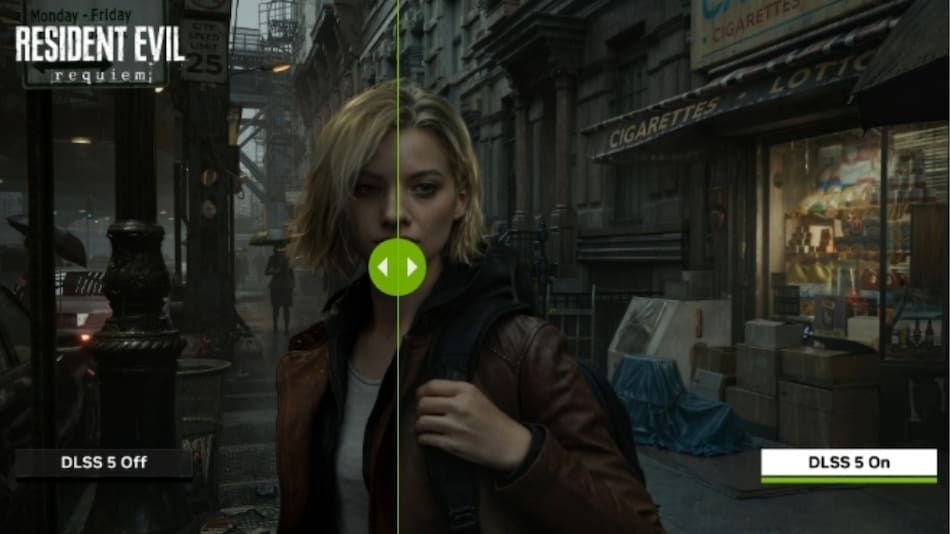
Image: gadgets360.com
A leaked DLL has turned the DLSS 5 argument into something players can test
The sharpest development in the Nvidia DLSS 5 leak is not that a file reportedly appeared early. It is that modders have already made that file do visible work inside real games, giving players an unofficial preview of the AI filter that drew heavy criticism when Nvidia revealed DLSS 5 earlier this year.
According to VideoCardz, the PC early access build of NBA 2K27 shipped with a previously unseen library named nvngx_dlssnr.dll, identified as NVIDIA DLSSNR version 310.8.0.0. Rock Paper Shotgun, TechSpot, Video Games Chronicle, and Club386 all report that members of the RenoDX modding community then used the file to get DLSS 5 neural rendering running in Remedy’s Control. VideoCardz says the implementation is not part of a public RenoDX release, and the current test affects character models rather than the full scene.
That distinction is important. This is not an official DLSS 5 launch, and NBA 2K27 itself reportedly has no menu controls for enabling the feature. TechSpot says the DLL does not explicitly say DLSS 5, although it contains “NR,” which the outlet reads as a likely reference to Nvidia’s neural rendering terminology. Still, the practical result is clear enough for the controversy to leave the demo stage: players are now seeing a version of Nvidia’s unreleased AI rendering stack applied to familiar characters, lighting, skin, and faces in games that were not built around it.
What reportedly leaked, and what has actually been shown
The reported file is unusually large for a DLSS component. TechSpot, citing analysis of the DLL, says the library is 158MB and that much of its size appears to be neural training weights. The same report says the file contains 148 million FP8 parameters and is likely an unfinished build. VideoCardz separately identifies the file as the runtime for DLSS 5 Neural Rendering, while noting that the early build appeared in NBA 2K27 before any official path for using it was known.
From there, the modding story moved quickly. VideoCardz reports that RenoDX members had the library running in Control within hours, with demonstrations focused on Jesse’s character model and several adjustable controls. Rock Paper Shotgun and Video Games Chronicle both report that modders found seven available styles or presets for the neural rendering effect. VideoCardz adds that HDR is not working correctly in the current implementation, with testing focused on SDR while modders investigate how the model expects image data.
The effect being tested is narrower than some social posts may suggest. In Control, the current implementation reportedly targets character models, not every surface and light source across the whole game. Club386 says others have also tried the mod across multiple games, including Cyberpunk 2077 and Kingdom Come: Deliverance II, while Video Games Chronicle points to community testing around Control, Final Fantasy 7 Rebirth, and images involving The Last of Us Part 2. Those are unofficial experiments, not a compatibility list from Nvidia.
The controversy is about authorship as much as image quality
Nvidia described DLSS 5, according to Video Games Chronicle, as a system that takes a game’s color and motion vectors for each frame and uses an AI model to add photoreal lighting and materials that remain anchored to source 3D content and consistent frame to frame. The pitch is technical and production-minded: give AI enough data from the game’s own render to infer richer visual detail.
The backlash has centered on the visible tradeoff. Rock Paper Shotgun characterizes the most criticized demonstrations as an AI filter that “yassified” game characters’ faces, while TechSpot reports that videos of the Control mod show significant changes to lighting and character faces even at relatively conservative settings. TechSpot describes the effect as adding or deepening shadows, simulating new skin shading, and altering eyes to enhance realism while still adhering to the original structure.
That is where the strategic tension sits for PC gaming graphics. Upscaling and frame generation have usually been sold as performance technologies, where the win condition is higher frame rate or cleaner reconstruction with minimal disruption to the source image. DLSS 5 neural rendering is being received differently because the visible output can change a character’s presentation. When a face in Control, Final Fantasy 7 Rebirth, or The Last of Us Part 2 looks recognizably different, players are no longer debating only aliasing, shimmer, or ray reconstruction noise. They are judging whether a rendering feature has crossed into art direction.
Nvidia has pushed back against that reading. Video Games Chronicle quotes Nvidia CEO Jensen Huang responding to complaints by saying critics were “completely wrong” because DLSS 5 fuses controllability of geometry, textures, and other game data with generative AI. TechSpot also notes Nvidia had previously said developers would be able to tweak DLSS 5, including changing or ignoring specific objects with varying levels of intensity. The leaked mod’s switches and sliders appear to support the idea that controls exist, but an unofficial Control test cannot show how strict those controls will be in finished games.
Early performance numbers are brutal, but they are not final benchmarks
The strongest practical warning from the modded tests is performance. TechSpot reports that the current DLSS 5 neural rendering mod drops Control on an RTX 5070 Ti at 4K from 71 fps to 35 fps. Tom’s Hardware cites the same early Blackwell test in its headline framing, also pointing to a fall release window and the 71-to-35 fps drop. Club386 reports another test using a Core i7-14700F and GeForce RTX 5080 where performance falls from around 90 fps to 40 fps.
Those are severe losses, especially for a feature associated with the DLSS brand, which many PC players mentally file under “performance gain.” The early neural rendering tests reverse that expectation. At least in these unofficial builds, the AI filter is a costly post-process-style visual layer rather than a free enhancement.
There are reasons to be cautious before turning those numbers into launch-day verdicts. Rock Paper Shotgun stresses that this is an unofficial implementation assembled from files found in NBA 2K27, and VideoCardz says the current build is experimental, SDR-focused, and not publicly released through RenoDX. TechSpot calls the DLL likely unfinished. Nvidia’s final integration could change performance, compatibility, control exposure, and default behavior.
Still, the hit is large enough that players should treat DLSS 5 neural rendering as a potential quality-mode feature until Nvidia proves otherwise. If a 4K test on an RTX 5070 Ti can be nearly halved in an unofficial setup, the final question is not only “does it look better?” It is “what do I have to give up to run it?” In competitive or latency-sensitive games, that trade would be hard to justify. In single-player showcases, it may depend on whether the visual changes match the developer’s intent.
Do not assume every DLSS game will get this filter
The leak has created a misleading sense that DLSS 5 can be dropped into anything with a GPU and a folder. The sources point to a narrower situation. TechSpot reports that the DLL only supports Nvidia RTX 50 series graphics cards. VideoCardz says the current implementation appears to use inputs already available to regular DLSS upscaling, and Rock Paper Shotgun reports that RenoDX modders believe Unreal Engine 5 games might be relatively easy to get running with it. That is a promising modding clue, not an official platform strategy.
NBA 2K27 is also a strange origin point. The file reportedly appeared in the early access build, but TechSpot says the basketball sim does not yet officially support DLSS 5 and has no controls for activating it. That makes the leak a signal that Nvidia and partners are preparing something, not proof that NBA 2K27 will ship as a DLSS 5 showcase in its current state.
The developer-control issue will decide how broad adoption feels. If DLSS 5 arrives as an opt-in rendering feature with per-object controls, intensity settings, and a clear off switch, it can be evaluated like other expensive visual settings. If it is pushed as a default enhancement that materially alters faces or scenes, the backlash will follow it from tech forums into Steam reviews, mod pages, and graphics settings guides.
That is the meta shift to watch. PC players have become comfortable with AI-assisted reconstruction when the output is framed as preservation of the original image at higher performance. DLSS 5’s AI filter controversy comes from the perception that the model is making new aesthetic decisions. Whether Nvidia can make that feel like a renderer upgrade rather than a style override will shape adoption more than any single comparison screenshot.
What players should wait to learn before judging DLSS 5
The confirmed picture is limited. Multiple outlets report that nvngx_dlssnr.dll was found in NBA 2K27’s early access files, that RenoDX modders got the neural rendering component running in Control, that the current tests expose seven styles or presets, and that early performance can be extremely expensive on RTX 50-series hardware. Nvidia has described DLSS 5 as using game frame data and AI to add photoreal lighting and materials, and Jensen Huang has publicly defended the approach against criticism.
What remains unannounced is more important for buyers. Nvidia has not, in the provided source material, published a final game support list, final performance targets, launch-day driver requirements, a clear consumer compatibility matrix beyond the reported RTX 50-series limitation in this DLL, or a firm release date beyond the “this fall” window reported by TechSpot and others. There is also no official statement in the provided sources saying the leaked NBA 2K27 file is the final runtime.
For now, players should treat every DLSS 5 modder clip as an experimental signal rather than a purchase recommendation. The Control tests are useful because they show the kind of visual transformation players fear, the kind of controls Nvidia may expose through developers, and the scale of the current performance cost. They do not prove how DLSS 5 will behave in a finished, supported game.
The safest expectation is that DLSS 5 neural rendering will launch as one of the most scrutinized PC graphics features in years. If Nvidia wants it to survive outside tech demos, it will need clear toggles, conservative defaults, strong developer controls, and enough performance optimization that players are not choosing between frame rate and a face filter they never asked for.