

Breaking down the first dev diary for NORSE: Oath of Blood: grid-based combat, progression, and a grounded, choice-driven Viking saga, and where it might sit in today’s tactics-RPG landscape.
Tripwire Presents and Arctic Hazard are lining up NORSE: Oath of Blood for a February 3, 2026 launch on PC, PS5, and Xbox Series X|S, and its first dev diary paints a surprisingly focused picture of what this Viking tactics RPG is trying to be.
Rather than leaning on myth and spectacle, the team keeps coming back to three ideas: grounded, weighty combat; a slow-burn progression fantasy about rebuilding a shattered clan; and a revenge story where your choices shape how far Gunnar is willing to go. Taken together, NORSE is positioning itself closer to a gritty historical war chronicle than a power fantasy.
Below is a breakdown of what the dev diary and early info tell us so far, and how it might fit in the current tactics-RPG landscape.
A grounded Viking revenge tale
NORSE: Oath of Blood is set in Dark Age Norway and written by historical novelist Giles Kristian, who appears throughout the dev diary talking about tone and character.
You play as Gunnar, son of Jarl Gripr. After Gripr is murdered by Steinarr Far-Spear and the clan is scattered, Gunnar has to rally survivors, rebuild the settlement, and claw his way back into power. It is a classic Viking revenge hook, but the dev diary emphasizes human-scale drama over legendary heroes or monsters.
Key takeaways from the diary:
- The team wants a “boots in the mud” portrayal of Viking life: hunger, cold, and fragile alliances are as important as axes and shields.
- Divine favor and pagan belief are present, but the focus is on how people behave because of their beliefs rather than on supernatural powers running the story.
- Gunnar is not a blank slate. He is a defined protagonist whose personality can bend under the weight of your decisions.
That last point is crucial, because it frames the tactics and progression systems as expressions of leadership choices as much as mechanical optimization.
Grid-based combat that aims for weight and readability
NORSE is a turn-based, grid-based tactics RPG. Battles unfold on square tiles, with characters occupying discrete positions and using movement and facing to gain advantages.
From the dev diary and early gameplay clips, several design priorities stand out:
1. Physicality through motion capture
Arctic Hazard is putting a lot of emphasis on full performance capture for combat. Rather than canned, floaty animations, the team wants every swing, shove, and shield clash to look like a person fighting in heavy gear.
That should matter in a grid tactics game because:
- Hit feedback becomes clearer. A clean hit, a parry, and a glancing blow are easier to read at a glance.
- Terrain and positioning feel more believable when units actually step, pivot, and collide like people instead of sliding chess pieces.
If the studio can keep these animations snappy and responsive, it could give NORSE a more visceral feel than many tactics titles where attacks are functionally just numbers popping off.
2. Tactical focus on positioning and control
The dev diary callouts and feature descriptions paint a picture of battles that reward crowd control and positional play:
- Expect classic tactics fundamentals like flanking, high ground, and cover from natural features such as rocks, boats, and fort walls.
- There are hints of control tools like pushes, knockdowns, and zone denial attacks, appropriate for shield walls and scrappy Viking brawls.
- Environments appear tight and cluttered, with choke points that make small-scale fights feel messy and personal instead of cleanly abstracted.
Rather than massive army-on-army clashes, NORSE seems more interested in squad-level skirmishes where a handful of units really matter. That would put it spiritually closer to something like XCOM or The Banner Saga than a large-scale tactics game.
3. Warband identity over faceless recruits
The game centers on your warband and settlement, and the dev diary repeatedly mentions “recruiting and training” your warriors.
While details are still light, you can reasonably expect:
- A mix of archetypes that reflect Dark Age warfare, such as shield-bearers, spearmen, raiders, and archers.
- Strong ties between characters and your choices. Who you take into battle, who survives, and who you elevate into positions of trust will feed back into the narrative.
If the writing team leans into distinctive personalities and inter-clan tensions, your warband could feel less like a bench of pawns and more like a volatile roster of people you know, similar to how Battle Brothers or Darkest Dungeon make even nameless recruits feel important.
Progression as the story of a struggling clan
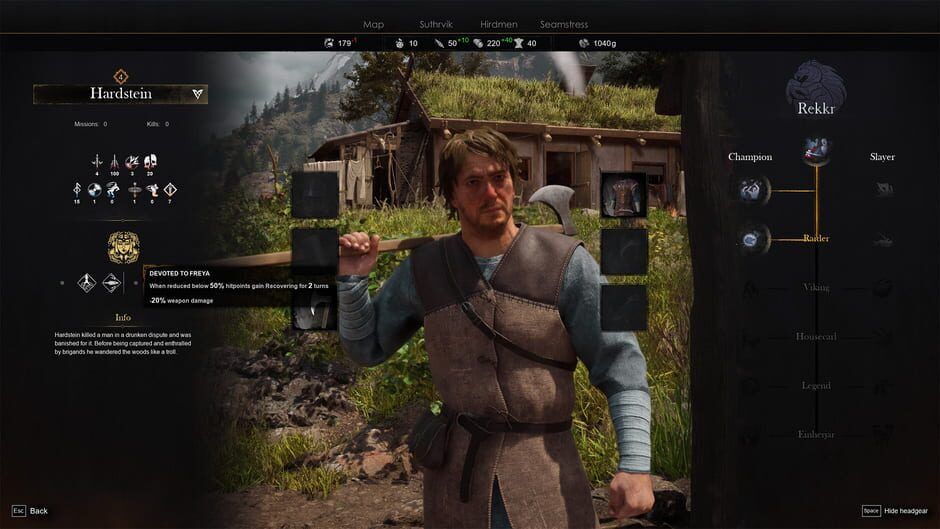
Progression in NORSE appears to be about more than just leveling up Gunnar and his inner circle. The dev diary highlights multiple layers of growth that all feed into the sense of rebuilding from ruin.
Settlement rebuilding
Gunnar starts the campaign from a place of weakness. The family stronghold is broken, the clan scattered, and nearby powers smell blood.
You will:
- Restore and expand your settlement, building structures that support your war effort and civilian life.
- Balance martial improvements like training grounds and armories with economic or social buildings that keep your people alive and loyal.
- Use the settlement as a narrative hub where story scenes play out, allies arrive, and tough decisions get made.
This pushes NORSE toward the “campaign layer + tactics layer” structure popularized by XCOM and adopted by modern tactics games like Warhammer 40,000: Chaos Gate – Daemonhunters and Darkest Dungeon 2.
Warband development
Alongside your budding settlement, you shape Gunnar’s warband:
- Characters can be recruited, equipped, and trained, with loadouts that emphasize different roles on the grid.
- Wounds, attrition, and resource scarcity likely mean you cannot field a perfect squad every time.
Tying warband progression to your choices about who to support, which clans to align with, and which conflicts to pursue could give progression a moral and political weight, not just a numerical one.
Gunnar’s personal arc
Gunnar is at the center of every system. Your decisions in the story and on the campaign map shape:
- What kind of leader he becomes
- How far he is willing to go for revenge
- Which relationships he preserves or destroys along the way
Framing character growth this way makes level-ups and skill unlocks feel like manifestations of personality and ideology, not just power spikes.
Choice-driven story that stays mostly grounded
The dev diary spends a surprising amount of time on narrative intent. Rather than being an excuse for fights, the story is meant to be the spine that holds the tactical structure together.
Key elements the team emphasizes:
- Historically grounded setting: NORSE leans into the politics, honor codes, and survival pressures of Dark Age Norway, not a mythical Asgardian fantasy.
- Consequences that ripple outward: Alliances with neighboring clans, treatment of prisoners, and decisions about raiding versus defending home turf are said to have lasting outcomes.
- Personal stakes over epic destiny: Gunnar is not destined to unite the north or save the world, at least from what we know. His struggle is about family, revenge, and the fragile future of his people.
Practically speaking, that likely translates to branching storylines, reputational changes with factions, and different end states for your settlement and warband.
If the script is as character-driven as the dev diary suggests, it might scratch a similar itch to The Banner Saga’s caravan drama and Fire Emblem’s relationship-focused storytelling, albeit without leaning on romance or high fantasy tropes.
Where NORSE could sit in the tactics-RPG landscape
The tactics space is crowded again. From XCOM-like moderns, to indie darlings, to big-budget experiments such as Marvel’s Midnight Suns, a new tactics game has to stake out clear territory.
NORSE: Oath of Blood looks like it is aiming for:
- Thematically grounded historical tactics: Closer to something like Expeditions: Viking or Battle Brothers than to tactical JRPGs.
- Small-squad, consequence-heavy play: Fewer units but higher narrative weight per character, following the model of The Banner Saga and Darkest Dungeon.
- A cinematic yet punishing tone: The motion capture and elaborate cinematics suggest a more cinematic presentation, but the subject matter and focus on revenge indicate a harsher, less forgiving journey.
If Arctic Hazard delivers a coherent package where tactics, settlement management, and story all push in the same direction, NORSE could carve out a niche between the number-crunching intensity of hardcore tactics titles and the more anime-inspired drama of series like Fire Emblem or Triangle Strategy.
What to watch before launch
With launch set for February 3, 2026, there is still plenty we do not know.
Key questions for tactics fans to track as Arctic Hazard shares more:
- Mechanical depth: How complex are the character builds and combat interactions? Is there enough variety to support multiple playthroughs?
- Difficulty tuning: Does the game lean into brutal attrition that punishes mistakes, or is it more forgiving and story-forward?
- Narrative branching: Are the major narrative decisions truly divergent, or more about flavor and tone?
- Run length and structure: Is NORSE a long-form campaign with light replay value, or a tighter experience intended to be restarted with different choices?
For now, the pitch is clear: NORSE: Oath of Blood wants to be a tactically satisfying, story-heavy Viking RPG about the cost of vengeance, not just an excuse to throw axes across a grid. If Arctic Hazard can match the weight of its combat to the weight of its decisions, this could be one of 2026’s most interesting tactics launches.