

Pac-Man, Mendel Palace, and The Tower of Druaga just hit Nintendo Switch Online. Here’s what each game offers, why Game Freak’s debut is the one you shouldn’t skip, and how valuable these drops really are for subscribers.
Nintendo has quietly dropped one of the more interesting Nintendo Switch Online NES updates in a while: three Namco-published games that hit very different notes for nostalgia hunters and curious historians. Pac-Man, Mendel Palace, and The Tower of Druaga are all available now in the base Switch Online NES library, and together they form a neat little snapshot of arcade and console design from the mid-to-late eighties.
What makes this batch stand out is that it is not just another round of familiar first-party reissues. These are third-party titles with their own legacies, and one of them is secretly one of the most important pre-Pokémon releases on the service.
The basics: what you get as a Switch Online subscriber
If you are already paying for Nintendo Switch Online, these three NES games are included at no extra cost. They live in the existing NES app alongside staples like Super Mario Bros. 3 and The Legend of Zelda, and you access them the same way: download or update the NES app, scroll to the new tiles, and launch.
The standard Switch Online subscription still sits at around the cost of a budget retail release per year, and the NES catalog is one of the main perks. It has grown from obvious classics into something closer to a curated retro channel. The addition of more obscure or historically important third-party titles like Mendel Palace is what keeps that library from feeling like the same handful of games you have already bought three times.
Because these are NES versions running under Nintendo’s official emulator, you get modern conveniences layered over vintage design. Save states make experimental maze games less punishing, the rewind feature helps you correct bad reads in tricky enemy patterns, and online play lets you effectively simulate a couch co-op session in Mendel Palace with a friend on another continent. For anyone who bounced off these games in their original forms, the Switch Online wrapper goes a long way toward making them easier to appreciate today.
Pac-Man: the recognizable comfort pick
Pac-Man on NES is the most straightforward part of this update. If you have touched a video game in the last four decades, you know the loop: clear dots from a single-screen maze while avoiding ghosts, grab power pellets to turn the tables, and chase high scores.
The NES version is not a pixel-perfect arcade port, but it captures the essence. For Switch Online users, that matters more than technical fidelity. This is the pick-up-and-play option in the trio, something you can launch for a few minutes between larger games. Rewind makes it easy to chase a personal best without starting from scratch, and save states let you preserve a strong run directly inside the NES app.
As a service offering, Pac-Man fills an important role: it is instant nostalgia. It is the game grandparents recognize and younger players understand within seconds. That kind of cross-generational hook is valuable in a subscription catalog that needs both depth and approachability.
Historically, Pac-Man is obviously massive, but in 2026 this particular NES release is not the main event. It is comfort food, not the reason enthusiasts are paying attention.
The Tower of Druaga: obscure, influential, and finally approachable
Where Pac-Man is instantly readable, The Tower of Druaga can feel opaque. Originally an arcade release in the mid eighties, its NES version brings a methodical, almost puzzle-like twist to action mazes. You guide Gilgamesh floor by floor up a tower, dealing with monsters, dodging projectiles, and hunting for hidden items that are frequently required to progress or to stand a chance against later challenges.
This is the game in the trio that benefits the most from Switch Online’s quality-of-life tools. In its original form, The Tower of Druaga was notorious for cruel secrets, many of which require highly specific actions that were only documented in magazines, word-of-mouth tips, or official hint materials. Without that meta-knowledge, it can feel punishingly unfair.
On Switch, you can brute force your way into understanding its systems. Save states let you test a floor’s layout, experiment with item conditions, and reload if a decision ruins a run. Rewind lets you correct a single fatal mistake instead of replaying several floors. Played this way, The Tower of Druaga feels less like an ancient quarter-eater and more like a strange ancestor of modern action-roguelites and dungeon crawlers.
Historically, Druaga’s influence is bigger than its name recognition. It helped shape Namco’s Babylonian Castle Saga and fed ideas into later action RPGs and dungeon crawlers across Japan. Having it in the standard Switch Online library turns it into a playable lesson in how designers were grappling with longer-form arcade adventures at the time.
For most players, though, this is the curiosity piece. It is fascinating to sample and rewarding if you are willing to treat it like a slow-burn project, but it is not the most immediately fun of the three.
Mendel Palace: Game Freak’s first game comes home
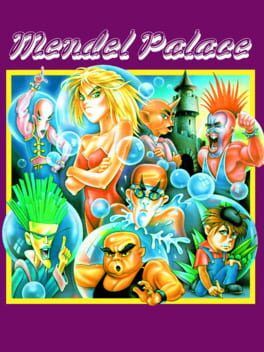
Mendel Palace is where this update jumps from nice-to-have to genuinely noteworthy. Developed by Game Freak before Pokémon existed as a concept, it predates Red and Green by years and shows a very different side of the studio’s sensibilities.
Originally released in Japan as Quinty, Mendel Palace is a tile-flipping action puzzle game built around one simple verb. You control a character on a grid of floor panels while waves of living dolls crowd the stage. Tap a tile and it flips, sending any character standing on it sliding across the floor. The goal is to fling enemies into walls or hazards before they overrun you.
The elegance comes from how much Game Freak extracts from that single interaction. Each area introduces new enemy doll types with distinct behaviors. Some charge straight at you, some mirror your movements, others lay traps or manipulate tiles themselves. Levels become pattern recognition challenges as much as tests of reflexes. Memorizing how a given enemy set responds to your flips is key to clearing later worlds.
Crucially, Mendel Palace supports two-player co-op, which transforms its tone. Solo, it is a sharp, slightly mean arcade puzzle game. With a friend, it becomes a slapstick chaos generator, full of accidental team-kills and last-second rescues. On Switch Online, you can recreate that experience locally or online, which suits a game built around short, self-contained stages.
From a historical angle, Mendel Palace is invaluable. It features early work from artist Ken Sugimori, who would go on to define the look of Pokémon. The exaggeration in enemy animations, the way characters telegraph intent, and the clear visual readability of the board all hint at a studio already thinking carefully about clarity and personality. You can see the seeds of later Nintendo handheld design here: simple controls, expressive sprites, and a focus on tight, repeatable loops.
Bringing this specific game to Switch Online does more than pad out the NES list. It fills a gap in the story of how Game Freak evolved, and it does so in a format that is easy for any subscriber to try, even if they have never heard of Quinty.
Which game matters most historically?
If you are interested in the big-picture history of games, two of the three additions stand out.
Pac-Man is the most famous property attached to this update, but its arcade form is the landmark. The NES version is a serviceable adaptation, not the definitive version scholars point to when tracing the history of character-driven arcade design.
The Tower of Druaga is arguably more significant within design circles. Its maze-like towers, hidden item requirements, and long-form progression influenced a wave of dungeon crawlers and early action RPGs in Japan. You can draw a line from this game to certain structural choices in later console epics.
Mendel Palace, though, is historically crucial within a different context. It is the commercial debut of a studio that would later reshape handheld gaming. For Pokémon historians, it is chapter one. You can observe design values that will eventually inform games that sold hundreds of millions of copies. When a subscription service makes that kind of lineage playable, it adds real curatorial value to the catalog.
Framed that way, The Tower of Druaga is the most important for understanding the evolution of dungeon-crawler structure, while Mendel Palace is the most important for understanding the evolution of one of the industry’s most influential developers.
Which one is worth revisiting today?
Modern players dipping into the NES app usually want something that still feels good without homework. In that sense, all three of these games serve different moods, but they are not equal.
Pac-Man is the timeless palette cleanser. It works in five-minute bursts, it is perfect for family hand-offs, and the NES version is close enough for casual play. If you just want a reliable arcade loop on your Home menu, this is it.
The Tower of Druaga is the hardest sell in 2026. It can be fascinating if you approach it like a historical project and do not mind consulting guides, but it is also the most hostile to new players. Switch Online’s save and rewind features soften the edges, yet the underlying design is still built for a different era.
Mendel Palace lands in the sweet spot. Its core mechanic is immediately understandable, its stages are short, and it escalates in a way that feels closer to a modern indie arcade puzzler than an early NES relic. Co-op is a genuine draw, both locally and online, and its difficulty curve is tough without being inscrutable.
If you only try one of the three, make it Mendel Palace. It stands on its own as a clever, fast-paced puzzle-action game and doubles as a playable peek into Game Freak before Pokémon. In a subscription library full of familiar comforts, it is the rare new drop that feels both historically important and genuinely fun to learn now.
Why this drop is a win for Nintendo Switch Online
Nintendo Switch Online’s retro collection increasingly lives or dies on how surprising its updates feel. First-party heavy hitters are largely accounted for, and the gaps that remain often involve licensing or rights tangles. That makes third-party partnerships crucial, and this Namco-focused drop is a quiet sign that the pipeline is still alive.
By delivering a crowd-pleaser like Pac-Man, a deep-cut curiosity like The Tower of Druaga, and a historically rich oddball like Mendel Palace, Nintendo has hit three audiences at once. Casual subscribers get something recognizable, retro fans get a notorious maze gauntlet with modern conveniences, and industry watchers get to revisit Game Freak’s origin story.
For Switch Online users, the practical advice is simple. Update your NES app, sort by recently added, and queue up Mendel Palace first. Once you have bounced dolls off tiles for a while, Pac-Man is there for quick-score chases and Druaga is waiting if you feel brave enough to climb into one of Namco’s strangest towers.
This is what the NES library should be in 2026: not just a museum of Nintendo’s back catalog, but a rotating, playable syllabus of how console and arcade design grew up.