
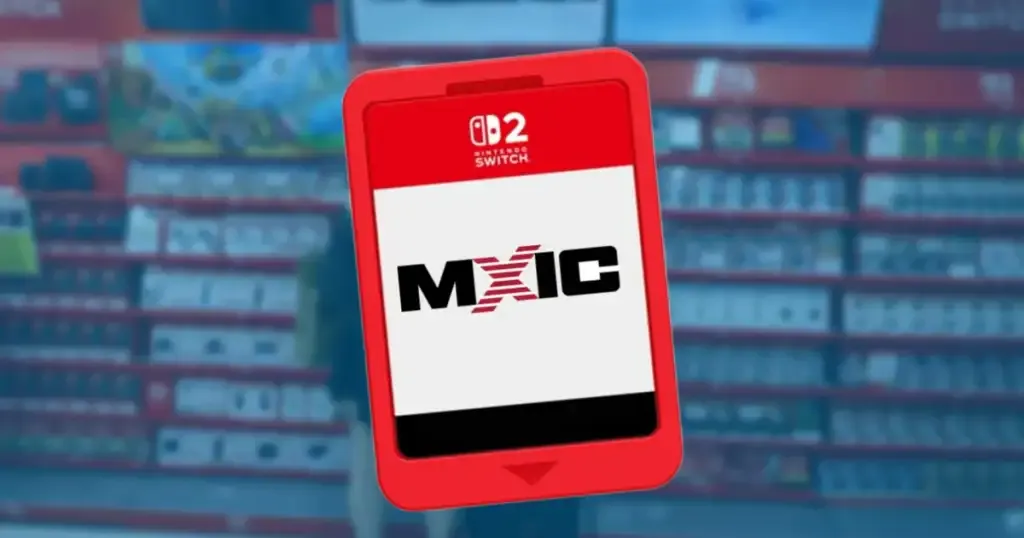

Macronix is leaving ROM manufacturing after the segment fell to 5 percent of sales, raising questions for Switch 2 physical games, Game-Key Cards, and cartridge availability.
Image: mezha.net
Macronix is leaving ROM, and Nintendo’s cartridges lose a major supplier
Macronix is moving out of ROM manufacturing, a shift that touches the small plastic heart of Nintendo’s physical business: Switch and Switch 2 game cards. Nintendo Everything describes Macronix as Nintendo’s main producer of physical cartridges, while Nintendo Life and Eurogamer call it one of Nintendo’s key or main ROM suppliers. Across those reports, the confirmed pressure point is the same: ROM chips are used in Switch and Switch 2 cartridges, and one of the companies tied to that supply chain is no longer treating ROM as a growth business.
The news comes through industry analyst David Gibson, who shared details from Macronix’s latest financial release and earnings commentary. According to the figures cited by Nintendo Everything, Nintendo Life, Eurogamer, Twisted Voxel, and IXBT Games, ROM products fell to 5 percent of Macronix’s sales in the third quarter, down from 26 percent a year earlier. Nintendo Life and Twisted Voxel add that ROM sales were down 39 percent year over year, even as Twisted Voxel notes they rose 9 percent compared with the previous quarter.
The practical tension is easy to understand, even if the outcome is not yet settled. Nintendo Switch 2 cartridges and original Switch game cards depend on specialized memory. Macronix’s chairman, according to Gibson’s summary cited by multiple outlets, said the company has limited capacity and is prioritizing NOR and eMMC memory chips instead. Twisted Voxel and IXBT Games report that none of Macronix’s planned NT$37.8 billion capital expenditure is going toward ROM production, with investment directed to eMMC and NAND. Nintendo Everything reports that Q3 is the last quarter Macronix will report ROM sales separately.
Short-term panic is not supported by the current reporting
The clearest guidance for buyers is also the least dramatic: there is no sourced claim here that Switch 2 physical games are about to vanish from shelves. Gibson, as cited by Nintendo Everything, Nintendo Life, Twisted Voxel, and IXBT Games, stressed that Macronix is not Nintendo’s only game card memory supplier. Eurogamer specifically names Rohm Co., also identified as Oki Semiconductor, as another source Nintendo uses for ROM memory.
That supplier spread matters. If a collector is wondering whether every upcoming boxed release has suddenly become a scarcity target, the available reporting does not support that conclusion. Nintendo Life frames the immediate outlook as likely “business as usual” for Nintendo, while still noting that the decision could affect cartridge production in the future. Twisted Voxel similarly reports that Gibson does not expect physical Nintendo Switch 2 game cards to disappear immediately.
The near-term risk is better understood as pressure rather than disappearance. A manufacturer leaving ROM reduces one source of capacity in a market where the remaining partners may need to absorb demand. Eurogamer’s read is that losing a key partner could put more strain on supply and potentially result in higher prices. That is an informed interpretation based on the supplier change, not a Nintendo price announcement. Nintendo has not, in the supplied material, announced a cartridge shortage, a physical software cancellation plan, or a new price structure tied to Macronix.
Game-Key Cards are the obvious pressure valve
If full Switch 2 game cards become harder or more expensive to source, the format to watch is Nintendo’s Game-Key Card. Twisted Voxel describes Game-Key Cards as physical products that contain a download key rather than the complete game data, requiring players to download the software. Eurogamer and Nintendo Life both raise the possibility that Macronix’s exit could accelerate a shift toward digital distribution and Game-Key Cards.
That distinction is crucial for players who buy physical because they care about lending, resale, preservation, or simply having a complete playable object on the shelf. A traditional cartridge can carry game data. A Game-Key Card, as described in the supplied reporting, does not contain the full game and relies on a download. For small and mid-sized releases, including the kind of sharply designed indie platformers that often find a second life in boxed collector editions, that difference changes the value proposition.
The sources do not say Nintendo or third-party publishers will replace a specific upcoming full cartridge with a Game-Key Card because of Macronix. That remains an expectation raised by analysts and outlets, not a confirmed release policy. The useful signal for buyers will be found on product pages and box labeling: whether a Switch 2 physical game is a complete game card, a Game-Key Card, or a download-only release with a box-shaped retail presence.
Digital sales are rising, but the numbers still leave room for physical games
The Macronix decision lands in a market where Nintendo digital sales are already strong. Nintendo Everything, citing Gibson, reports that digital accounted for 61.5 percent of Nintendo software sales between April and June, up from 59.3 percent the previous year. Twisted Voxel gives the same year-over-year increase as 2.2 percentage points. Nintendo Everything also notes Gibson’s reminder that Nintendo’s digital share has ranged from 46.1 percent to 67.2 percent over the past year, with major physical launches able to move the figure.
That range is the important part. A headline number above 60 percent can make a full physical retreat sound inevitable, but Nintendo’s own sales mix, as relayed through Gibson’s analysis, still swings depending on the release calendar. Big boxed games can pull the share down. Digital-heavy periods can push it up. Nintendo Life separately states that digital made up more than 60 percent of Nintendo’s total sales during Q4 2026 and Q1 2027, while the other supplied reports focus on April to June and the past-year range. Since those timeframes are not presented identically across the sources, the safest conclusion is that digital is a majority in recent reported periods, but not fixed at one stable level.
Eurogamer adds a wider industry frame, saying this could put more pressure on Nintendo, described there as one of the last companies still investing in physical media, to raise game prices further or abandon cartridges. That is Eurogamer’s analysis, not a statement from Nintendo in the supplied material. The same Eurogamer report also says Nintendo stated last month that it has no plans to ditch physical games, which cuts against any instant doomsday reading of the Macronix news.
The manufacturing shift may be bigger than Nintendo, but the evidence is uneven
Several reports point to Macronix’s own business incentives rather than a Nintendo-specific decision. The company’s ROM segment has shrunk sharply as a share of sales, and its chairman reportedly said capacity is limited. The announced investment focus is on eMMC, NAND, and NOR, categories that Macronix appears to see as better uses of manufacturing capacity than ROM.
Eurogamer connects the move to the broader memory and storage squeeze, calling it likely another side effect of global AI-driven demand. It also cites Micron’s earlier decision to exit the consumer memory business and shut down its Crucial brand as part of a wider pattern of memory companies redirecting resources. That connection is plausible industry context from Eurogamer, but the supplied source material does not include a direct Macronix statement saying AI demand caused the ROM exit.
That distinction matters because Nintendo cartridge supply is a very specific problem inside a much larger semiconductor story. The confirmed facts are that Macronix’s ROM business has declined as a share of revenue, the company is prioritizing other memory products, and no new ROM products are planned according to the reports citing Gibson. The broader claim that AI demand is the underlying driver should be treated as interpretation unless Macronix or Nintendo says so directly.
What Switch and Switch 2 buyers should watch next
For anyone buying Nintendo Switch 2 physical games, the next useful clues will come from Nintendo’s financial materials, publisher packaging choices, and retailer listings. Nintendo Life notes that Nintendo’s own financial release was due on November 5 and expects the issue could come up in the company’s usual Q&A session even if it is not addressed in prepared material. If Nintendo comments on supplier redundancy, cartridge capacity, or Game-Key Card strategy, that would be a stronger signal than analyst inference alone.
In the meantime, buyers should avoid treating every physical release as endangered. The reporting points to a medium-term supply and cost question, not an immediate end of Switch 2 game cards. For collectors, the safer habit is to read listings carefully before pre-ordering. Look for whether a boxed game includes the full game on card, requires a download, or is labeled as a Game-Key Card. That is especially important for smaller games, imports, and late physical runs, where production economics can matter as much as audience demand.
For players who simply want to play, the likely short-term result is less dramatic: physical games should continue, digital will keep growing, and more publishers may have an incentive to choose cheaper or more flexible formats if cartridge costs rise. For players who care about the craft of a complete physical release, from a tight platformer preserved on a card to a big first-party box that can be shared years later, Macronix’s exit is a supply-chain story worth watching closely. It is not, based on the current sources, proof that Nintendo cartridge supply is collapsing today.