

How the RMG-K emulator brought rollback netcode to the entire Nintendo 64 library, why it matters so much for games like Super Smash Bros. and Mario Kart 64, and what it signals for preservation-focused multiplayer in the future.
Nintendo 64 emulation just quietly hit a milestone that online retro fans have been dreaming about for years. A fork of Rosalie’s Mupen GUI, known as RMG-K, has implemented rollback netcode across the entire Nintendo 64 library for two-player online play. In practical terms, that means you can now play classics like Super Smash Bros., Mario Kart 64, GoldenEye 007, Mario Tennis, and countless others over the internet with responsiveness that finally feels close to local multiplayer.
PC Gamer and Kotaku both highlighted the update after RMG-K’s May 14 release, and the early testing clips tell the story better than any changelog. Players are reporting stable, responsive matches between regions as far apart as Spain and Australia in GoldenEye, dropping from around nine frames of input delay with traditional delay-based netcode to just four using rollback. Super Smash Bros. 64 footage shows intense 1v1 matches where movement and combo timing actually hold up under real-world internet conditions.
This is not just a small quality-of-life patch for netplay diehards. For a system whose biggest social memories revolve around four friends on a couch, bringing the entire N64 library into the modern rollback era is a huge step forward for retro multiplayer communities and game preservation.
How Rollback Netcode Works On An N64 Emulator
To understand why this matters, it helps to contrast rollback with the old model of online play that most N64 netplay setups relied on.
Traditional delay-based netcode forces the game to wait for everyone’s inputs to arrive over the network before advancing to the next frame. The worse your connection or the further apart players are, the longer the delay the game has to impose just to stay in sync. That is why online matches on older emulators could feel sluggish and mushy even when they technically ran at full speed.
Rollback turns that idea around. Instead of waiting, the game immediately simulates the next frame using predictions of what remote players will do. Locally, your inputs are processed instantly. If the real input from the other player arrives a frame or two later and does not match the prediction, the emulator rolls back to the last known good state, applies the correct inputs, then quickly re-simulates forward to catch up. Done well, the corrections are almost invisible and the game feels close to offline.
RMG-K’s developers built this on top of GekkoNet, a networking framework that abstracts much of the hard work of synchronizing game state and handling those rollbacks cleanly. According to PC Gamer’s reporting, programmer NyxTheShield described the process as “honestly not that hard” precisely because GekkoNet was designed to support this style of compensated networking. The result is a solution that applies generically across Nintendo 64 titles instead of targeting a single game.
At the moment RMG-K’s rollback implementation is focused on 1v1 play. That means you will not be recreating four-player Mario Party chaos over rollback just yet. But even two-player support already covers a huge swath of the console’s most competitive and replayable games.
Why Super Smash Bros. 64 Benefits So Much
Super Smash Bros. 64 is the obvious showcase for this tech. The modern rollback wave in fighting games was driven by the need to preserve tight control and reaction-based play over imperfect connections, and Smash 64 players have been stuck for years between two bad options. They could either play on original hardware with people physically nearby, or tolerate chunky delay-based netplay that blunts the game’s speed and execution.
With RMG-K’s rollback, those trade-offs finally start to disappear. Neutral game positioning, shield drops, tech chases, and tight combo strings all rely on sub-10-frame reactions. Online delay can turn those into guesswork. When rollback keeps your local inputs instant and lets the network do the correction work behind the scenes, match flow looks and feels like authentic Smash.
Clips circulating in the Smash 64 community show exactly that. Players are landing consistent punishes and edgeguards, even in cross-continent matches, that would be nearly impossible under the old delay-based systems. Mods like Smash Remix, which push the game even harder with new movesets and faster pacing, also stand to benefit.
For a niche competitive scene that has never had an official online release, this suddenly looks like the closest thing to a modern “rollback edition” of Smash 64 that we are likely to see for a long time.
Mario Kart 64 And The Party Game Upside
While fighting games are the headline, the same rollback upgrade quietly transforms a lot of other N64 staples. Mario Kart 64 is a perfect example.
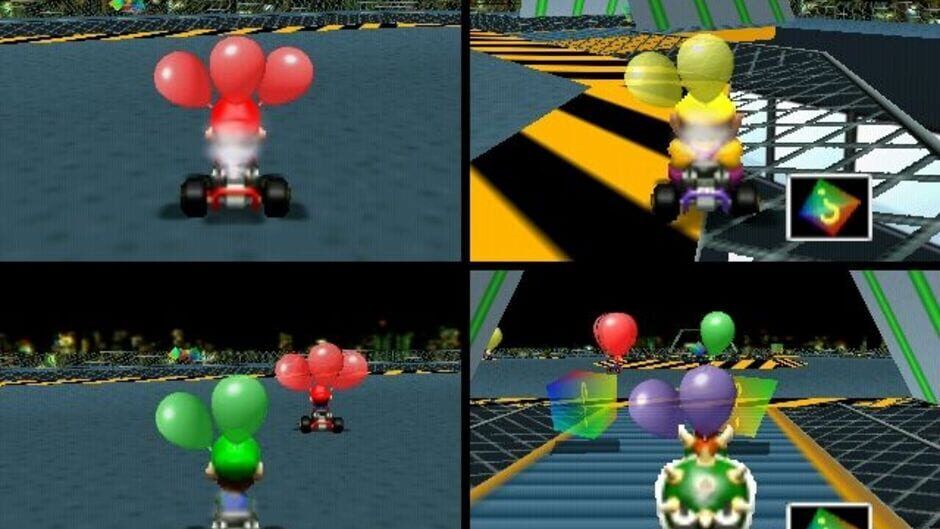
N64-era Mario Kart is built around split-second item usage and tight drift timing. Hitting a well placed green shell, dodging a red shell with a perfectly timed hop, or snatching first place with a late lightning bolt all depend on responsive controls and consistent visuals. Under heavy delay, races feel slippery and unfair, with items firing late and collisions not lining up with what players see.
By letting Mario Kart 64 run with near-instant local input, rollback makes online races feel far closer to the living-room experience players remember. Drifts snap when you expect them to, red shells connect when they visually hit, and items do not feel like they are firing half a second behind your thumb.
The same applies to other multiplayer favorites like Mario Tennis, F-Zero X, and even slower-paced games where precise timing still matters, from puzzle titles to sports games. Any two-player N64 game that relies on timing benefits from shedding the extra latency burden.
A New Template For Retro Netplay
One of the most impressive aspects of RMG-K’s rollback is its scope. This is not a game-specific fork built just for one competitive scene. It is a general-purpose N64 emulator where rollback netcode is baked into the core netplay feature set.
In practice, that means a preservation-friendly model for online multiplayer. Instead of needing custom online re-releases or invasive patches, the emulator carries the weight. As long as a game runs correctly in RMG-K, it can benefit from the improved netcode without modifying the ROM or injecting game-specific hacks.
That generality matters a lot for future-proofing. Not every N64 game will suddenly have an active online community, but having the option available across the entire library lowers the barrier for niche groups to form around obscure fighters, sports titles, or import-only curiosities. If a scene decides a forgotten game is worth exploring, the infrastructure is already there.
It also provides a reference point for other retro emulation projects. We have already seen rollback-focused solutions for individual titles like Slippi for Super Smash Bros. Melee, and newer official collections are starting to adopt rollback in curated form. RMG-K shows that, with the right architecture, this approach can scale to a full console library without requiring a bespoke solution for every game.
What It Means For Preservation-Focused Online Play
From a preservation standpoint, the most exciting part of this development is not just that old games can be played online. It is that they can be played online in a way that respects how they were meant to feel.
Latency-heavy online play subtly changes game design. Moves that are reactable offline become unreactable guesses. Movement feels heavier. Some strategies become dominant simply because they are easier to execute under network delay. In a sense, delay-based netplay creates a slightly different version of the game, tuned unconsciously around its own constraints.
Rollback narrows that gap. It gives preservation projects a way to keep the original timing and balance of a game intact even when players are separated by thousands of miles. For historians, speedrunners, and competitive communities alike, that is critical. When people boot up a preserved version of Super Smash Bros. or Mario Kart 64 twenty years from now, they should be able to experience interactions as they were designed, not as patched around the limitations of early netplay.
It also hints at a future where preservation-focused online services could operate on top of open emulators rather than relying entirely on walled-garden, time-limited official releases. If frameworks like GekkoNet and projects like RMG-K continue to mature, museums, communities, and organizers could conceivably host stable, low-latency lobbies for legacy platforms without waiting for platform holders to revisit each game.
The Road Ahead
There are real challenges ahead. The current implementation targets two-player sessions, and scaling rollback to four-player chaos in games like Mario Kart 64, Mario Party, or Diddy Kong Racing will multiply both network and synchronization complexity. Accurate emulation and good networking libraries are only part of the equation. Quality matchmaking, simple setup flows, and long-term maintenance will determine whether this becomes an everyday tool or just a cool tech demo.
There is also the reality that projects like RMG-K sit in a complicated space legally and socially. The fork itself has already sparked debate within the community over the use of AI-assisted coding tools during development, as reported by both PC Gamer and Kotaku. Regardless of where you land on that discussion, the underlying breakthrough for rollback-enabled N64 netplay is likely to influence how other emulator authors think about online features.
Even with those caveats, the direction of travel is clear. For the first time, the idea of “authentic” N64 multiplayer over the internet is not a contradiction in terms. If you are part of a Smash 64 Discord, a Mario Kart 64 league, or just a group of old friends trying to recreate a dorm-room setup from the late 90s, rollback netcode on RMG-K might be the update that finally makes it workable.
Retro preservation often focuses on boxes and screenshots and single-player campaigns. This update is a reminder that what we are really trying to preserve is how games felt when people played them together. And thanks to rollback netcode, one of the most social consoles ever made just got a lot closer to that goal.