
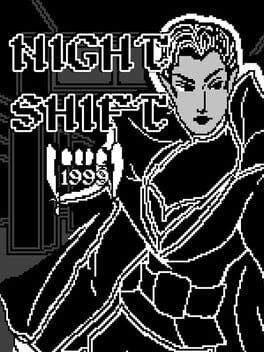

Hands-on with the Night Shift: 1999 demo, a 1-bit vampire visual novel set in 1999 Sydney, and why fans of Coffee Talk, VA-11 Hall-A, and lo-fi narrative games should keep it on their radar.
Platform: PC (Steam demo)
Genre: 1-bit visual novel / urban vampire story
Developer: Georgina de Manning
Night Shift: 1999 takes the warm, late-night conversations of games like Coffee Talk and VA-11 Hall-A, then drapes them in a 1-bit shroud and drops them into the sweaty, fluorescent hum of late-’90s Sydney. The newly released Steam demo is short but confident, giving a clear sense of how its setting, tone, and choice structure could grow into something special for fans of low-fi narrative games.
A 1999 Sydney that feels lived-in, not nostalgic
The demo keeps its perspective tightly focused on Kings Cross, Sydney at the tail end of the millennium. It is not a postcard version of the city. The writing leans into narrow streets, the sense of being a local on shift, and the mundane routines that wrap around the supernatural twist of vampirism.
Rather than loudly announcing its period setting with constant references, it quietly grounds itself through details like late-night venues, shift work mundanity, and that turn-of-the-millennium feeling where analog and digital are brushing against each other. You get the sense that this is a city and a moment in time that the game actually cares about, even though you are viewing it through the limiting filter of 1-bit art and the confined perspective of a worker on night shift.
That 1-bit style suits the world. High contrast visuals give the city a stark, almost photographic feel, while emphasizing light sources, signage, windows and reflections. It evokes the sense of walking home under street lamps after a long shift, where the rest of the world feels like it is half asleep and half unreal. It is not trying to recreate CRT scanlines or VHS fuzz so much as capture the emotional memory of the era.
A vampire story that lives in the quiet moments
Night Shift: 1999 approaches vampirism as an everyday burden more than a superpower. In the demo, supernatural elements are threaded through scenes that are about work, exhaustion, and interpersonal awkwardness. You are playing a vampire in late-’90s Sydney, but your concerns feel closer to those of a tired hospitality worker than a gothic antihero.
The tone is reflective and conversational instead of operatic. Dialogue often sits in that slightly uncomfortable space between small talk and confession, where characters are deciding how honest to be with each other. When the story acknowledges blood and hunger, it does so in a way that highlights temptation, shame, and restraint rather than spectacle. The result is a kind of grounded urban fantasy where the horror is internal and social.
This fits neatly into the lineage of Coffee Talk and VA-11 Hall-A. Those games anchored their stories in quiet nighttime jobs and made emotional labor the real mechanic. Night Shift: 1999 pushes that further into the supernatural while keeping the focus on what it feels like to be on shift, to manage your own needs against the expectations of others, and to wonder what you are sacrificing just to make it through another night.
Choice structure that nudges, not shouts
The demo shows a choice structure that is more about shading the protagonist’s inner life than steering the plot through huge branches. When dialogue options appear, they mostly define how you present yourself to others, how much you reveal about your condition, and where you sit on the spectrum between denial and indulgence.
There are glimpses of a morality or temptation system tied to vampiric hunger. You can lean into more predatory impulses, or you can try to keep your darker needs compartmentalized. The demo does not hammer you with game-over states for choosing badly. Instead, it suggests that what changes is the texture of relationships and the way future scenes will read. Fans of narrative games who enjoy subtle reactivity rather than flowchart-heavy plotting will likely appreciate this approach.
Importantly, choices feel grounded in the character’s situation. Many prompts are about tone of voice and emotional framing, like whether to deflect with humor or answer sincerely. This keeps the act of choosing in line with the game’s intimate scale. Instead of constantly deciding which faction to support or which citywide crisis to address, you are deciding how to handle a conversation with a coworker or how to manage a quietly dangerous craving.
Why Coffee Talk and VA-11 Hall-A fans should pay attention
If Coffee Talk was about the late-night calm of a café and VA-11 Hall-A about the messy neon of a cyberpunk bar, Night Shift: 1999 feels like a walk home afterward, when the streets are quieter and your thoughts are louder. It shares their love of dialogue-forward storytelling and low-fi presentation, but it trades drink mixing for a more introspective look at identity, addiction, and control.
Like those games, this demo puts a lot of its energy into mood. Music, pacing, and stillness all work together to make the simple act of talking feel important. The restricted 1-bit art style echoes the uncluttered pixel work of those earlier titles, and the late-’90s urban setting scratches a similar itch for players who like their worlds to feel grounded rather than bombastic.
At the same time, the vampire hook gives Night Shift: 1999 a distinct flavor. It lets the writer articulate complicated emotional states through a metaphor that is instantly legible. Hunger, secrecy, the fear of hurting people you care about, and the seduction of giving up and embracing your worst instincts are all present, but handled with restraint.
Where the demo leaves Night Shift: 1999
By the time the Steam demo wraps up, it has not revealed huge twists or elaborate mechanics. Instead, it has done the more important work of proving that it can sustain a specific mood and perspective. Its 1999 Sydney feels textured, its vampire protagonist feels constrained in a compelling way, and its choices feel in tune with the kind of story it is trying to tell.
For players who want loud systems and big branching flowcharts, this demo will read as quiet and perhaps modest. But for fans of Coffee Talk, VA-11 Hall-A, and other low-fi narrative experiments, Night Shift: 1999 looks poised to be another late-night game about listening to other people and interrogating your own reflection, now from behind the eyes of someone who has already crossed the line between life and death.
With the demo now on Steam, this is a good moment to check in on what Night Shift: 1999 is trying to be. If the full release manages to expand its cast, deepen its choice structure, and continue treating both Sydney and vampirism with the same grounded care shown here, it could become one of the more memorable narrative games to come out of this current wave of lo-fi, emotionally driven storytelling.