
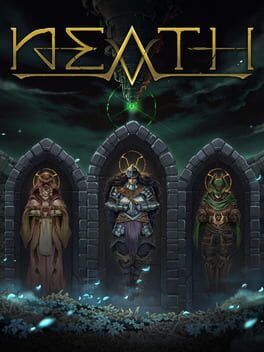

A deep look at Neath, the roguelike tactical RPG that trades Rogue Legacy’s colorful chaos for an irradiated inverted tower, shifting turn orders, and grim party survival ahead of its planned 2026 launch.
Cellar Door Games made its name with Rogue Legacy, a side-scrolling roguelite where death fueled a gleefully chaotic bloodline of new heroes. With Neath, the studio is stepping into far more unfamiliar territory. This is a tactical RPG in a dying world, built around an irradiated inverted tower that you ascend in turn-based battles, with roguelike runs and a much darker tone than anything the team has shipped before.
Where Rogue Legacy was all about buttery platforming and goofy heirs, Neath leans into anxiety, attrition, and the kind of controlled chaos you usually associate with Into the Breach or a punishing tabletop campaign. It is still clearly a Cellar Door game, just one pointed straight at players who enjoy poring over turn order, positioning and long-term party survival.
The core loop: ascend the irradiated inverted tower
Neath’s structure revolves around that inverted tower, a colossal, corrupted spire that drops away into the depths rather than rising into the sky. The world outside is dying, irradiated and twisted by the whims of a lazy god, so every expedition into the tower is both a descent into danger and an ascent toward a possible, terrible answer.
Each run begins with assembling a party and pushing into the tower’s levels, which are laid out like a grim homage to 90s dungeon crawlers. Think grid-based chambers, branching paths and ominous rooms that hint at terrible outcomes. You explore, trigger events, fight, loot and then push further, knowing that the run will eventually collapse under enemy pressure or resource drain.
Between expeditions you pull back, reassess your party and tweak your tools for the next attempt. That loop of dive, adapt and dive again sits at the heart of Neath’s design, only here your success depends less on twitch reflexes and more on your ability to read the battlefield and predict how a single action will ripple through a constantly shifting turn order.
Turn order as a weapon
Cellar Door describes Neath as a turn-based game where turns are always in flux. Instead of simply waiting your turn in a fixed sequence, you are nudging, delaying and hijacking actions on both sides of the board. Every move, ability and reaction is another lever that pushes an ally forward, drags an enemy back or reshapes who gets to act at a crucial moment.
The key idea is that you control every moment. If a powerful enemy is about to unleash a devastating attack, you might burn a limited tool to slip a defender ahead of them in the timeline, or shove that enemy into a different position so its attack resolves into empty ground. Likewise, setting up combos becomes a matter of engineering turn timing so your debuffer, crowd controller and damage dealer all act in a tight cluster before the enemy can respond.
This is where Neath’s tactical focus diverges sharply from Rogue Legacy. Instead of thinking in terms of quick jumps and dashes, you are thinking in sequences and chains, trying to see three or four turns ahead knowing that the order itself is malleable. In the best tactical RPGs, turn order is information. In Neath, it is also a resource to spend.
Engagement locking and the attack resolve system
To back up this emphasis on moment-to-moment manipulation, Neath introduces two headline mechanics: engagement locking and an attack resolve system.
Engagement locking appears to govern how units latch onto each other once they commit to a clash. When your fighter steps in to hold a monstrous foe, that enemy is not simply free to stroll past and one-shot your mage. Locking them in creates a miniature duel inside the wider battle, forcing you to weigh whether to reinforce that engagement, break it with a knockback skill or sacrifice the engager so the rest of the party can reposition.
The attack resolve system then handles how actions actually play out once they are committed. Rather than every attack resolving in a simple, predictable order, the system considers positioning, status effects and competing actions to determine what lands, what whiffs and who absorbs a blow.
This opens space for cinematic tactical moments. You might see a horrifying tower denizen wind up an attack that would obliterate a frozen ally, only to slide another character into its path and let them take the killing hit instead. You can knock an enemy just far enough that the attack they were about to land now cleaves uselessly through shadow. It evokes the push and pull of board game combat where resolving a turn is as dramatic as taking it.
Fear, sacrifice and positional play
Neath builds tension through more than just numbers. Enemies can literally freeze your party members in fear, locking them into place and turning them into liabilities on the field. Once fear sets in you are forced to get creative: push the threatening foe back a tile, use a tool to shovel an ally out of danger or stand a hardier character in their spot and absorb the blow.
This focus on positional problem solving aligns Neath more closely with games like Into the Breach than with traditional JRPGs. The grid becomes a puzzle. Every square matters because the tower’s grotesque inhabitants are trying to exploit your spacing as eagerly as you are theirs.
The tone of the encounters reinforces this. Where Rogue Legacy offset its difficulty with bright colors and jokes, Neath leans into dread. The inverted tower is irradiated, warped and indifferent, its rooms shaped by the idle whims of the god you are climbing to kill. Party members are not just hit point bars, they are fallible explorers whose terror, injuries and ultimate sacrifices feel like the price of picking a fight with a deity that barely notices you.
Building a party across roguelike runs
Despite the tactical focus, Neath is still a roguelike at its core. Runs are meant to be repeatable, unpredictable and sharply punishing, but also long-term rewarding as you learn the systems and slowly tune your approach.
You construct a party before each trek, then grow that team over time by earning new abilities and discovering relics that twist your build in unexpected ways. Relics appear to function as persistent modifiers or artifacts that grant the party new synergies. One relic might bolster engagement locks, turning any skirmish into a durable frontline, while another could double down on mobility and turn manipulation at the expense of raw durability.
Because the inverted tower is irradiated and god-touched, it is the perfect narrative excuse for procedural encounters and shifting layouts. Each climb should feel slightly different, mixing new enemy combinations, strange events and relic drops that ask you to re-evaluate your usual tactics.
If Rogue Legacy’s lineage system was about embracing failure to inch further each time, Neath’s roguelike loop looks more concerned with knowledge and composition. You learn which enemy types cause fear, what patterns usually precede a catastrophic attack and which builds can survive the tower’s nastiest floors. The next run, you go in marginally better prepared.
From Rogue Legacy to Neath: a sharp left turn
For Cellar Door Games, Neath is both an evolution and a gamble. The studio has spent years refining the feel of action-centric roguelites, so stepping into a deliberate tactical RPG is a big genre shift. Yet the through-line is clear: a fascination with replayability, clever mechanical systems and giving players tools to break out of bad situations if they are smart enough.
The shift in tone is just as striking. Rogue Legacy thrived on colorful, often comedic heirs and a castle that felt more like a cartoon deathtrap than a horror setting. Neath instead looks toward grim tabletop inspirations like Mansions of Madness and the compact, lethal battlefields of Into the Breach. It is a world of irradiated stone, flesh-twisted horrors and a god whose whims have turned the tower into a vertical graveyard.
If it works, Neath could occupy an interesting middle ground between pure puzzle tactics and more traditional narrative-driven tactical RPGs. Its focus on procedural runs, run-ending mistakes and high-stakes sacrifices should appeal to roguelike veterans who want something brainier than another action platformer, while the story of a party clawing its way toward an indifferent god might hook RPG fans who usually live in turn-based campaigns.
How Neath fits into the modern tactics landscape
Neath is arriving into a crowded tactical scene, but its pitch is distinct. Modern tactics games often fall into a few camps. There are the large-scale squad tactics titles with persistent campaigns and lengthy narrative arcs. There are puzzle-box tactics games that treat each encounter like a self-contained brainteaser with perfect information. And there are tactics hybrids that pull in deck-building, city management or other meta layers.
Neath slots closest to the puzzle-box side while layering on top a structure of roguelike runs and dark RPG progression. The shifting turn order, engagement locking and attack resolve system seem designed to generate situations where you are solving a mini tactical riddle every couple of turns. Do you burn your limited tools to save a party member and preserve the build, or sacrifice them to preserve the timeline and keep your other heroes alive?
Compared to Into the Breach, Neath looks more sprawling, with a heavier emphasis on character builds and long-term party development. Compared to tactical dungeon crawlers like Darkest Dungeon, its timeline manipulation and board game inspired rules might produce more granular, deterministic outcomes even when the setting is just as oppressive.
That mix meshes neatly with Cellar Door’s history. Rogue Legacy’s best moments emerged when you combined the right heir traits, gear and run knowledge to tear through a castle that had once terrified you. Neath aims for that same feeling of mastery but asks you to earn it through strategic foresight instead of platforming skill.
Looking ahead to the 2026 climb
Neath is currently targeting a 2026 release, with a Steam page outlining it as a single player roguelike tactical RPG where you ascend the inverted tower, kill an indolent god and control every moment along the way. That gives Cellar Door Games time to refine the crunchy new systems it is experimenting with and to make sure the tower’s floors feel as varied and threatening as its premise suggests.
For now, Neath is a fascinating pivot for a studio previously defined by agile action. If the engagement locking, attack resolve system and fear mechanics come together, the result could be one of the most distinct tactical RPGs in the next few years. Players hungry for a darker, more methodical twist on Cellar Door’s roguelike sensibilities should keep a close eye on the base of that inverted tower as 2026 approaches.