
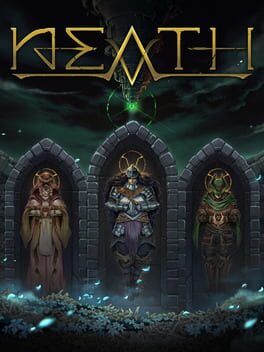

How Rogue Legacy studio Cellar Door Games is twisting the classic roguelike and modern tactics formula with Neath’s irradiated inverted tower, fate manipulation, and mind‑breaking turn control.
Neath is the kind of pivot that feels obvious only after someone else makes it. Cellar Door Games, best known for the kinetic platforming chaos of Rogue Legacy, is now building a slow-burn, anxiety-soaked roguelike tactical RPG. Instead of bouncing through colorful castles, you are guiding frail souls through a decaying world overshadowed by an irradiated, upside-down tower, praying the god at its apex does not notice you long enough to survive another floor.
The pitch is as clean as it is strange: ascend an inverted tower, manage a fragile party, and manipulate not just your allies’ turns but the enemy’s too. Every run is a climb toward an indolent god, with the world’s rules warping beneath your feet.
An inverted tower that rewrites the rules of a run
Most roguelikes lean on downward motion. You descend into dungeons, go deeper into the pit, always moving toward the center of the world. Neath flips that mental model with its colossal inverted tower hanging over a dying landscape. You climb up through something that looks like a dungeon but behaves more like a god’s mood swing.
Cellar Door frames the tower as a kind of living edict. Its “Taboos” are god-given rules that change how reality functions during a run. These can twist simple tactical expectations: perhaps critical hits are forbidden, or healing comes with a curse, or ranged attacks trigger retaliatory effects. Because the tower is inverted, that sense of disorientation is the point. You are not just clearing floors; you are moving through layers of divine whim, where each ascent feels like a new set of house rules imposed by an uncaring deity.
Structurally, Neath is a traditional roguelike: runs are self-contained, each trip up producing new layouts, encounters, and loot. Death sends you back to the settlement of Shale with knowledge, upgrades, and scars. But the inverted tower framing and the Taboos system add a narrative reason for that run-based volatility. The world is not stable because the god at the top refuses to keep its commandments straight.
This makes the tower feel more like a character than a backdrop. A floor is not just a different tileset; it is an argument the god is having with itself, expressed as mechanical rules that you must navigate.
Fluid turn order and “moment” control
At the heart of Neath is a combat system that is less about fixed initiative and more about juggling a living timeline. Instead of a strict alternating sequence of turns, actions constantly reshape the order in which units act. Cellar Door describes this as a fluid turn system where every “moment” is something you can manipulate.
You are never just moving units and swinging weapons. You are editing the queue of events. Shoving an enemy back in the initiative track, yanking an ally forward, forcing a monster to act now instead of later: these are as important as raw damage. In practice, it pulls Neath closer to Into the Breach than XCOM. You play scenarios several steps ahead, trying to ensure the board state three turns from now does not kill you.
The twist is that you are not only controlling your team. Many abilities directly dictate what enemies will do on their turns. You might compel a cultist to waste their action fleeing, or force a monstrosity to swing early at empty air, burning its big attack before your party wanders into range. It turns the enemy phase into another puzzle instead of a passive punishment window.
This interwoven control makes the combat feel like managing a shared timeline rather than opposing turns. You are less a commander shouting orders and more a manipulator of fate, rearranging the script as it is being written.
Fear, engagement, and fragile parties
Cellar Door repeatedly emphasizes how fragile your characters are. This is not a tactics game about armored walls slowly grinding through cover. Instead, fear, panic, and mental breakage sit at the core of the design.
One of Neath’s signature systems is “engagement locking.” When a character is targeted or threatened by an enemy, they become locked in fear. Mechanically, this means they are bound to that enemy’s presence or intent. To free them, you must disrupt the threat: shove the monster away, stun it, pull your ally out of line of fire, or intervene in the turn order before the attack lands.
The result is that positioning is not just about line of sight, it is about emotional entanglement. A cheap chip shot from a cultist might not kill your hero, but the psychological lock that follows can strand them in a disastrous position. Every enemy action becomes a source of cascading risk as more party members get snagged in overlapping engagements.
Compared to classic roguelikes where survivability is mostly about your own stats and gear, Neath forces you to monitor your party’s collective mental state. There is a little of Lovecraft’s dread here, but focused through tactical systems instead of a simple sanity meter. You are constantly asking which teammate’s mind you can afford to let crack.
Fate’s Die and the art of rigging the run
By leaning on fate as a theme, Neath extends its control fantasy beyond turn bars. One of the standout ideas is Fate’s Die, a mechanic that lets you meddle with chance events across the run.
Trapped chests can be nudged into misfiring in your favor, gods can be bargained with when the odds look bleak, and branching events echo old-school dungeon crawlers from the 90s. But Fate’s Die is not a simple “more luck” tool. Each use is a negotiation: push your luck to make a loot roll kinder and you might be inviting a more vindictive Taboo next floor, or a future encounter that appears precisely when you least want it.
This is where Neath distances itself from modern roguelites that often smooth away randomness in service of a cleaner power curve. Cellar Door is embracing the cruelty. Fate is something you grab and twist, but every twist has a price, and the game makes sure you feel the weight of having tampered with it.
Between climbs: Shale and long-term progression
Outside the tower, the settlement of Shale anchors your progress. After each failed or successful run, you return to this hub to lick your wounds and invest in the future. You assign serfs, improve facilities, and generally shape how the next ascent will play.
This is the layer where Neath looks closest to Rogue Legacy, in spirit if not mechanics. Shale provides meta-progression via infrastructure rather than bloodlines. Upgraded structures can unlock new character classes, expand your pool of abilities, or twist the starting conditions of a run. Since party members are fragile and expendable, the town becomes the true continuity of a campaign. It remembers every god you angered and every Taboo you broke.
For fans of classic roguelikes, this might feel like a concession to modernity. But by tying upgrades to a grim, serf-driven economy in a world ruled by capricious deities, it keeps the tone consistent. Progress never feels clean. You are squeezing power out of a bleak world, not building a cheerful base.
How Neath stands apart from classic roguelikes
On paper, Neath shares plenty with traditional roguelikes: procedural runs, permadeath, harsh consequences, and systems heavy enough to reward obsessive study. But it diverges in a few key ways.
First, the focus is explicitly on tactical party combat rather than single-character dungeon crawling. Classic roguelikes like NetHack or ADOM are essentially one-hero survival stories. Neath is about maintaining a tiny, brittle squad under constant mental assault, which brings positioning, synergies, and cross-character rescues to the forefront.
Second, the fluid turn system is a major departure from the grid-and-tick approach that defines so many roguelike ancestors. You are not just spending action points on a static grid; you are acting on an evolving timeline you can tamper with. That makes abilities which alter turn order feel as important as swords and spells.
Third, fate manipulation is foregrounded as both tool and narrative motif. Where older roguelikes often treat randomness as a background process, Neath takes that RNG and hands you handles to pull on it directly. Every time you throw Fate’s Die or haggle with a god, you are explicitly engaging with luck as a resource.
Finally, Neath leans hard into atmospheric, authored flavor while retaining systemic depth. Classic roguelikes are dense and evocative, but often abstract and text-driven. Neath wraps its systems in detailed art, animation, and voice that bring the irradiated inverted tower and its pantheon to life without sacrificing complexity.
How it diverges from modern tactics games
Modern tactics games often drift toward power fantasy. XCOM, Fire Emblem, and their peers can be brutal, but they steadily hand you heroes who stack reliable tools on top of reliable tools. Neath, in contrast, is built to keep you uncomfortable.
For starters, there is almost no guarantee of permanence. Units are fragile, runs are finite, and the tower’s Taboos constantly eat away at your established habits. You cannot lean on one overpowered build for long; the god at the top is deliberately rewriting your rulebook between ascents.
The emphasis on enemy control is also unusual. Many tactics games give you limited crowd control to blunt incoming damage, but they rarely let you script enemy behavior so directly. Neath’s design treats the enemy turn as just another lever you pull, which shifts the skill ceiling toward reading and rewriting the entire combat timeline.
Then there is the roguelike structure itself. While some tactics games borrow roguelite elements, they often simplify meta-progression or runs to stay approachable. Neath looks more committed. Failures are expected, even encouraged, and Shale’s upgrades are there to deepen your relationship with the game’s systems, not to sand off every edge.
Tonally, Neath is also darker than most tactics titles. Panic and psychological damage feel as important as hit points. You are not training a squad of superstar soldiers; you are shepherding doomed pilgrims through the shadow of a god that does not care if they live.
A new direction for Cellar Door Games
For a studio whose reputation rests on crisp, immediate action, Neath is a significant left turn. It trades tight platforming loops for meticulous, turn-based puzzles, and replaces Rogue Legacy’s tongue-in-cheek humor with cosmic dread and religious horror.
Yet you can still see the Rogue Legacy DNA. The run-based structure, the bold mechanical hooks, the willingness to mix difficulty with experimentation: all of it carries over. The biggest change is how that design sensibility is now being used to interrogate control, fear, and fate instead of lineage and loot.
If Cellar Door sticks the landing, Neath could bridge a gap that has existed for a long time. Classic roguelike fans may find a tactics game that truly respects their love of unforgiving systems, while tactics fans may get a roguelike where every decision feels like it is rewriting a living world’s rules, not just numbers on a character sheet.
For now, what is clear is that ascending an irradiated, inverted tower under the gaze of a fickle god is a compelling stage for this team’s next experiment. PRAISE NEATH, as the in-game cultists say. Just do not expect the god listening to offer mercy.