
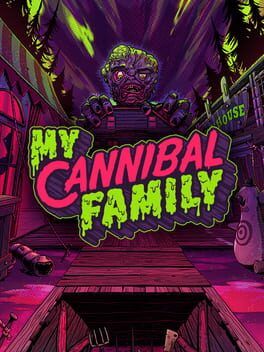

How Wolf & Wood’s My Cannibal Family twists cozy management-sim comforts into a darkly funny monster horror sandbox, where park design, resource management, and revenge all feed the family.
A Management Sim About Feeding The Family
My Cannibal Family takes a genre usually associated with cozy spreadsheets and charming mascots and points it straight at the meat grinder. Developed by Wolf & Wood and published by Raw Fury, it is a “monster horror sim” where you build and manage a remote theme park not to delight your guests, but to eat them.
You play as a vengeful creature left for dead by a mob crew. The park is bait, the visitors are livestock, and the long-term goal is to track down the criminals who wronged you. It sounds like an edgy joke, yet the reveal at Future Games Show highlighted a surprisingly structured, systems-driven management game that wraps its nastiness in campy slasher movie energy.
Designing A Horror Theme Park Where Throughput Means Dinner
At its core, My Cannibal Family riffs on RollerCoaster Tycoon and Planet Coaster, but trades safety ratings and customer satisfaction surveys for body counts and patrol routes. The park you build must still function as a believable tourist trap. You place ticket booths, queue lines, rides and attractions, food stands, and decorations so that visitors actually want to come in and stay long enough to spend money.
The twist is that every chokepoint, blind corner, and scenic overlook doubles as an opportunity for ambush. The modular building tools let you stack walkways, hide crawlspaces, and layer underground sections beneath your park. A cozy haunted house façade can mask a maze of vents and tunnels you use to stalk victims. Staff-only corridors become escape routes or hunting lanes. Even classic theme park props like animatronics and fog machines are recontextualized as cover for late night slaughter.
The game is structured around six unlockable parks, each with its own layout and theme. Progressing through them is not just a cosmetic reward. New parks introduce different traffic flows, sight lines, and environmental hazards, which in turn change how you plan your traps. A wide-open fairground favors big crowd-control devices, while a cramped, vertical park might reward stealthier, one-by-one takedowns.
Dark Humor On The Edge Of Bad Taste
Making a cannibalism-driven sim palatable is a tonal tightrope. Wolf & Wood leans into grotesque, over-the-top monster horror that sits closer to Evil Dead than grim survival horror. The family you are building is a crew of cartoonishly monstrous relatives, and the language around victims is so heightened it feels more like a late-night horror host than a true crime podcast.
The marketing leans on camp. Trailers revel in splashes of neon lighting, exaggerated splatter, and dopey tourists stumbling past obviously cursed attractions. Even the idea of categorizing your harvest as “FLESH” or “FAMILY” pushes things into absurdist territory. FLESH is pure resource, something to grind into upgrades and currency. FAMILY turns chosen victims into new monstrous relatives who can help you run and defend the park.
The key to the dark humor is how mundane management chores rub up against this nastiness. One moment you are worrying about queue length and attraction density, the next you are laughing at patch notes that buffed a guillotine ride’s “customer conversion rate.” The joke is not just that you are a monster. It is that the language of business optimization maps uncomfortably well to turning people into resources.
Resources: FLESH, FAMILY, And Infrastructure
Under the lurid premise sits a recognizable management backbone. Visitors feed a cash economy that keeps your park growing. Attractions have income-per-minute profiles. Decorations and amenities affect how long tourists stay and which areas they gravitate toward. Keeping the place just safe and entertaining enough to avoid scaring everyone away becomes its own balancing act.
Layered on top of that is an explicit resource conversion loop. Guests you manage to harvest split into FLESH or FAMILY. FLESH functions as a kind of organic mineral. You spend it to unlock deadlier traps, reinforce your lair, or mutate your own abilities. FAMILY is slower to accumulate and more valuable in the long term, since every new relative becomes both a character and a tool.
Family members can handle mundane tasks such as manning stalls, repairing attractions, or patrolling vulnerable angles. They also become active participants during attacks. A hulking uncle might specialize in close-range grapples, while a more agile cousin scuttles along ceilings to cut off fleeing targets. As your clan grows, resource management shifts from simply feeding yourself to positioning your family effectively and giving them the tools they need.
Even outside your park, resource play continues. The surrounding region hides enemies, side missions, and bonus caches. Intel gathered through radio chatter can reveal high-value targets or rival gang activity. Venturing out risks your monster’s safety but can pay off with rare materials that meaningfully alter your build, adding another choice between staying home to fine-tune park throughput or striking out to secure long-term power.
A Sandbox Of Traps, Stealth, And Slasher Spectacle
While the structure is that of a management sim, moment-to-moment play often looks like a stealth action game. Nights are when the park’s wholesome mask slips. You swap from bird’s-eye planning to third-person stalking, slipping behind tourists, using shadows and noise to isolate them from the crowd.
Traps are not just passive set-and-forget devices. Creative tools let you chain attractions and hazards together, essentially scripting your own horror scenarios. You might build a rickety rollercoaster that "breaks" at a set point, dumping riders down into a hidden killbox patrolled by family members. A mirror maze might be laced with secret doors that let you dart in and out around a terrified group, picking them off while they try to find the exit.
Keeping the park operational means you cannot simply turn every corner into a death trap. Overuse of obvious hazards risks panicking guests, which kicks off AI behaviors like stampedes or mass exits. That, in turn, hits your revenue and star rating. The most efficient players will be those who think like both imagineers and slasher villains, nesting danger just out of sight and trusting level design to funnel prey exactly where it needs to be.
Co-op support for up to four players nudges the sandbox toward emergent comedy. Friends can divide roles between designer, trap engineer, and field hunter, or coordinate elaborate multi-angle ambushes. Shared resources mean everyone feels the consequences when a botched attack spooks half the park into leaving early.
Indie Success Through Extremely Weird Pitches
On paper, “multiplayer cannibal theme park management sim” sounds like a dare rather than a commercially viable pitch. Yet My Cannibal Family fits neatly into a wave of indie projects built around one outrageous but cleanly expressed hook.
Instead of chasing the broadest possible audience, Wolf & Wood and Raw Fury are aiming at the players who perk up whenever they hear a genre mashup they have never seen before. The description practically markets itself. If you are the kind of player who loved the meticulous numbers in sim games but wished they had more teeth, one screenshot and a logline are enough to sell you.
Raw Fury’s involvement matters here. The publisher has a track record of elevating unusual concepts that might otherwise struggle to find visibility, from minimalist adventures to genre-blending strategy titles. By giving My Cannibal Family a polished reveal at Future Games Show, along with a slick trailer cut more like a slasher flick than a systems-heavy sim, they position a niche idea in front of a mainstream showcase audience.
This strategy mirrors how other breakout indies have punched above their weight. Games like Cult of the Lamb or Dredge translated high-concept elevator pitches into systemic depth and strong visual identity. My Cannibal Family is chasing a similar mix. It takes the familiarity of theme park builders, injects horror iconography and punchline-friendly terminology like FLESH and FAMILY, then supports it with real progression systems and co-op features.
If it delivers on that promise, it could slot neatly into the growing subgenre of “cozy but cursed” management games, sitting alongside titles that wrap genuinely solid strategy in macabre or irreverent skins.
Why This Premise Works
Part of the appeal lies in how My Cannibal Family literalizes the often-morbid math hiding under management sims. These games already treat people as moving resources plotted on heatmaps and churn rates. By stripping away the pretense and making guests explicitly into meat and labor, Wolf & Wood lets players laugh at the cold logic that underpins tycoon design.
At the same time, strong horror visuals and camp presentation keep the tone buoyant. You are not quietly committing atrocities in a realistic world. You are starring in a gaudy monster movie that knows exactly how silly it is, even as it demands careful planning and optimization.
That blend of sincere systems and outrageous premise is increasingly where indie developers shine. My Cannibal Family looks primed to join that lineage, serving up a theme park sim where customer satisfaction is less about smiles per hour and more about how efficiently you can turn a queue line into a buffet.