
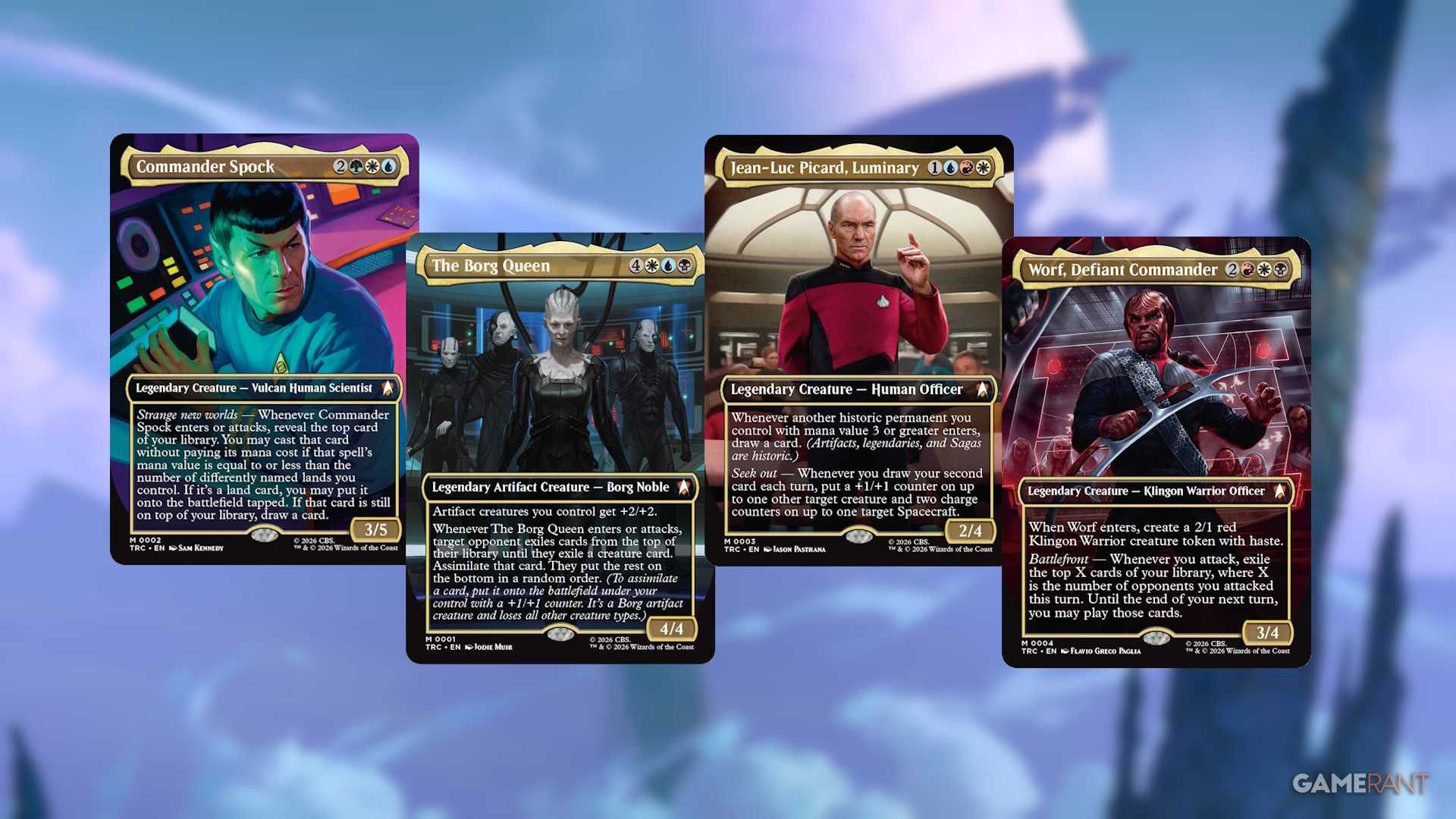

The Magic: The Gathering Star Trek crossover is splitting attention between Commander deck strength, deep franchise references, and collector-card scarcity.
Image: gamerant.com
The Borg are absorbing the early Commander conversation
Magic: The Gathering’s Star Trek release lands on November 13, 2026, with four Commander decks, Collector’s Edition versions, Play Boosters, Collector Boosters, special treatments, and signed headliner cards. Wizards of the Coast’s own Commander decklists page confirms the lineup as Federation Fleet, Landing Party, Klingon Fury, and We Are the Borg, each built as a ready-to-play 100-card Commander deck with a foil borderless face commander, tokens, a deck box, and a batch of new-to-Magic cards.
The strongest early attention is clustering around We Are the Borg. IGN ranked the Magic The Gathering Star Trek Commander decks and put We Are the Borg in the top spot, while its separate card-value coverage singled out Borg Cube’s showcase version as one of the most valuable cards it was tracking before release. That creates the central tension around this crossover: some buyers are evaluating these decks as playable Commander products, while others are chasing Star Trek Magic cards as collectible objects, special frames, foil treatments, and franchise references.
Wizards describes the four decks as spanning the Star Trek franchise, but the market attention is already narrower than that broad pitch. Borg cards have a clean identity for both Magic players and Trek fans: assimilation maps directly onto stealing or transforming creatures, the Borg Cube is instantly recognizable, and the Collector Booster chase economy gives those cards extra visibility. In strategy terms, that is a powerful demand stack. A card can be mechanically interesting, visually iconic, and financially watched at the same time.
We Are the Borg has the cleanest mechanic-to-flavor pipeline
The clearest confirmed mechanic tying theme to gameplay is assimilate. MonsterVine’s review highlights Borg Cube as a spacecraft that can use assimilate to exile a creature and return it under your control as a Borg with a +1/+1 counter. IGN’s value list also describes Borg Cube as an artifact spacecraft with affinity for artifact creatures that feeds into the assimilate mechanic.
That is why We Are the Borg is getting attention beyond normal precon ranking chatter. The mechanic reads intuitively even to a player who has not studied the full card file: the Borg take something, change it, and add it to the collective. MonsterVine specifically called the Borg Cube flavor work strong, even while criticizing other parts of the set’s flavor execution.
The deck’s draw is not only power perception. It is legibility. Commander players often upgrade precons by leaning into the clearest engine, and Borg cards give buyers an obvious path: artifacts, spacecraft, theft-style effects, +1/+1 counters, and a board state that visibly converts opposing material into your own. That does not prove the deck will dominate tables, and the provided sources do not give a full matchup or upgrade analysis. It does explain why this deck is the easiest one for players and collectors to rally around before the metagame settles.
Spock, Worf, and Picard are competing on different axes
IGN’s precon ranking places Federation Fleet last, but the details still show why the deck will have an audience. Federation Fleet is Jeskai, blue-red-white, and led by Jean-Luc Picard, Luminary. IGN describes Picard as a four-mana 2/4 that draws cards as you play historic permanents, then triggers Seek Out to charge a spacecraft and add a counter to another creature. The same article lists Alhammarret’s Archive as a notable reprint. That sounds cohesive, but IGN judged it less mechanically interesting than the other decks.
Landing Party, the Bant green-white-blue deck associated with Spock, is attracting a different kind of attention. IGN lists Ancient Greenwarden, Scute Swarm, Exploration, and Heroic Intervention among its notable reprints. Even without full secondary-market accounting in the provided sources, that reprint package points toward practical Commander value: lands, board protection, and token scaling are evergreen casual pillars.
Klingon Fury, led by Worf, Defiant Commander, has the most direct combat identity in IGN’s description. It uses Battlefront to encourage aggression, with Worf creating Klingon Warrior tokens and rewarding attacks against multiple opponents by exiling cards from the top of your library that can be played until the end of your next turn. IGN lists Sword of Light and Shadow and World at War as notable reprints. That places Klingon Fury in the familiar precon lane of pressure plus card access, a safer multiplayer plan than pure combat often gets credit for.
This is the important split for buyers: Borg has the loudest theme and early ranking momentum, Landing Party has the most obviously Commander-friendly reprint spread in the cited material, Klingon Fury offers the cleanest aggressive play pattern, and Federation Fleet may appeal most to Picard fans or players who want historic-permanent and spacecraft synergies. Those are different purchase cases, and treating the four decks as interchangeable Star Trek products misses the economic and strategic sorting already happening.
The key references are helping some cards punch above their text box
Polygon’s Star Trek reference coverage shows how deep Wizards went on episode and film callbacks. The set uses sagas to reference episodes such as The Inner Light and In the Pale Moonlight, includes famous quotes such as Live long and prosper, and reaches into stranger franchise corners.
Adversary by Algorithm connects to Star Trek: The Next Generation’s Elementary, Dear Data, where Data plays Sherlock Holmes and the holodeck creates a Moriarty capable of challenging him. Polygon also points to Humpback Whales as a reference to Star Trek IV: The Voyage Home, where the former Enterprise crew travels back to 1986 because an alien probe is communicating through whale songs. H.M.S. Bounty, Unlikely Timeship represents the stolen Klingon Bird of Prey from that film. Polygon’s discussion of Pongify links the reprint to the TNG episode Genesis, where a botched treatment causes the Enterprise crew to de-evolve.
These references matter for search behavior because they widen the buyer base. A Commander player may search for Borg Cube because it is a spacecraft with assimilate. A Trek fan may search for Humpback Whales because it evokes The Voyage Home. A collector may search for Captain Jean-Luc Picard, Captain James T. Kirk, Mr. Spock, Science Officer, or Q, Stacking the Deck because those names sit at the center of Star Trek’s cultural memory. Wizards’ own buyer’s guide says the set pulls from across the entire franchise, with Play Boosters potentially including moments from Kirk and Spock, Picard’s foes, and recent installments.
MonsterVine’s review also identifies where the reference strategy strains. The outlet praised some cards, including Borg Cube, Hull Breach, and Interstellar Effigy, but criticized uneven flavor elsewhere, citing There’s Coffee in that Nebula as a loose mechanical fit and Data New Life as awkward when the card’s combat role clashes with the character’s identity. That critique is useful for collectors: recognizability can drive searches, but flavor fit can determine which references players keep talking about after release week.
Card values are being driven by scarcity, treatments, and utility
IGN’s list of MTG Star Trek valuable cards is explicitly based on pre-release pricing, and the outlet warns that those prices will shift as TCGplayer data updates. Within that caveat, the list shows where early collector pressure is forming. IGN reported Sacred Foundry in showcase treatment at $60 at the time of writing and Borg Cube in showcase treatment at $80. Its top ten also included showcase versions of Overgrown Tomb, Q, Stacking the Deck, Breeding Pool, Dathon, His Heart Open, Captain James T. Kirk, and Captain Jean-Luc Picard, plus a surge foil Mountain and a borderless surge foil Mr. Spock, Science Officer.
Wizards’ collecting guide explains the product architecture behind those searches. The release includes seven different signed headliner cards, each physically signed by a Star Trek actor and randomly inserted into Collector Boosters. Wizards says there are fewer than 250 copies of each signed card. That is hard scarcity, and hard scarcity changes collector behavior faster than ordinary rarity does.
The LCARS shock lands add a second value lane. Wizards says there are 10 LCARS shock lands using a frame inspired by the Enterprise’s onboard computer, with non-foil and traditional foil versions appearing in Play Boosters and Collector Boosters. Surge foil versions appear only in Collector Boosters. That matters because shock lands are already high-utility Magic cards across formats, so the Star Trek frame is layered on top of existing demand rather than creating demand from scratch.
There is also a Commander deck foil economy. Wizards says Collector’s Edition Commander decks contain the same ready-to-play decks as the regular versions, but every card is in surge foil. IGN notes those Collector Editions are well over $100 each, while the regular four-deck bundle was listed at $224.97 through Amazon at the time of its article. The result is a three-lane market: regular precons for play, Collector’s Edition decks for all-foil sealed or display value, and boosters for lottery-style chase cards.
The set’s biggest risk is uneven Universes Beyond translation
The Star Trek crossover arrives during a crowded Magic year. IGN says it is the seventh Magic set of 2026 and brings the year’s Commander deck total to 17. That volume matters because Commander buyers are no longer starved for precons. A new deck has to justify itself through theme, reprints, upgrade paths, or collectible pull.
MonsterVine frames the broader issue as a Universes Beyond problem: the set can feel like a collection of characters and references without a cohesive narrative tying them together. The outlet also criticized some photorealistic art as uncanny, while praising other pieces as stunning. That unevenness is important because Star Trek is a likeness-heavy property. When the art lands, a card can become a display piece. When it misses, the same actor likeness can become a barrier for players who prefer Magic’s less photographic fantasy style.
For strategy-minded buyers, the safest approach is to separate playable value from collector heat. We Are the Borg has the strongest early attention because its mechanic, iconography, and chase-card visibility line up. Landing Party has the most clearly appealing reprint profile in the supplied deck-ranking material. Klingon Fury looks like the combat deck for players who want Worf and multiplayer pressure. Federation Fleet is likely to live or die on how much a player values Picard, historic permanents, and spacecraft sequencing.
For collectors, the searches are already clear: LCARS shock lands, signed headliners, showcase Borg Cube, showcase captains, Q, Spock, Kirk, Picard, and surge foil variants. For players, waiting may be rational if the goal is singles value, because IGN’s price list is pre-release and the outlet itself expects movement. For Star Trek fans buying a sealed keepsake, scarcity and product type matter more than deck ranking. Wizards has built this release so that the same crossover can be a Commander night purchase, a binder project, or a Collector Booster chase. That is why MTG Star Trek is producing so many different searches before the table results have even had time to settle.