
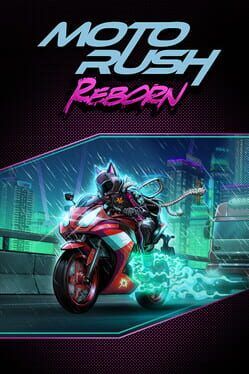

Baltoro’s Moto Rush Reborn takes the high-speed DNA of Moto Rush GT, injects it with a demon-possessed engine, and tears through Neo-Tokyo as one of 2026’s freshest old-school arcade racers on Switch, Xbox, and PC.
Moto Rush Reborn is shaping up to be the perfect kind of surprise for 2026: a loud, fluorescent arcade racer that knows exactly what it wants to be. Rather than chasing sim realism or open-world sprawl, Baltoro is doubling down on pure speed, simple inputs, and razor-focused tracks, all wrapped in a demon-fueled Neo-Tokyo fever dream.
At its core, Moto Rush Reborn is an evolution of 2019’s Moto Rush GT, a traffic-dodging bike racer that quietly passed a million copies sold. Instead of building a straightforward sequel with more of the same, Baltoro has taken the foundation of GT and rebuilt it with a sharper identity. The structure and high-speed lane-switching DNA return, but the new game shifts from a more anonymous, pick-up-and-play aesthetic to a bold, narrative-driven concept that blends manga storytelling with neon futurism.
That shift starts with the premise. Moto Rush Reborn opens not on a championship podium, but with a crash and a curse. After wiping out in a race, your rider stumbles into a junkyard and finds a demon-possessed engine. It is an upgrade in the most literal sense: the thing pulses with unnatural power, promising impossible speed and acceleration. The catch is that every race you win is also a tug-of-war for your own soul.
Instead of being a simple backdrop, that demonic hook is threaded directly into progression. Each course hides Demonic Symbols, collectibles tucked behind risky shortcuts or brutal traffic gauntlets. Grab them and you unlock hand-drawn manga panels that slowly piece together the story of the engine, Neo-Tokyo’s underbelly, and your rider’s struggle against possession. It is a clean way to reward mastery and exploration while giving old-school arcade structure a narrative drip-feed.
All of that plays out in a stylized vision of Neo-Tokyo that leans hard into color and contrast. Baltoro describes 45 handcrafted tracks scattered across the city, from power plants and collapsing tunnels to busy highway interchanges and glass-front malls that you literally blast through. This is not a procedural endless runner. Each level is sculpted to test reaction times and route knowledge, with traffic patterns, ramps, and lane layouts tuned to keep you hovering on the edge of control.
The visual shift from Moto Rush GT is just as important as the new setting. Where GT was clean and functional, Reborn throws itself into a saturated neon palette, pouring magenta and cyan across the skyline and letting headlights streak into light trails as you scream past. That retro-futurist tone finally gives the series a recognizable face in a genre that lives and dies on vibe as much as physics.
Underneath the style, the riding model is all about immediacy. You thread through dense traffic at up to 299 km/h, constantly juggling ducking, jumping, and sliding while searching for gaps. Wheelies double as both style and utility, serving as speed-boosting maneuvers that reward aggression. Ramps are not just shortcuts but risk multipliers, flinging you over gridlocked avenues or into tighter, more dangerous lanes above.
Every track is designed around three skill goals that effectively define how you approach a run. Record Time is the pure time-attack challenge that keeps speedrunners coming back, encouraging memorization of traffic waves and optimal boost windows. Zero Demolition is the old-school perfectionist mode that asks you to clear the course without a single collision, which is deceptively punishing once the game starts stacking faster vehicles and narrower lanes. Near Misses may be the most arcade-flavored of the trio, asking you to flirt with disaster by brushing past cars as closely as possible.
Taken together, these objectives give Moto Rush Reborn the kind of score-chasing backbone that defined classic cabinet racers. You might replay a stage just to finally string together a clean Zero Demolition run, then dive back in to route a path that milks Near Misses without tanking your Record Time. It is a structure that naturally breeds leaderboards, streaming challenges, and friend-group rivalries without needing elaborate progression systems.
What makes all of this particularly interesting is where Moto Rush Reborn is headed. Moto Rush GT started life as a Switch-focused title. Reborn is coming not only to Nintendo’s hybrid but also to Xbox and PC, which puts it front and center in a niche that has been surprisingly underserved across platforms. For players who grew up with hang-on cabinets, Burnout’s traffic-dodging chaos, or the lane-focused intensity of games like OutRun and Super Hang-On, there is a real gap between ultra-serious sims and sprawling open-world racers.
On Switch, Reborn feels like a natural extension of what worked for GT. It slots cleanly into the system’s pick-up-and-play ecosystem, the kind of game you can run through a couple of levels in handheld mode or grind out perfect runs on the TV. The neon Neo-Tokyo setting and manga story bits also align well with the console’s broader audience taste for stylized, characterful games rather than purely photoreal showpieces.
On Xbox and PC, the potential is arguably bigger for the broader arcade racing niche. Xbox has leaned heavily into simulation through Forza, while smaller arcade racers tend to skew either toward combat-heavy experiences or indie minimalism. Moto Rush Reborn offers something more focused, modern, and tightly authored. It is not trying to compete with massive open-world racers. Instead, it is filling the space of the short-session, pure-skill arcade game players can chase times in between bigger releases.
PC, meanwhile, could be the platform where its leaderboard and mastery focus really shine. Fast restarts, precision input, and an enthusiastic community of time-attack and score-chasing players are all baked into the ecosystem. If Baltoro leans into robust online rankings and maybe even daily or weekly challenge runs, Moto Rush Reborn could quietly become a staple in the rotation alongside other high-replayability arcade titles.
All of this loops back to why Moto Rush Reborn feels like a smart evolution of Moto Rush GT rather than a safe one. The team has kept the tight, reflex-based core that made the original resonate, but they have wrapped it in a much stronger identity. The demon engine gives the game a hook you can describe in a sentence. Neo-Tokyo gives it a visual signature. The collectible manga pages turn repetition into discovery instead of grind.
As 2026 fills up with ever larger, more complex releases, Moto Rush Reborn’s best asset might be its clarity. It is a game about going very fast between very dangerous cars in a city that looks like a synthwave album cover, all while a demon in your engine dares you to push just a little further. For fans of old-school arcade racers, that sounds less like a throwback and more like exactly the kind of focused, stylish racing fix the genre has been missing.