
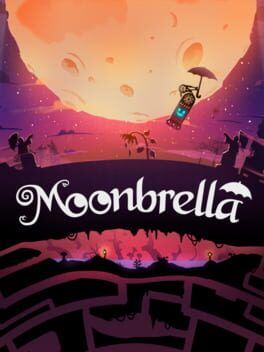

Moonbrella trades the jump button for physics-driven umbrella traversal, aiming to hook Metroidvania fans, speedrunners, and movement nerds with a fresh take on 2D exploration.
Moonbrella does something that sounds almost sacrilegious for a 2D platformer: it removes the jump button. In a genre where the feel of a simple hop can make or break the entire experience, developer Jett Williams is betting everything on an umbrella, a strange abandoned world, and a single, very specific question: what if traversal was about surfing physics rather than just timing jumps?
A Metroidvania Without A Jump Button
Moonbrella is pitched as a 2D physics-based Metroidvania in which your umbrella is your movement, not just your tool. There is no traditional jump. Instead you are constantly managing momentum, angles, and timing as you open and tilt your umbrella to glide, ricochet, float, and slingshot your way across an abandoned planet on a long climb toward the moon.
This instantly sets Moonbrella apart from the crowded Metroidvania field. Where most games mix familiar double jumps, air dashes, and wall clings, this one effectively says: what if every bit of elevation is earned by how you interact with the environment and its physics? That simple restriction gives the game a strong, memorable identity and creates the kind of mechanical hook that can carry an entire indie release if it feels good in the hands.
Physics-Driven Umbrella Traversal
The core promise is that the umbrella is not just a glide button but a physics object in its own right. The little snippets shown so far highlight characters catching updrafts, redirecting momentum off slopes, and chaining swings across gaps without ever pressing a jump key. The movement reads more like a mix of grappling hook puzzler and momentum platformer than a typical Metroidvania.
Good physics design in a game like this lives and dies on predictability. If the umbrella’s arc, acceleration, and drag are readable and consistent, players can use them like a language, expressing skill through increasingly daring routes. If it is even slightly off, frustration sets in quickly. That is why Moonbrella’s design is so bold: it puts all its eggs in the physics basket and asks you to learn its system as if it were a musical instrument.
Why This Hooks Speedrunners And Movement Nerds
A game that orbits entirely around a single nuanced movement system is a clear invitation to speedrunners. The lack of a jump button means there is far less traditional platforming noise and a lot more room for exploiting momentum, odd collision angles, and clever line choices. Every slope, ledge, and vertical shaft becomes an opportunity to discover a faster route or an unintended umbrella tech.
If the level design supports it, Moonbrella could end up in the same conversation as games like Celeste or Rain World when it comes to expressive movement. That does not mean it will look the same or feel the same, but the appeal is similar: mastering the controls is the game, not just the way you get to the next boss.
Players who obsess over movement tech, route planning, and category splits will likely watch this one closely. A no-jump physics Metroidvania almost begs for glitch-hunting, sequence breaking, and races to see who can “break” traversal the hardest while still keeping runs marathon safe.
Standing Out In A Packed Metroidvania Scene
Metroidvanias are everywhere, and many of them are good. That makes it difficult for new projects to stand out unless they have a strong aesthetic, a unique mechanical gimmick, or both. Moonbrella seems to understand this reality. It does not try to reinvent every system at once. Instead it focuses entirely on one question: how fresh can exploration feel when the only way up is to master an umbrella?
On the surface, that might sound like a small change, but in practice it rewires how the entire world must be built. Enemy placement, platform spacing, vertical shafts, backtracking routes, and secret areas all need to account for umbrella physics rather than standard jump arcs. If the design team leans into that, the end result could feel much more distinct than yet another competent but familiar Metroidvania with a double jump you have seen a hundred times.
It also helps that Moonbrella is targeting a wide range of platforms, including Nintendo Switch, PlayStation, Xbox, and PC. If the game can nail both performance and input latency, its tight, physics-heavy traversal could play just as well on handheld as it does on a high-refresh monitor, which is important for the kind of players it likely wants to attract.
Who Moonbrella Is Likely To Attract
Moonbrella is not really shaping up to be a game for people who just want to chill and mash a jump button. It is more likely to appeal to players who like to practice movement for its own sake, experiment with routes, and grind out difficult rooms until they feel seamless.
Fans of precise platformers and exploration-heavy indies are the obvious audience. If you loved learning advanced tech in something like Hollow Knight, spending time in challenge rooms just to get better at air control, Moonbrella’s umbrella-first design is likely to be compelling. Players who are drawn to games that build identity around a single tool, such as grappling hook platformers or physics puzzlers, may also find a lot to like here.
On the other hand, if you mainly come to Metroidvanias for combat depth, build variety, or story, Moonbrella is more of a wildcard. The early coverage leans heavily on traversal as the main hook, so those other pieces will need to justify the time you spend mastering its unusual controls.
What To Watch For Before Launch
As promising as the concept is, there are a few key things to keep an eye on as Moonbrella heads toward release.
The first is feel. Everything in this game flows from how the umbrella responds when you press a button or tilt a stick. Latency, acceleration curves, and collision behavior between character, umbrella, and environment will determine whether the system is satisfying to learn or just punishing. A demo or hands-on impressions will be crucial for understanding if the physics actually live up to the concept.
The second is level design variety. A no-jump structure is inherently restrictive, so the team will need to constantly remix how you use your umbrella to avoid repetition. That means creative challenges built around different environmental features, interesting secrets that reward skillful control, and enough new traversal upgrades or umbrella variations to keep discovery alive over a full Metroidvania-length campaign.
The third is difficulty tuning. A physics-heavy game like this can easily skew too hard for casual players and too forgiving for the niche that wants high-skill routing and speedrunning. Accessibility options like assist toggles, generous checkpoints, and clear conveyance of movement possibilities could let more players appreciate the core idea without diluting the depth that makes the game interesting.
Finally, Moonbrella will need to show how its combat and progression support that traversal core. A strong movement hook is a great start, but the best Metroidvanias find ways for exploration, upgrades, enemy encounters, and narrative to all reinforce each other. If your umbrella-focused toolkit grows in ways that change how you engage with fights and secrets, the mechanical fantasy of “using an umbrella to reach the moon” could feel even more cohesive.
A Promising Mechanical Experiment
On paper, Moonbrella is exactly the sort of focused, mechanically daring project that makes the indie scene exciting. It takes a crowded genre, pulls out one of its most fundamental assumptions, and rebuilds the experience around a single expressive tool. If the umbrella feels great, if the physics behave consistently, and if the level design is tuned to reward repetition and mastery, Moonbrella could carve out a devoted niche among Metroidvania fans and speedrunners alike.
If you care more about how a game feels under your fingers than how many upgrade trees it has, this is one to keep on your radar as it drifts toward release.