
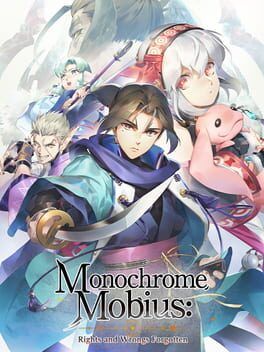
A deep-dive preview of Monochrome Mobius: Rights and Wrongs Forgotten on Switch 2, how this Utawarerumono-adjacent RPG currently plays on PS4/PS5/PC, and what its belated Nintendo debut could mean for fans and localization prospects.
Monochrome Mobius: Rights and Wrongs Forgotten is finally headed to Nintendo hardware through a newly announced Switch 2 version, giving JRPG fans a second chance to notice a game that quietly slipped past many players on PlayStation and PC.
Aquaplus originally developed Monochrome Mobius as a 20th anniversary project for the long-running Utawarerumono franchise, but it is not a traditional mainline entry. Instead it works as a standalone prequel story centered on series regular Oshtor, years before the events that visual novel and strategy RPG fans already know. For newcomers, it functions as an approachable entry point into the world, lore, and bittersweet tone Utawarerumono is famous for, without requiring any prior knowledge. For existing fans, it fills in character history and adds emotional context that re-frames familiar events.
Set in the frontier region of Ennakamuy, the story opens on a young Oshtor living a modest life with his mother and sister. His routine is shattered when a mysterious girl named Shunya appears and claims that Oshtor’s supposedly dead father is still alive somewhere beyond the known world. The journey to uncover the truth acts as both a road trip character drama and a broader look at the politics, myths, and gods that underpin the Utawarerumono setting. Compared to the heavily text-driven tactics hybrids the series is known for, Monochrome Mobius leans harder into classic Japanese RPG pacing, with long stretches of voiced story sequences punctuated by exploration, dungeon crawling, and turn-based combat.
Monochrome Mobius also serves as the franchise’s first full pivot from grid-based tactics into a more straightforward party-driven battle system. On existing platforms the game presents a three-member active party, with characters taking turns based on a visible turn timeline. Positioning is not locked to tiles and there is no movement phase. Instead combat focuses on timing, turn manipulation, and skill synergy. Many enemy attacks and abilities interact with that turn bar, pushing characters back or pulling them forward, while player skills can do the same to line up double turns or interrupt especially dangerous enemy actions.
The flow will be immediately familiar to anyone who grew up on PS2 and PS3 era JRPGs. You roam town hubs and linear fields, accept simple side quests, gear up at shops, and descend into mostly straightforward dungeons connecting story beats. On PS4, PS5, and PC, Monochrome Mobius has sometimes been criticized for its plain environments and unambitious dungeon layouts, but it compensates with extensive banter between party members, frequent cutscenes, and traditional progression systems that reward grinding just enough without becoming oppressive. Players who enjoy older Falcom or early Tales entries will likely feel at home.
Visually, the game blends 2D character portraits and UI artwork with fully 3D environments and models. Oshtor and Shunya’s designs retain the Utawarerumono house style, which emphasizes expressive eyes and clear silhouettes, while the world leans on soft color palettes and fantasy architecture rather than cutting-edge rendering tricks. On PlayStation 5, the game runs at higher resolutions and smoother performance than the PS4 version, but it still telegraphs its mid-budget origins. Texture detail is modest, animation work is serviceable, and camera work during some story scenes is functional rather than cinematic.
The PC release, handled by Shiravune, added higher resolution options and improved stability after launch patches, but many players still describe Monochrome Mobius as a charming but technically unremarkable throwback. Load times on PS4 can be noticeable when bouncing between areas, while PS5 and a well-configured PC cut those waits significantly. These realities frame expectations for the Switch 2 port. Rather than hoping for a visual overhaul, fans should expect something close to the PS5 build’s level of detail and framerate, with the main upgrade over older consoles coming from Nintendo’s newer hardware finally having the muscle to handle that target without severe compromise.
What makes the Switch 2 version interesting is not just raw power but audience fit. Until now, Utawarerumono has barely touched Nintendo platforms, leaving a sizeable chunk of JRPG-focused Switch owners with no easy on-ramp into its universe. The hybrid appeal of Nintendo’s hardware has already turned late ports into second lives for games like Dragon’s Dogma and older Final Fantasy titles. Monochrome Mobius is well placed to benefit from that same phenomenon, especially since its throwback pacing and comfort-food structure pair naturally with handheld play sessions.
Switch 2 should be able to deliver parity or near-parity with the PS5 version in terms of resolution and performance. The original release targets were not especially high, and the art direction leans on clear lines and strong colors instead of expensive visual effects, which tend to scale down gracefully. The big questions revolve around how well the port handles loading, streaming data in larger field maps, and minor UI readability tweaks for portable mode. If Aquaplus and its partners can keep frame pacing consistent while preserving the full Japanese voice track and cinematic scenes, this could become the definitive way to play for fans who prefer convenience over maximum fidelity.
For JRPG fans, the delayed arrival also intersects with an increasingly crowded genre landscape. On PS4 and PS5, Monochrome Mobius launched into a market already busy with heavyweight competitors, from big-budget turn-based revivals to niche but polished mid-tier projects. It struggled to stand out. On Switch 2, the timeline will be different. Early in a system’s life, players often have more time and curiosity for games that sit between indie and triple-A. A story-driven JRPG tied to a cult-favorite series, but marketed as a self-contained tale, could find a warmer reception than it did two years ago.
Localization is the other major unknown hanging over this announcement. The original PC version has a full English text localization and Japanese audio, and the PlayStation editions outside Japan have also been localized. However, Aquaplus has not yet confirmed whether the Switch 2 release will ship simultaneously in the West or debut in Japan first. Given that localization work already exists, the main bottlenecks are likely scheduling, QA, and publishing logistics rather than script translation. It would be surprising if a Western Switch 2 version did not appear eventually, especially with Nintendo’s audience now accustomed to a steady stream of localized niche JRPGs.
There are some fine-grain localization questions worth watching. The PC script has been generally well received, but some fans have noted occasional stiffness in phrasing and minor terminology inconsistencies compared to earlier Utawarerumono localizations. If Aquaplus revisits the script for Switch 2, this port could serve as a chance to refine terminology and improve text flow while preserving the careful character work that defines the series. Voice options are almost certain to stay Japanese only, in line with prior games, but players will be hoping for day one parity across supported languages.
From a broader industry perspective, Monochrome Mobius on Switch 2 reflects how many long-running Japanese series are using Nintendo’s hardware to reach new demographics. Trails, Atelier, and Ys all expanded their reach significantly once they arrived on Switch, even when the ports were not technically perfect. If Aquaplus can deliver a stable, feature-complete version, Monochrome Mobius could perform above expectations and encourage the studio to consider bringing both past and future Utawarerumono titles to Nintendo systems. That would be a meaningful shift for a franchise that has historically lived on PlayStation and PC.
For now, the lack of a firm release window or explicit Western confirmation leaves the Switch 2 port in a holding pattern. What is clear is that Monochrome Mobius: Rights and Wrongs Forgotten is a very particular kind of RPG, built for players who miss the cadence of PS2-era epics, who value character-driven storytelling over flashy combat systems, and who are curious about diving into the margins of a cult hit like Utawarerumono. When it finally arrives on Switch 2, it will not redefine the genre, but it could quietly become one of the platform’s more memorable comfort-food JRPGs, especially for fans meeting Oshtor and Shunya for the first time on Nintendo hardware.