

4A Games pulls Metro back into the tunnels with Metro 2039, a winter 2026 horror-focused sequel that trades Exodus’ wide-open zones for cramped metros, a new protagonist called The Stranger, and harsher survival systems.
Metro is going back underground. After Metro Exodus pushed the series toward broader, semi-open environments, 4A Games has now fully unveiled Metro 2039 as a deliberate pivot back to the series’ origin point in the suffocating tunnels of Moscow. The reveal trailer and first details paint a picture of a more focused, more oppressive Metro that wants to be the darkest chapter yet.
Metro 2039 is slated for release in winter 2026 on PS5, Xbox Series X|S and PC, with 4A once again building on its proprietary engine. The studio is promising a single player only experience that leans hard into horror, scarcity and moral pressure. Even in a short debut showing, it is clear this is meant to feel closer to 2033 and Last Light than Exodus.
The most immediate shift is the protagonist. Longtime series lead Artyom steps aside for The Stranger, a recluse whose isolation and recurring nightmares set the tone for the entire reveal. Where Artyom was a hopeful, sometimes idealistic survivor pulled into grand conflicts, The Stranger comes across as someone who has already seen too much. The trailer introduces him on the fringes of the ruins, apparently determined never to return to the Metro, before some unseen crisis forces him back into the tunnels.
That change in perspective helps sell Metro 2039 as a story about being dragged into the heart of a nightmare rather than willingly chasing a better future. The Stranger is voiced, and his weary, haunted delivery over the footage immediately grounds the game in something more intimate and personal. The Metro has always been about people clinging to life in impossible conditions. Framing that through a character who would rather stay away gives 2039 a more reluctant, almost survival horror protagonist instead of a traditional hero.
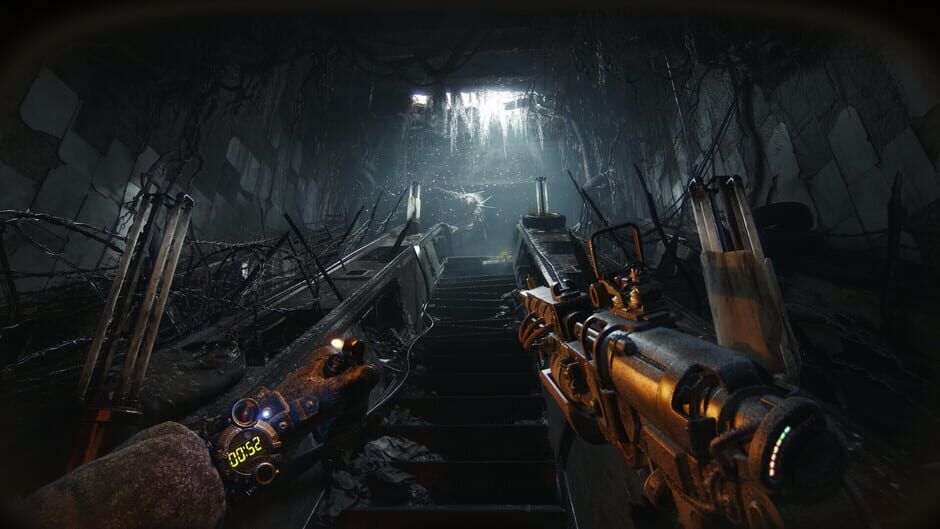
The setting itself underlines that shift. Whereas Exodus frequently pushed players to explore surface zones, open river valleys and wide outdoor hubs, Metro 2039 almost aggressively showcases choke points. The reveal footage lingers on low ceilings, dripping pipes, abandoned platforms and carriages clogged with debris. Light sources are few and unreliable. Any glimpse of the surface is cold and lifeless, a staging ground that only exists to funnel you back beneath Moscow.
4A is openly describing Metro 2039 as a return to the series’ roots, and that is visible in the way spaces are framed. The camera moves slowly through cramped corridors, tight staircases and junctions where visibility is limited to the cone of a flashlight. This is not a playground for experimenting with vehicles or sprawling side areas. It looks like a guided descent into environments that are designed to feel hostile the moment you step into them.
That tighter focus feeds directly into the tone. The new game is being billed as the bleakest Metro yet, and the reveal trailer supports that with imagery and pacing. Corpses lie frozen into place, scenes of violence are staged as static tableaus and propaganda posters cling to crumbling walls. The few survivors shown do not feel like plucky resistance fighters. They are gaunt, wary and resigned.
There is also a clear emphasis on fear of authority rather than just fear of mutants. The central human threat is described as a Fuhrer, a leader who has turned the subterranean network into a rigid, brutal regime. The reveal teases squads of armored soldiers, public executions and a populace controlled through terror and lies. It makes the underground feel less like a desperate refuge and more like a prison that stretches for miles under the city.
Combat, at least in its first glimpse, supports that oppressive mood. Firefights in the trailer are quick and ugly, with minimal HUD presence and weapons that look and sound unreliable. Rifles jam, handmade shotguns kick hard, and muzzle flashes briefly blind both the player and their targets in the darkness. Encounters feel sudden and close range, more about surviving a few chaotic seconds in a corridor than holding a position in a big arena.
Stealth remains a core pillar. There are hints of familiar Metro systems such as shooting out lights to shroud an area in darkness and using soft footsteps to slip past patrols. Enemies react loudly when alerted, and the layout of rooms suggests multiple approaches, but the confined architecture means that mistakes escalate quickly. Rather than letting players circle wide around a camp, Metro 2039 seems eager to trap them in a nervous game of inches.
Weapon customization makes a brief appearance, with glimpses of taped stocks, improvised scopes and barrels assembled from whatever the Metro can provide. Just like in earlier games, guns look assembled from scavenged parts rather than pristine military hardware. That visual language matters. It tells you that every shot is costly, every bullet is precious and every upgrade represents a long chain of desperate looting and trade.
Survival systems are clearly back at the forefront. The trailer repeatedly shows the player checking gear in low light, swapping filters and tending to equipment while the environment gnaws at their resources. There are shots of gas masks frosting from the cold and cracking under pressure, suggesting that maintaining your protection is once again a constant worry. The implication is that players will be juggling ammo, filters and med supplies in a way that recalls the tension of Metro 2033.
The Stranger’s isolation also plays into survival. Unlike Exodus, where the Aurora’s crew provided a sense of community between missions, Metro 2039’s reveal keeps the protagonist largely alone. Brief interactions at stations feel transactional and strained, not like warm homecomings. That distance reinforces the idea that you are an outsider moving through someone else’s crumbling world, never fully belonging to any faction or safe haven.
4A has said that real world catastrophes informed this new story, but their actual impact on gameplay seems to be in the way the game frames choice and consequence. The reveal leans into lingering shots of civilians catching your eye, of children hiding behind adults, of propaganda blaring in the background. It suggests that the player will once again be forced to navigate moral grey zones where there are no clean options, only different kinds of damage.
In terms of structure, all signs point to a more linear campaign that still allows for exploration within handcrafted spaces. The developers are talking about carefully composed environments that tell stories at a glance. The reveal shows rooms that could be read as frozen vignettes, each scene hinting at what happened there in the moments before disaster struck. That level of authored detail fits a game that wants to keep players on edge through constant environmental storytelling instead of sheer scale.
Technically, Metro 2039 looks like a step forward while still prioritizing atmosphere over spectacle. The lighting highlights dense dust in the air and the sickly glow of old bulbs. Snow and condensation cling to surfaces, and creature animations rely more on unsettling movement than flashy effects. By keeping the spaces tight and focused, 4A can pour more effort into making every corner look like a place where people suffered, struggled and sometimes simply disappeared.
All of this makes Metro 2039 feel like a reset for the franchise that does not abandon what Exodus added, but recontextualizes it. The surface is still there, but it no longer offers the broad breath of relief it once did. Instead, it is a cold threshold that underscores how dependent humanity has become on these underground tunnels, no matter how poisoned they are socially and politically.
As a reveal, Metro 2039 successfully reframes expectations for the series. It asks players to trade the comparative freedom of Exodus for the suffocating tension that made the first games stand out, then deepens that with a more damaged protagonist and harsher systems. If the final game can maintain the claustrophobic horror and meaningful survival choices hinted at in this first showing, Metro’s return to the Metro could be its most punishing journey yet.