
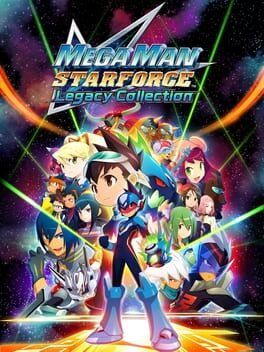

Capcom says Mega Man Star Force Legacy Collection needed more than a straight DS port, so the team used RE Engine to solve multi-platform, UI, preservation, and feature problems under tight constraints.
Image: IGDB
Store links: Mega Man Star Force: Legacy Collection on Steam
Capcom’s answer starts with a blunt admission about Star Force
Capcom’s explanation for using RE Engine on Mega Man Star Force Legacy Collection is surprisingly direct: director Akira Oda told Automaton, as translated and reported by Nintendo Everything and My Nintendo News, that a simple port would not have carried “even 10%” of what made the original Nintendo DS games work. That is the concrete development here, and it reframes the engine choice. RE Engine was not selected because Mega Man suddenly needed the technology behind Capcom’s current big-budget productions. It was selected, according to Oda, because this collection had to solve difficult design and platform problems efficiently.
Oda’s answer also identifies the pressure point. Unlike Mega Man X and Mega Man Battle Network, which he described as having high recognition and strong sales, Oda said the original Mega Man Star Force series “ended on a less-than-stellar note.” In plain terms, Capcom did not see Star Force as a case where nostalgia alone could carry a basic archive release. The collection had to re-present a lower-profile RPG subseries in a way that would make sense to players who did not grow up holding a DS sideways, watching two screens, and navigating its specific blend of card-building, relationship systems, and grid combat.
That is where the Mega Man RE Engine story becomes less strange. Nintendo Everything notes that RE Engine powers Capcom projects such as Pragmata and Resident Evil Requiem, while the RE Engine public history identifies it as Capcom’s proprietary engine created during Resident Evil 7 development and later used across the company. For Mega Man Star Force Legacy Collection, the engine is best understood as Capcom’s internal production platform, not as a promise that these DS RPGs have been rebuilt as modern 3D action games.
The engine choice is about the wrapper as much as the games
The source material points to a collection built around adaptation rather than raw emulation. The public listing summarized by Wikipedia says Mega Man Star Force Legacy Collection compiles the three Nintendo DS entries originally released between 2006 and 2008, and that the package adapts the dual-screen format for single-screen play. Players can adjust the screen layout and toggle a smoothing filter. Those details matter because Star Force’s original design was inseparable from DS hardware: one screen handled the field and interface flow, while the other supported information, touch-era presentation, and battle context.
Oda’s “drastic design changes” line should be read against those features. A legacy collection for a single-screen television, handheld, PC monitor, or modern console cannot treat the DS layout as a museum object if the goal is broad playability. It needs a screen-management layer, an input layer, presentation options, and menus that can hold extras without burying the RPG systems. RE Engine gives Capcom an in-house environment for building that surrounding structure across platforms.
That does not mean every feature is automatically caused by RE Engine. The confirmed features are the collection’s features, not proof of a particular engine module. The fair interpretation is narrower: Capcom’s own stated reason was efficiency under limited cost and time, while also designing for multi-platform release. The features publicly associated with the collection, including adjustable layouts, filters, assists, online functions, galleries, music playback, and a navigator menu, are exactly the kinds of problems a modern collection wrapper has to organize.
Star Force is a harder preservation case than a screen-capture port
Mega Man Star Force has always been closer to an RPG systems bundle than a simple action rerelease candidate. The games carry progression through battle cards, forms, exploration, character relationships, and the series’ Brother Band identity. According to the public summary, the collection keeps that social framing alive through an in-game friends list based on Brother Band, with up to 100 players per game. It also supports online card trading and ranked or casual battles, while the same listing says cross-platform play is not supported.
That combination shows the preservation challenge. For an action platformer collection, the core questions are often input latency, aspect ratio, scanline or smoothing options, saves, and museum material. For Star Force, the package also has to account for systems that originally depended on handheld-era connectivity, distribution events, and version-era community play. The collection’s listed “bonus cards” include items that were originally obtained through special means such as events and toys, and the summary says it includes crossover content based on Konami’s Boktai that had previously been cut from the English release of the first Star Force game.
Those additions are preservation work in a practical sense. They do not merely store the ROMs in a launcher. They decide what a 2026 player can access without old hardware, defunct events, toys, or regional release gaps. Oda’s comment that a straight port would fail to communicate the original fun is especially relevant here, because Star Force’s fun was tied to progression economies and availability conditions that are easy to lose when a DS-era RPG is lifted out of its original ecosystem.
Menus, filters, and assist options are part of the modernization argument
Mega Man Star Force Legacy Collection’s confirmed enhancements are not only cosmetic. The public summary lists an auto-save function, adjustable enemy encounter rates, and options to multiply Mega Man’s defense and damage output. For an RPG player, those are major pacing tools. Encounter rates change how often exploration is interrupted. Defense and damage modifiers can turn a replay into a lore run, a completion route, or a lower-friction way to sample the full trilogy. Auto-save reduces the old handheld risk of losing progress.
The smoothing filter and screen layout options sit in the same design family. A filter is usually discussed as a visual preference, but for DS games it can also affect readability on modern displays. Screen layout options decide how much space the battle view, interface, and supporting information receive when the original two-screen composition is compressed onto one display. These are preservation choices with player-facing consequences.
The menu layer also appears to be a deliberate part of the collection’s identity. The public summary says Star Force Mega Man appears as an interactive navigator character on the main menu, similar to MegaMan.EXE in Mega Man Battle Network Legacy Collection. The same listing describes an art gallery and music player, plus the ability to toggle between original soundtracks and new rearrangements of every track. In a Capcom legacy collection, the menu is where the archive, convenience features, and fan service meet. RE Engine’s role, based on Capcom’s explanation, is that it gave the team a supported internal foundation to build that structure while aiming at several platforms.
The multi-platform goal explains the conservative tradeoffs
Oda said the team had to work within limited costs and timeframes while designing for multi-platform release. My Nintendo News summarized the Automaton answer as Capcom choosing RE Engine because the team wanted to release the game on as many platforms as possible, and because the engine was versatile and efficient under those constraints. That is the business logic behind a Capcom legacy collection: the audience is fragmented across Nintendo hardware, PlayStation, Xbox, and PC, so the wrapper has to travel.
The public listing cited in the source material says Mega Man Star Force Legacy Collection released on March 27, 2026 for Nintendo Switch, PlayStation 4, PlayStation 5, Windows, Xbox One, and Xbox Series X/S. My Nintendo News, however, refers to the game as “upcoming” in its July 10 post. Those two pieces of source material conflict on status, so the safest practical reading is that readers should check their platform storefront for current availability rather than relying on a secondary article’s tense. The supplied Steam page confirms a Steam store presence for Mega Man Star Force Legacy Collection, but the excerpt provided does not include price, system requirements, review status, or release-state details.
The absence of cross-platform play, as stated in the public summary, is another useful boundary. RE Engine and a multi-platform plan do not automatically mean every online feature is unified across ecosystems. Players interested in ranked battles, casual matches, card trading, or Brother Band-style friends should treat platform choice as consequential if their friends are concentrated on one system.
A possible template for future Capcom legacy collections, but not a promise
The forward-looking part of this story is tempting: if RE Engine can support a DS RPG collection with single-screen layouts, filters, online systems, music options, galleries, voice work, and menu navigation, it could become a stronger internal template for future Capcom legacy projects. That is interpretation, not an announcement. None of the provided source material says Capcom has confirmed another Mega Man RE Engine collection or a new preservation roadmap.
Still, Oda’s explanation gives us a practical clue about Capcom’s thinking. The company looked at a series with lower recognition than X or Battle Network, decided a plain port would undersell it, and chose its current internal engine because the work needed to be efficient, supported, and multi-platform. For players who care about Capcom legacy collection quality, that is the part to watch. The engine choice is less about graphical horsepower and more about whether Capcom can keep building flexible wrappers for older games whose original hardware features, online functions, and event content no longer fit modern conditions.
For Mega Man Star Force Collection players, the immediate guidance is simple. If you want the DS originals preserved with modern convenience, the confirmed feature set addresses the major friction points: screen layout, smoothing, assists, auto-save, encounter controls, online battles and trades, bonus cards, galleries, music options, and navigator presentation. If your priority is competitive or social play, confirm where your community is buying, because the available source material says cross-platform play is absent. If your priority is historical completeness, the inclusion of previously hard-to-access bonus material and the previously cut Boktai crossover content is the strongest preservation signal in the package.