
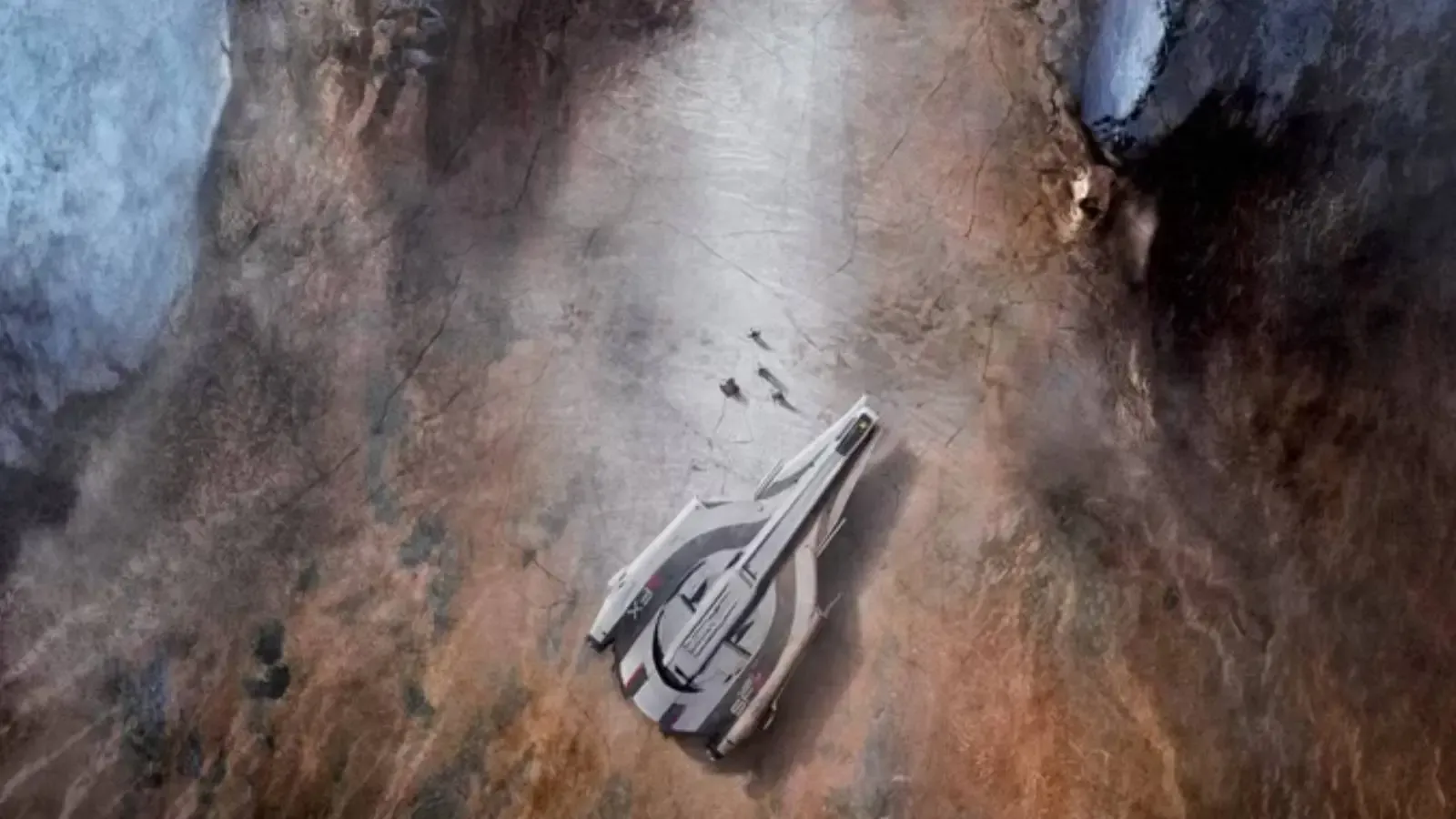

Former EA and analyst comments have revived doubts about Mass Effect 5, but no cancellation has been announced. Here is what is confirmed, what is speculation, and why BioWare's future is under scrutiny.
Image: gamingbible.com
A former EA manager has put Mass Effect 5 back in the danger zone
The strongest new development is not that Mass Effect 5 has been canceled. It has not, based on the source material available. The news is that Emmanuel Rosier, a former EA senior manager who is now director of market intelligence at Newzoo, told PC Gamer he is unsure whether EA’s new owners will keep funding BioWare’s next Mass Effect.
Rosier’s comments landed after EA’s $55 billion move to private ownership, a leveraged buyout described by IGN as backed in large part by Saudi Arabia’s Public Investment Fund, Silver Lake, and Jared Kushner’s Affinity Partners. Eurogamer’s coverage characterizes the post-buyout company in stronger Saudi ownership terms and separately reports that EA is carrying $20 billion in debt following the deal. The exact ownership framing differs across the reporting, but the pressure point is the same: a newly private EA is expected by analysts and former executives to look harder at returns, costs, and which projects deserve capital.
That is where Mass Effect 5 becomes exposed. IGN reports that the next Mass Effect has been in early development for some time with a small team and still has no release window. A beloved name with no dated launch plan is very different from a sports franchise with annualized revenue, and Rosier’s warning is best read through that business lens rather than as a leak of a cancellation decision.
What is confirmed, and what remains unannounced
The confirmed foundation is narrow but important. BioWare is owned by EA. EA has gone private in a $55 billion buyout, according to IGN. The next Mass Effect is in early development, has been handled by a small team, and has no announced release window, according to IGN’s summary of the project’s status. BioWare also faced downsizing after Dragon Age: The Veilguard, IGN reports.
There is no confirmed cancellation in the supplied reporting. There is no confirmed sale of BioWare. There is no official statement in these sources from EA or BioWare saying development has stopped, changed platforms, changed scope, or been reprioritized under the new owners.
Even the platform picture should be handled carefully. Eurogamer’s Mass Effect 5 game hub lists PC, PS5, and Xbox Series X/S, but the reporting supplied here does not include an EA announcement of final launch platforms, technical targets, pricing, editions, or release timing. For readers tracking the next Mass Effect as a purchase, that means there is nothing concrete to plan around yet beyond the fact that the project has existed in early development and remains undated in public reporting.
Rosier’s warning is analysis, not a cancellation notice
Rosier’s comments matter because of his résumé and his current job, but they still sit in the category of informed analysis. Eurogamer reports that Rosier spent nine years as a senior manager at EA and left in 2024. He now works as Newzoo’s director of market intelligence, so his comments to PC Gamer are framed around portfolio logic, funding discipline, and business risk.
Speaking about BioWare’s place inside EA’s portfolio, Rosier told PC Gamer, via Eurogamer, “They’ve been struggling as a studio, as a brand have been struggling in recent years, and I don’t know if they will keep funding that one. I think that’s the biggest question mark for me.” Asked more directly whether the next Mass Effect would survive, he said, “I will believe it when I see it, the next Mass Effect game, let’s put it that way.”
IGN’s account of the same PC Gamer interview adds Rosier’s reasoning about BioWare development cycles. He said he had worked many years with BioWare and that projects can “stretch for years and years until something comes.” He also said “everything can happen at this moment” and that new investors without attachment to EA’s historical portfolio would likely take “the most financially sound decision.”
That is not confirmation that a decision has already been made. It is a warning that the next Mass Effect now has to survive a harsher capital allocation environment, where sentiment, legacy, and brand prestige may carry less weight than expected return.
BioWare’s recent record makes the funding question sharper
The renewed doubt around BioWare’s future is not appearing in a vacuum. IGN notes that BioWare’s recent releases have struggled commercially or reputationally compared with the studio’s peak. Dragon Age: Inquisition is described by IGN as a franchise-best sales success, but Anthem underperformed, Dragon Age: The Veilguard underperformed, and Mass Effect Andromeda is widely considered a disappointment among fans. IGN also notes that Mass Effect Legendary Edition was well received, which shows the franchise still has affection and market value, even if the path to a new blockbuster entry is less proven.
From a strategy perspective, that mixed record changes the next Mass Effect from a guaranteed crown jewel into a risk asset. A single-player RPG with long development cycles has to compete internally against businesses with clearer recurring revenue. Eurogamer writes that, after the buyout and debt load, EA is expected to lean more aggressively on its biggest franchises, with EA Sports FC Ultimate Team and Apex Legends cited as examples of higher earning potential.
IGN similarly reports that analysts expect EA’s new owners to seek returns through lucrative sports franchises and Battlefield. That does not automatically crowd out Mass Effect 5, but it does raise the hurdle. The question is no longer simply whether fans want the next Mass Effect. The question is whether a new ownership group sees the project as a sufficiently strong use of money, people, and years of development time.
Former BioWare leadership has raised a similar concern
Rosier is not the only former insider asking whether BioWare still fits the company EA is becoming. Eurogamer reports that BioWare veteran Mark Darrah reacted to the buyout by warning that EA might sell studios that have struggled in recent years, have not been very profitable, have not shipped a game in a while, or make “the kind of games that this new company isn’t interested in making any more.”
Darrah’s warning is broader than Mass Effect 5, but it speaks directly to the BioWare future question. BioWare’s identity is built around expensive narrative RPGs with long production timelines. Under a public EA, that was already a difficult fit at times. Under private ownership with buyout debt and investor expectations, the fit could become more difficult if leadership prioritizes predictable, scalable revenue.
The strategic tension is clear. BioWare owns creative credibility that cannot be rebuilt quickly, and Mass Effect remains one of EA’s most recognizable non-sports brands. At the same time, credibility does not pay down debt unless it turns into shipped products and meaningful revenue. That is the gap Rosier and Darrah are pointing at.
The sale rumors are separate from the reported facts
A second layer of uncertainty comes from rumor reporting around possible studio or IP sales. GamingBible cites claims attributed to Insider Gaming’s Mike Straw, via Gamereactor and Bluesky, that EA could look to sell IPs or studios after the Saudi acquisition, with BioWare mentioned as a potential name in the discussion. ThatParkPlace also reports Straw’s claim that BioWare could be sold or shut down as part of an effort to reduce annual spending by roughly $700 million.
That layer should be treated differently from Rosier’s comments. Rosier is offering public analysis based on his former EA experience and current market intelligence role. The Straw claims are unconfirmed insider claims. ThatParkPlace explicitly notes that none of the reported plans have been officially confirmed by EA. GamingBible also tells readers to treat the rumor with heavy skepticism.
A BioWare sale, if it ever happened, would not automatically mean the end of Mass Effect. GamingBible points to examples of franchises continuing under new owners, while also noting community concern that the current industry environment is difficult for studio sales. The practical issue would be rights, funding, staffing, and development continuity. None of those details are confirmed here, which is why the sale rumor should not be collapsed into a claim that Mass Effect 5 is dead.
For fans, the honest answer is uncertainty rather than doom
Mass Effect uncertain is the accurate read because the signals point in different directions. On the positive side, the next Mass Effect has been acknowledged as being in early development, the franchise still has major name recognition, and Legendary Edition showed that the trilogy’s reputation remains commercially useful. On the negative side, the project has no release window, BioWare has recently downsized, several recent BioWare releases have underperformed according to IGN, and EA’s new ownership structure is expected to put more pressure on return-driven decisions.
Players should not treat Mass Effect 5 as imminent. The supplied sources give no date, no preorder details, no final platform confirmation from EA, no gameplay specifications, and no pricing. Anyone considering hardware purchases, subscription decisions, or backlog planning around the next Mass Effect should wait for direct communication from EA or BioWare.
The next meaningful signals would be official ones: a BioWare development update, an EA investor or company statement that names the project, staffing evidence around the Mass Effect team, or a clear reveal with platforms and a production timeline. Until then, Rosier’s “I will believe it when I see it” is not proof of cancellation, but it captures the new risk profile. Mass Effect 5 is still a known project in public reporting. Its path through the post-buyout EA economy is the part now in question.