
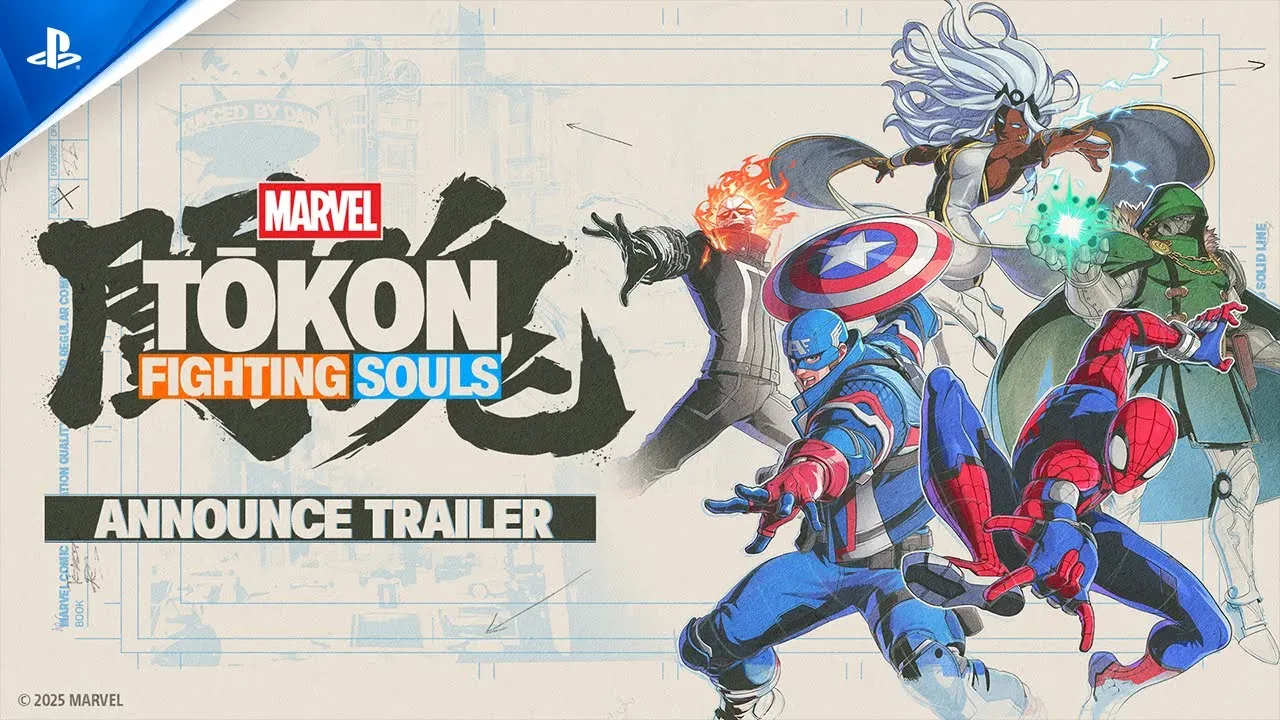

Arc System Works and Marvel Games used EVO 2026 interviews to clarify how Marvel Tokon Fighting Souls is trying to make 4v4 tag play readable, competitive, and character-driven before launch.
Image: playstation.com
EVO’s clearest message: 4v4 is the premise, readability is the fight
The most important Marvel Tokon Fighting Souls update out of EVO 2026 was not a single character reveal. It was the developers explaining how a four-character team fighter is supposed to stay legible once eight Marvel characters, assists, tags, projectiles, and stage movement are all competing for screen space.
Shacknews spoke at EVO 2026 with Arc System Works producer Takeshi Yamanaka, game director and lead battle designer Kazuto Sekine, and Marvel Games senior game producer Michael Francisco. The interview frames readability as a central priority for Marvel Tokon gameplay. Shacknews describes the current setup as teams of four, with one lead starting character and three types of assists available, a structure that can look intimidating even to players already comfortable with tag fighters.
That tension is the whole story for competitive players. Arc System Works is selling a Marvel fighting game with the scale and chaos people associate with the license, but the studio also has to make the game trainable. If players cannot parse when assists are available, when control changes hands, and when a team’s full strength comes online, the matchup chart becomes noise. Sekine told Shacknews that EVO 2025’s first playable demo drew many players, and that the EVO 2026 build, now featuring Magneto, received a warm response from even more attendees. The subtext is clear: the studio is still tuning the on-ramp in public.
The team structure is built to ramp up, not dump four kits on you at round start
The useful detail for fighting game players is that Marvel Tokon Fighting Souls does not appear to treat 4v4 as four full characters immediately operating at maximum complexity. Public descriptions of the game’s systems describe matches beginning with a single fighter and an assist character, then expanding toward a full lineup through mid-match conditions such as damage accumulation and Wall Breaks. That design, if it holds in the final release, makes the match flow closer to controlled escalation than a constant four-body scramble.
Beebom’s mechanics roundup also reports a shared life bar, staged character unlocks, and assist layers tied to an Assemble Gauge. Its controls breakdown lists Light, Medium, and Heavy attacks, a Unique Attack button for character-specific mechanics, Assemble as the assist input, and Quick Skill as a simplified special-move option. Beebom adds that motion inputs still produce stronger damage, which is a familiar compromise for modern fighters: lower execution friction for entry-level play, with reward still attached to deliberate inputs.
For competitive players, that structure changes how you should think about team building. A four-character roster slot does not necessarily mean four independent mains. If the match starts narrow and opens over time, the first layer is your point character and early assist plan. The next layer is how your team benefits when more characters become available. The final layer is how you cash out once the match has expanded and active tag options enter the decision tree.
That is different from learning a traditional 1v1 Arc System Works character, where your neutral plan, pressure resets, defensive routes, and meter usage live inside one kit. Here, the initial question is whether your lead can survive and force progress long enough for the team engine to activate. Players should be labbing starter confirms and assist-safe pressure first, then adding team routes after the basic match script is stable.
The competitive hook is controlled escalation and assist discipline
Sekine’s comments to Shacknews matter because 4v4 readability is not a cosmetic issue. It is a competitive integrity issue. In tag games, bad visibility turns defense into guessing at silhouettes. Good visibility lets players identify call timing, punishable assists, incoming threats, and the real point of interaction.
The reported Marvel Tokon structure gives Arc System Works several levers to reduce overload. Starting with fewer active team resources lowers the amount a new player has to track in the opening seconds. Unlocking more of the team during the match gives stronger players a route to higher ceiling expression. The shared life bar reported by Beebom also potentially keeps the focus on team momentum rather than four separate health management puzzles, though final balance will determine whether that creates cleaner decision-making or simply amplifies snowball rounds.
The Assemble system is the piece to watch. Beebom identifies Assemble as the assist button and ties layered assist mechanics to an Assemble Gauge. Shacknews separately describes three types of assists. Taken together, those reports point to a game where assist usage will likely define neutral and pressure far more than raw solo character strength. If assists are too safe, Tokon risks devolving into rotating coverage. If assists are too weak or too expensive, 4v4 becomes mostly branding. The sweet spot is where assist calls let you steal space, create layered offense, or stabilize bad matchups, but still give the opponent a readable answer.
That is where Arc System Works’ background becomes relevant without guaranteeing the outcome. The studio has experience building visually dense anime fighters, but Marvel team games create a different problem. Guilty Gear pressure is often fast, but the player usually reads one opponent. Tokon asks players to read the opponent’s character, their available assists, the team’s current unlock state, and the next tag threat. The EVO interview suggests the developers know this is the central challenge.
Magneto shows the roster philosophy: identity beats old muscle memory
The Magneto discussion at EVO 2026 is the sharpest example of Marvel Tokon Fighting Souls’ roster philosophy. According to Shacknews, Magneto was playable in the EVO 2026 build and drew heavy attention because of his history in competitive Marvel games. The twist is that he reportedly does not play like his Marvel vs. Capcom versions. Shacknews describes Tokon’s Magneto as a zoner with grappling options who creates balls of scrap around the stage, magnetizes enemies, and pulls them into metal bombardments.
Yamanaka told Shacknews that the team wants to create the “coolest possible version” of each Marvel character it can. IGN’s EVO interview with Sekine, Yamanaka, and Francisco centers the same point, describing Magneto as a reinvention of one of fighting games’ most iconic Marvel characters. That matters because legacy Marvel players will arrive with muscle memory and expectations. If you are waiting for tri-jump Magneto with old Marvel vs. Capcom routing, the public reports say this is not that character.
That choice is risky and healthy at the same time. Risky, because Marvel fighting game veterans have strong attachments to old archetypes. Healthy, because a new Arc System Works Marvel game cannot survive purely by imitating decades-old movement templates. Magneto as space control plus forced movement gives him a recognizable fantasy without making him a museum piece.
The same philosophy shows in the launch roster composition. Shacknews reported that EVO 2026 revealed the final launch team, the Samurai Outriders, led by Robbie Reyes’ Ghost Rider and joined by Blade, Loki, and Deadpool, with Deadpool voiced by Nolan North. Shacknews also reported that Arc System Works acknowledged the team is an odd collection, with the story mode explaining why they are together. That is a roster statement: leaders, team identities, and story framing are being used to justify combinations that may not be obvious from comic popularity alone.
Feedback has already shaped the game, but online access is still a practical concern
IGN’s EVO 2026 interview says the first beta cooled some early excitement because of issues with tag and assist mechanics, while later play tests appeared to bring some players back around. Sekine told IGN that the team has maintained the core mechanics while continuing communication with the player base, and that this exchange helped balance the developers’ intended direction with the experience players wanted. Francisco added that Marvel Games welcomes feedback and recognizes the fighting game community as one of gaming’s most hardcore audiences.
That feedback loop is good news for players who plan to compete, but it does not answer every practical question. Shacknews reported that an open beta is scheduled for July 24 through July 26 on both PC and PlayStation 5. GameSpot’s Doctor Doom character guide page lists Marvel Tokon Fighting Souls for PS5 and PC with an August 6, 2026 PT release date. Shacknews also reports the game launches August 6 on PC and PS5.
PC access has a separate complication. Rock Paper Shotgun reported that Steam backend data, as spotted through SteamDB, listed Marvel Tokon Fighting Souls as unavailable to activate or purchase in 132 countries, including entries such as Egypt, Latvia, Monaco, the Philippines, and Vatican City State. RPS notes that the Steam page mentions a PSN account requirement for online play and for accessing pre-order bonus items, while saying it was unclear from the listing whether PSN would be required simply to launch the game and play story content.
That distinction matters for anyone treating Tokon as a competitive platform. If online play requires PSN and regional availability remains restricted, the player pool is affected before balance ever enters the conversation. The Helldivers 2 comparison in RPS is a warning signal, not confirmation that Sony will handle Tokon the same way. For now, the confirmed public issue is the Steam backend restriction reported by RPS and the Steam page language about PSN for online play and pre-order items.
How serious players should approach the beta
If you are using the open beta to decide whether Marvel Tokon Fighting Souls belongs in your rotation, do not spend the first hour chasing highlight routes. The reported system is too team-dependent for day-one combo fishing to tell you much. Start by checking whether the game cleanly communicates assist availability, unlock progress, and tag state under pressure. If those states are readable while you are blocking, the game has a real competitive foundation. If they are only understandable when you are winning neutral, that is a problem.
Next, test the input compromise. Beebom reports Quick Skill as a simplified one-button special option while motion inputs deal higher damage. The important question is not whether shortcuts exist. Modern competitive games already live with that. The important question is whether the damage and routing gap gives motion inputs enough value without making basic character access feel fake. A good shortcut system helps players reach the match. It should not flatten optimal play.
Finally, pay attention to team order and role compression. Based on the publicly described team ramp, your point character needs a stable low-resource plan. Your assists need jobs, not vibes. Magneto’s reported Tokon design, for example, sounds like a control piece who may define where the opponent is allowed to stand, rather than a legacy rushdown engine. Doctor Doom’s official GameSpot-hosted character guide describes Nullify Shield as a way to block projectiles and turn enemy firepower against them, which points toward anti-zoning and counter-projectile utility. Those are the kinds of functional roles that matter in a 4v4 team game.
Marvel Tokon Fighting Souls is coming into a genre where players will forgive complexity if the rules are consistent and the screen tells the truth. The EVO 2026 interviews suggest Arc System Works and Marvel Games understand the assignment. The beta will show whether the match itself explains those rules at tournament speed.