
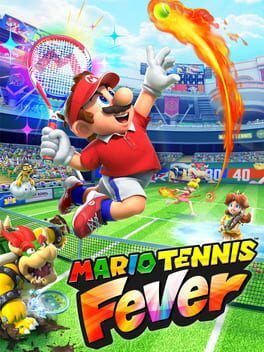

Mario Tennis Fever 1.1.0 is live on Switch 2 with Galaxy Court, GameShare via GameChat, the Black Hole Racket, Luma colors, Mario's classic outfit, and balance changes. Here is what the patch changes for current players.
Image: IGDB
Mario Tennis Fever 1.1.0 is live, and it changes the player pool as much as the court
Nintendo has released Mario Tennis Fever update 1.1.0 for Nintendo Switch 2, a free patch dated July 15, 2026 in the patch notes republished by Nintendo Life, Nintendo Everything, My Nintendo News, and Vooks. The headline addition is Super Mario Galaxy content, led by Galaxy Court, but the more immediate shift for active players may be social: the update adds GameShare and Play via GameChat, letting owners play with friends who do not have the game.
That combination matters because Mario Tennis Fever is built around modes that live or die on matchmaking friction and party availability. The Super Mario Wiki listing describes the game as supporting single player, 2 to 4 player multiplayer, local wireless, online play, LAN play, and Local GameShare. Version 1.1.0 adds the practical layer Nintendo’s support-page notes describe: through GameChat, a player can bring in friends who have not bought the game, with Nintendo Switch Online required for GameChat.
For current players, this is not only a content drop to sample once. It opens a cleaner path to filling doubles, teaching swing controls to casual friends, and testing Mix It Up without asking every participant to purchase Mario Tennis Fever first. Nintendo’s notes, as quoted by multiple outlets, say Play via GameChat supports tennis matches with swing controls, tennis matches with button controls, and games in Mix It Up. That is a wider trial surface than a narrow demo-style hook, though the available source material does not specify limits such as session length, resolution, roster restrictions, or whether all courts and characters are available to non-owners.
The tension in this Mario Tennis Fever 1.1.0 update is that it speaks to two different audiences at once. Ranked players get a new court with altered bounce behavior and character specification changes that could touch matchups. Party players get a Galaxy-themed special match, Luma color variants, and GameShare. The patch is free, but its real value depends on which side of Mario Tennis Fever you are using most.
Galaxy Court is a pace-and-bounce test, not a simple reskin
The confirmed Galaxy Court Mario Tennis Fever addition is based on Super Mario Galaxy, according to Nintendo’s patch notes as quoted by Nintendo Everything, Nintendo Life, My Nintendo News, and Vooks. The important competitive detail is the surface behavior: the court is set on a distant planet, the ball speed is not particularly fast, and balls have a high bounce.
In sports-game terms, that reads like a timing patch disguised as a new venue. Slower ball speed usually gives defenders a fraction more time to recover, but a high bounce changes the contact point, return rhythm, and pressure windows. Players who rely on low, quick exchanges may need to adjust positioning, while characters with better reach, stability, or sideline control could feel different on this surface than they do elsewhere.
Nintendo’s notes also say Galaxy Court has a different shape depending on whether players are in Free Play, Ranked Match, or Special Match. That is the key mode-specific detail. Current players should not assume the same geometry across casual lab sessions and ladder play. If you are testing routes, recovery angles, or Fever Shot setups, Free Play may not fully mirror what Ranked Match asks of you, and Special Match uses its own spherical-court rules.
Nintendo World Report’s post describes the Galaxy-themed update as introducing black holes that can absorb shots or players in range. That does not line up cleanly with the patch notes quoted elsewhere, which state that the Black Hole Racket creates the black hole when its Fever Shot hits the ground and that black holes do not draw in incoming balls. For players, the safer reading is the official patch-note wording as republished by several outlets: Galaxy Court changes bounce and shape, while the black-hole hazard is tied to the new racket’s Fever Shot behavior, not a universal court rule that pulls the ball.
That distinction matters for match prep. If black holes do not affect incoming balls, then the Black Hole Racket is a player-positioning threat rather than a ball-trajectory trap. Galaxy Court changes how rallies feel. The Black Hole Racket changes where opponents can safely stand.
The Black Hole Racket pressures feet and HP instead of stealing the rally
The new Black Hole Racket is the largest equipment addition in the Mario Tennis Fever patch notes. Nintendo’s notes say it is a new Fever Racket that causes a black hole when its Fever Shot hits the ground. As the black hole grows, nearby players are pulled toward it. A player who gets close takes HP Gauge damage, and if the HP Gauge hits zero because of the black hole, that player is knocked out and sucked in.
The balancing clause is just as important as the spectacle. Nintendo’s notes explicitly say black holes do not have the effect of drawing in incoming balls. That keeps the racket from becoming a universal rally hijacker, at least based on the wording available. The danger is spatial control and health pressure, not automatic ball denial.
For current players, the first question is where the racket fits in the Fever Racket ecosystem introduced by Mario Tennis Fever. The Super Mario Wiki overview explains that Fever Rackets have individual special abilities and use Fever Shots after players build the Fever Gauge during rallies. Within that framework, the Black Hole Racket sounds like a zoning tool. It can punish opponents who recover through predictable lanes, crowd the net, or stand too close to a landing zone. It may be less useful if the opponent can calmly reset around the hazard because the ball itself is not being pulled off course.
That is an interpretation from the rules Nintendo published, not a confirmed tier-list verdict. The supplied sources do not provide frame data, damage values, black-hole duration, radius, startup timing, cooldown, or ranked usage statistics. Without those numbers, nobody should call the Black Hole Racket dominant or dead on arrival. The meaningful confirmed read is narrower: it adds an HP-based positional threat, and Nintendo has already limited that threat by excluding ball attraction.
Players who care about ranked consistency should spend their first sessions testing practical questions the notes leave open. How quickly does the black hole grow? How hard is it to escape once pulled? Does high bounce on Galaxy Court make it easier to place Fever Shots into dangerous spots, or does the slower ball speed give opponents enough time to reposition? The patch notes define the mechanic, but match feel will decide whether it becomes a common ladder pick.
GameShare via GameChat gives Mario Tennis Fever a lower-friction multiplayer funnel
Mario Tennis Fever GameShare may be the most commercially important piece of update 1.1.0, because it changes who can be in the room. Nintendo’s patch notes say GameShare and Play via GameChat have been added so players can play with friends on GameChat who do not have the game. NintendoFuse also highlighted that GameShare via GameChat support has been added to play with friends who do not own Mario Tennis Fever.
There is one clear requirement in the published notes: a Nintendo Switch Online membership is required to use GameChat. The sources do not clarify whether the requirement applies only to the host, to every participant, or in a more specific arrangement, so players should check the system prompt before planning a session around it. The support notes do confirm the playable categories inside Play via GameChat: button-control tennis, swing-control tennis, and Mix It Up.
From a mode-focused perspective, that is smart targeting. Swing controls are the easiest sell to a casual sports crowd, button controls are where returning Mario Tennis players will likely feel at home, and Mix It Up is the party-mode lane. A single feature touching all three makes GameShare more useful than a narrow one-match novelty.
For owners, the practical upside is obvious. If you have been sitting on Mario Tennis Fever because your doubles group did not all buy into Switch 2 software yet, update 1.1.0 lowers the barrier. It also gives lapsed or skeptical friends a way to feel the timing, camera, and Fever mechanics before committing.
The unanswered questions are still meaningful. The supplied sources do not say whether GameShare works locally outside GameChat in the same way, whether guest players can customize Luma colors, whether progression rewards can be earned by non-owners, or how performance holds up in remote sessions. Those are the kinds of details that determine whether GameShare becomes a regular league-night tool or mainly a try-before-you-buy feature.
Galaxy Court Match pushes Mix It Up toward controlled chaos
Version 1.1.0 also adds Galaxy Court Match, a new Special Match rule set. Nintendo’s notes say players compete on a spherical court made on a distant planet, and that one of three types of Prankster Comets will appear as the match progresses, greatly changing strategy.
That phrasing places Galaxy Court Match closer to the party and variety side of Mario Tennis Fever than the ranked-training side. A spherical court alone changes spatial reads, but the rotating Prankster Comet element is the larger variable. The sources do not list the three comet types or describe their exact effects, so any specific counterplay advice would be guesswork. What is confirmed is that the mode is built to alter match strategy over time rather than simply change the background.
For Mix It Up players, this is the freshest part of the patch. My Nintendo News specifically ties the new Galaxy Court Match to Mix-It-Up mode and says Prankster Comets mix up gameplay. Nintendo Life identifies it as a new special match alongside the new court, Luma colors, classic Mario outfit, and balance adjustments. If your regular group has already exhausted the existing party rotation, Galaxy Court Match gives you a new rule set with a recognizable Super Mario Galaxy hook.
For competitive players, the advice is different. Treat Galaxy Court Match as a separate skill environment unless Nintendo confirms ranked integration beyond the regular Galaxy Court shape. The patch notes distinguish Galaxy Court’s Free Play and Ranked Match forms from its Special Match form, which strongly suggests that learning the spherical Special Match layout will not map one-to-one onto ranked geometry.
The reward layer is small but concrete. Nintendo’s notes say five new colors of Luma have been added as playable character options, and Mario’s classic outfit has been added as a reward for collecting five medals. Vooks notes that Mario previously only appeared in his tennis outfit. The sources do not specify whether those medals are new, mode-specific, or retroactively counted, so current players should check their in-game reward status after updating.
Character-spec changes point to a wider balance pass, but the public notes we have are partial
The Mario Tennis Fever patch notes also include character specification changes. Nintendo Life, My Nintendo News, and Vooks all reproduce the table at least in part, and the visible entries show a balance pass that appears focused on underperforming precision, stability, and movement rather than sweeping nerfs.
The listed changes include Diddy Kong receiving slightly stronger shots, a slight increase to sideline aiming ability, and a fix for weak backhand Star Shots. Kamek gets increased spin. Dry Bones receives faster running movement, improved sideline aiming, and a slight increase to the distance from which the ball can be returned stably. Pauline and Bowser Jr. get improved sideline aiming. Baby Peach gets an increased stable return distance, while Piranha Plant’s stable return distance is increased slightly. My Nintendo News and Vooks also show the table continuing beyond the visible supplied excerpt, including a Yoshi bug-fix entry that is cut off in the source material provided here.
For current players, the clearest competitive signal is that several characters are being made more reliable at angles and recovery. Sideline aiming buffs affect point construction. Stable return distance changes affect defense under pressure. Running speed for Dry Bones affects court coverage, especially on a high-bounce court where players may have to adjust deeper or wider.
There is a limit to what can be responsibly concluded. The supplied source material confirms character-spec changes and multiple balance changes, but it does not provide a complete, clean table for every affected character. It also does not show detailed racket-wide buffs or nerfs beyond the addition and rule text for the Black Hole Racket. If you are looking for full Mario Tennis Fever patch notes to update a ranked main list, use Nintendo’s official support page or the full in-game notice before locking in conclusions.
Still, the visible pattern is useful. Nintendo seems to be smoothing out weaker tools, fixing at least one Star Shot bug for Diddy Kong, and improving characters’ ability to play to the lines. That should make early post-patch ranked sessions noisy. Expect players to test formerly fringe picks before the ladder settles.
Should current players update now or wait for the meta to settle?
There is no price barrier in the reporting available: the update is described by NintendoFuse, Nintendo Life, My Nintendo News, and Vooks as free, and Nintendo Everything says Switch 2 owners can access version 1.1.0 now. The game itself is a Nintendo Switch 2 title, with the Super Mario Wiki listing its release date as February 12, 2026 and its formats as game card and digital download.
If you mainly play offline, couch multiplayer, or Mix It Up, update now. Galaxy Court Match, Luma colors, Mario’s classic outfit reward, and GameShare support all improve the social side of the package. GameShare in particular gives owners a reason to reinstall or gather friends who skipped the game.
If you primarily play Ranked Match, updating is still effectively where the active population will move, but you should treat the first week as a scouting period. Galaxy Court has a high-bounce profile and different shapes across modes. The Black Hole Racket introduces a new HP and positioning threat. Character changes touch shot strength, spin, sideline aiming, movement, return stability, and at least one Star Shot bug fix in the visible notes. That is enough to disturb matchup habits even if the full tier impact is not yet clear.
The best ranked approach is to separate lab work by mode. Test Galaxy Court in Ranked Match conditions if available, not only in Free Play. Run sets against Black Hole Racket users to learn escape ranges rather than assuming the hazard is a ball magnet, because Nintendo’s notes say it does not pull incoming balls. Revisit characters named in the notes, especially Diddy Kong, Dry Bones, Kamek, Pauline, Bowser Jr., Baby Peach, and Piranha Plant, if your roster choices depend on precision or recovery.
Mario Tennis Fever update 1.1.0 is a meaningful patch because it expands access, adds a new surface profile, and nudges character balance at the same time. The open question is whether the Galaxy content becomes a long-term ranked wrinkle or mainly a strong party-mode refresh. For now, the confirmed answer is simple: the patch is live, free, and large enough that regular players should relearn a few habits before judging the post-1.1.0 game.