
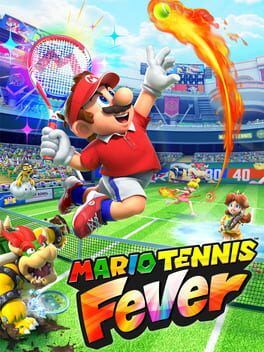
A deep dive into everything packed into the Mario Tennis Fever overview trailer, from its 38-character roster and Adventure campaign to GameShare multiplayer and amiibo cosmetics that push it beyond a simple Mario Tennis Aces follow-up.
Nintendo’s new overview trailer for Mario Tennis Fever makes it clear this is not just “Aces 2.” It looks like the first tentpole sports game built specifically to show what Switch 2 can do, both in content density and in how flexible it is for local and online play.
Below is a full breakdown of what the trailer reveals, and how it all adds up to something that feels much closer to a platform-defining sports package than a simple follow-up.
The Biggest Mario Tennis Roster Yet
Mario Tennis Fever launches with 38 playable characters, the most in series history and a noticeable jump from Mario Tennis Aces. The trailer and follow-up coverage lock in several of the newcomers: Goomba and Nabbit finally get full tennis movesets, Piranha Plant joins as a proper character rather than a court hazard, and Baby Wario and Baby Waluigi round out the baby lineup.
The rest of the line-up pulls from the usual Mario sports mainstays like Mario, Luigi, Peach, Daisy, Rosalina, Yoshi, Bowser, Bowser Jr., Donkey Kong, Wario, Waluigi and Toad, along with series regulars from past tennis entries. Between the heavy hitters, speedy tricksters and gimmick characters, the roster looks closer to something you’d expect from a late-generation entry than a fresh start on new hardware.
What stands out most is how the trailer frames the cast. Rather than just listing names, it leans into personality: Goomba waddling into position without arms, Nabbit zipping across the court to steal impossible balls, Piranha Plant whipping shots with exaggerated lunges. It feels like Camelot is trying to recapture the character-driven energy of Power Tennis while keeping the snappy feel of Aces.
Fever Rackets, Classic Mode, and the New Baseline
At the core of Mario Tennis Fever is the new Fever Racket system. These special rackets layer wild, situational powers on top of the familiar topspins, slices and lobs that Aces players already know.
The overview trailer gives a few concrete examples. The Ice Racket frosts over the court so characters skid on movement, which changes spacing and defense. The Shadow Racket creates a ghostly duplicate of your character that mirrors your movement, effectively letting you cover two angles at once. Other Fever Rackets briefly rain balls, warp shot trajectories or spawn hazards on court.
The important detail is that Fever Rackets sit on top of a more grounded baseline than Aces. The trailer and site copy point to a Fever Gauge that powers up these special shots, but there is also a Classic Mode that disables Fever Rackets entirely. That means players who hated dealing with complex meter and slow-motion aiming in Aces can flip a switch and get almost pure, timing-based tennis without losing access to the rest of the game’s content.
That dual design is a big part of why Fever feels like a flagship project. It simultaneously serves the competitive crowd that wants fundamentals to shine, the party-leaning crowd that wants nonsense on screen, and the families who just want to mash buttons with motion controls in Swing Mode. Rather than picking a single audience, Camelot is building one flexible ruleset and then exposing options everywhere.
Adventure Mode: A Proper Campaign, Not Just a Tutorial
The overview trailer briefly calls out an Adventure mode, and outlets that combed through the footage confirm it is a full campaign rather than a glorified training ladder.
Structurally, Adventure looks like a hybrid of Aces’ single-player and the themed events from Mario sports entries on GameCube. You guide Mario and friends across a world map stitched together from themed courts and gimmick stadiums. Each node is a bespoke scenario: rally-based score attacks, boss-style duels that lean hard on hazards, or special objectives tied to Fever Rackets.
Progression is where Fever pushes further than Aces. Instead of just unlocking passive stat boosts, you gradually earn and test new Fever Rackets as you climb through the campaign. Trial Towers, which are accessible outside Adventure as their own mode, slot into this structure as challenge gauntlets where you take a limited selection of rackets and characters and try to clear a string of increasingly cruel setups without getting knocked out.
The difference in tone is immediately obvious. Aces framed its story as a mostly straight tennis quest with occasional puzzles. Fever’s Adventure slices closer to a Mario platformer in attitude. Wonder-inspired courts twist the rules mid-match, Talking Flowers chime in with commentary, and most objectives exist to force you into situations where the new mechanics matter. It feels like the single-player mode is designed first to show off the game’s breadth, and only second as a tutorial funnel.
Mix It Up and Wonder Courts: Unconventional Rulesets Everywhere
Where Aces largely stuck to standard rallies with a few hazard courts, Mario Tennis Fever throws out the rulebook in dedicated modes that the overview trailer spends a lot of time on.
Mix It Up mode is the umbrella for alternate rulesets. Ring Shot returns as one of the flagship options, asking you to aim through floating rings to earn points, with the trailer showing tight clusters of rings on the baseline and trick shots that bend the ball through several in one go. The focus is less on winning the game and more on precision and pathfinding.
Wonder Court Matches lean on Super Mario Bros. Wonder’s “anything can happen” vibe. As Wonder Effects trigger, the court morphs under your feet. Platforms rise and fall, item blocks materialize, and ball physics shift in surreal ways. Because these Wonder courts are framed as their own match type rather than a one-off gimmick, they are likely to rotate through online lobbies and local playlists as evergreen content rather than disappearing once you beat a specific mission.
Pinball Matches are another standout. Courts are packed with bumpers, flippers and target panels. Balls can ricochet several times before even crossing the net, which turns shot selection into a puzzle. In the overview trailer there is a quick sequence where a player intentionally banks a shot through multiple bumpers to curve it back into an unreachable pocket, the kind of situation that simply would not work in a more grounded tennis sim.
Rocket Factory Matches further push the Fever Racket idea by spawning new rackets mid-match. Instead of sticking with a single setup, you are constantly tempted to risk a change for a wild effect. That layer of mid-game drafting is the sort of experimentation Camelot never really dove into before on a console tennis title.
The throughline is that Fever wants multiple ways to play that feel legitimate instead of throwaway. Classic rallies, hazard courts, and high-chaos modes all coexist and can be toggled rather than buried as one-off mini-games.
Local Multiplayer: From Couch Chaos to Local Wireless and GameShare
The overview trailer is as interested in how people play together as it is in the rules they play under. On Switch 2, that starts with four-player support and scales out through a series of connection options.
Standard local multiplayer still works how you would expect. Up to four players share a single Switch 2, with the option to use traditional controls or Swing Mode motion swings. Courts, Fever Rackets and rule presets can all be customized, so you can run anything from a no-gimmick, Classic doubles match to a Ring Shot scramble on a Pinball court.
Local wireless play takes it a step further by letting multiple Switch family systems link up. The key new feature here is GameShare. If one person owns Mario Tennis Fever on Switch 2, up to three nearby players can join on their own Switch 2, and in some cases even on original Switch hardware, using a limited client. GameShare is essentially the modern echo of DS Download Play and Wii U’s asymmetrical local experiences, but on a much more ambitious scale.
The trailer and official site explain that GameShare supports a curated selection of modes rather than the entire game. That is a smart compromise. It ensures that the shared build stays lightweight while still exposing enough of the roster and rule variety to hook new players. For a flagship sports title, that kind of “bring your system, we’ll get you in” frictionless setup can define how the game gets played at parties and tournaments.
Online Play and Ranked Structure
Although the trailer does not spend as much time on menus as modes, it does confirm a familiar but expanded online layer. Standard online matches cover one-on-one and doubles play, with options for casual and ranked matchmaking.
Ranked matches are where Classic rulesets and Fever Rackets really collide. The overview emphasizes that you can queue with or without Fever mechanics, which effectively splits the ladder into two styles. Fans of Aces’ tighter competitive meta can chase ranks in a more traditional format, while players who want to experiment with high-variance setups can stay in Fever-enabled queues.
Special online tournaments and seasonal events look set to pull from the Mix It Up catalog. Limited-time Ring Shot ladders, Wonder Court spotlights and Pinball weekends give Nintendo hooks to promote the game long after launch. On Switch 2, where the online ecosystem is expected to be more robust than the original Switch, Fever seems built to be a living sports hub rather than something you only dust off for a few couch sessions.
amiibo Support: Cosmetic Rewards That Respect Competitive Balance
The overview trailer quietly drops one of the most-requested features since amiibo launched in 2014. Mario Tennis Fever finally supports Mario series amiibo, but in a refreshingly restrained way.
Scanning compatible amiibo, such as Mario, Luigi, Peach, Daisy, Rosalina, Yoshi, Toad, Bowser, Bowser Jr., Donkey Kong, Wario and Waluigi, unlocks character-themed tennis ball designs. These balls are purely cosmetic. Nintendo’s own breakdown and multiple outlets stress that there are no stat boosts, ability unlocks or gameplay advantages tied to amiibo.
From a design standpoint, that choice matters. Aces often struggled to balance its hardcore aspirations with its party roots, and paywalled unlocks would have been a nonstarter for a ranked-focused community. Fever treats amiibo as a form of personal flair. Swapping in a Yoshi egg ball or a luminous Rosalina star pattern is a way to show off your favorite character or your collection without changing match outcomes.
It also conveniently gives Nintendo another gentle reason to keep Mario amiibo in circulation for Switch 2 without turning them into mandatory DLC. Given how many households already have at least a few Mario figures sitting on a shelf, it is an easy win that adds charm but not friction.
Why This Feels Like a Flagship Switch 2 Sports Game, Not Just Aces Again
All of these pieces add up to a project that clearly aims higher than a quick follow-up.
First, the scale is different. A 38-character roster with multiple new faces, a full Adventure campaign, Trial Towers, and a suite of Match variants like Wonder Courts, Rocket Factory, Pinball and Mix It Up suggest a content footprint closer to a generation-defining sports title than a one-note experiment.
Second, the systems are layered in a way that acknowledges how diverse the Mario Tennis audience has become. Fever Rackets and Wonder Effects carry the spectacle that modern trailers need, but Classic Mode, motion-enabled Swing Mode and elective Fever queues in online ranked play give purists the control they wanted out of Aces but never fully got.
Third, the connectivity story is very specifically tuned to Switch 2’s role as a hybrid successor. Four-player local, robust online options and especially GameShare support between Switch 2 and original Switch hardware turn Mario Tennis Fever into a go-to showcase whenever someone asks “So what do you actually do with this new system?” If 1-2-Switch tried to answer that question at the start of the previous generation, Fever looks positioned to answer it for the new one with far more staying power.
Finally, the restraint around monetization and progression stands out. amiibo are sidelined into cosmetics, and all of the wildest mechanics are built into the base rules rather than carved out as paid DLC. That foundation makes it much easier for Nintendo to treat Fever as a long-term pillar they can support with free events and, potentially down the line, carefully scoped character or court updates.
Taken together, the Mario Tennis Fever overview trailer reads like a mission statement for Switch 2-era Mario sports. Big rosters, flexible rulesets, deep campaigns, cross-system local play and clean cosmetic unlocks come together to form a package that feels significantly more ambitious than Aces, and closer to the kind of evergreen multiplayer staple that defined Nintendo consoles in the GameCube and Wii eras.