
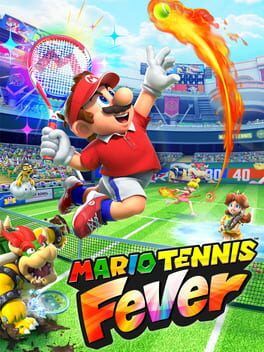

Famitsu’s big score and early reviews position Mario Tennis Fever as the new arcade tennis benchmark, but its success also highlights why “realistic” tennis sims like TopSpin 2K25 and Tiebreak+ keep falling short of their own ambitions.
Mario Tennis Fever is not the tennis game that simulation diehards have been begging for, but it might just be the tennis game the genre needs right now.
Famitsu handed Camelot’s latest a 34 out of 40, with individual reviewer scores of 9 / 8 / 9 / 8. That slots it comfortably into the magazine’s “you should really play this” bracket and lines up with a broader Western reception that ranges from “grand slam on Nintendo Switch 2” to “must‑have Switch 2 sports game.” For a series that has wobbled across its last few entries, that level of consensus matters.
What makes Mario Tennis Fever important is not just that it is good. It is that it feels definitive. Where sim‑leaning rivals are still trading compromises, Camelot has delivered something that confidently plants a flag as the new standard‑bearer for arcade tennis.
Fever mechanics that actually respect tennis
Fever’s headline addition is the Fever Racket system. Every racket carries a unique Fever Shot, fueled by a meter that climbs as rallies unfold. Triggering it turns a single point into a mini mind‑game: do you spend your charge on a vicious angle, a defensive reset, or a disruptive gimmick that throws literal obstacles onto the court?
Pre‑release trailers made this look like pure chaos. In practice, early critics have highlighted how rarely Fever Shots feel random. The most effective ones lean into positioning and anticipation, not coin‑flip power plays. The reverse mechanic that lets you counter an incoming Fever Shot with your own creates a kind of rock‑paper‑scissors rhythm layered on top of classic topspin, slice, and flat shots.
The key detail is that Mario Tennis Fever does not crumble when you strip those mechanics away. Multiple outlets note that turning off Fever Rackets still leaves behind a fast, demanding arcade engine that emphasizes footwork, timing, and shot selection. That is where it quietly distances itself from recent sim‑branded titles, many of which struggle to be satisfying even before you add any bells and whistles.
Accessibility without dumbing the sport down
The Mario Tennis series has always walked a line between party game and competitive sports title. Fever finds a clearer balance.
Controls remain simple enough for a family couch session. Basic shots are mapped to familiar buttons, trick shots are forgiving, and characters have readable archetypes. Newcomers can focus on learning when to commit to the net and when to camp the baseline, while the game’s generous animation work smooths out some rough inputs.
Underneath that surface, though, Fever is unapologetically brisk. Rallies are shorter and more winner‑heavy than real tennis, but the speed forces quick decision‑making. Meter management between Zone Speed, defensive slides, and Fever Rackets gives strong players ways to outthink, not just out‑mash, their opponents.
Compare that with how several recent sims teach the sport. TopSpin 2K25, for instance, can feel impenetrable at the tutorial level yet oddly shallow once matches begin. Shot types exist on paper, but community criticism keeps circling the same issues: slices that do not bite, topspin that lacks weight, and rallies that become repetitive exchanges to pre‑determined hot spots. Tiebreak+ has a more approachable baseline, but feedback from both critics and players regularly points to floaty physics and odd ball trajectories.
Fever’s readability is helped by its tone. Because it does not pretend to be a television broadcast you could mistake for the real thing, the game is free to exaggerate contact animations and telegraph winning angles. You understand why you lost a point, even when Baby Waluigi just dunked on you with a flaming Fever Smash.
Switch 2 tech gives Camelot room to breathe
If Mario Tennis Aces often felt caged by the original Switch’s aging hardware, Fever uses Switch 2 more like a proper home console.
Higher resolution character models and courts are the most obvious upgrades, but the more important improvements are the ones you feel rather than see. Critics have repeatedly praised Fever’s responsiveness. The new hardware’s faster CPU and SSD mean instantaneous point transitions, snappier replays, and significantly reduced input latency compared to Aces. Zone Speed effects pop in without hitching, and split‑screen doubles maintains a steady framerate instead of the drops that plagued the last generation.
All of that matters for a game built on quick reactions. The moment Camelot asks you to parry a Fever Shot with frame‑tight timing, Switch 2 quietly holds up its end of the bargain.
The hardware headroom also allows for bigger crowds, more dynamic lighting across different tournament venues, and more complex physics on Fever Racket effects. A bouncing Bullet Bill serve or a Boo curveball tracks smoothly without the jitter that could wreck online play on older systems. While it is still arcade tennis at heart, the overall physicality on display compares favorably with the heaviest hitters in the sim space.
A fractured sim scene still searching for its Federer
The glowing reception for Mario Tennis Fever arrives in a marketplace where realistic tennis games are abundant but unsettled.
TopSpin 2K25 marked the return of a revered name after more than a decade away. On paper, it should have been the new benchmark for hardcore players. Reviews admired its fundamental stroke mechanics and the simple pleasure of grinding out long rallies on clay or grass. Yet the package around that core drew persistent complaints: a tiny roster of real pros, a heavily criticized career mode tethered to online servers, and presentation that felt dated next to EA and 2K’s own football and basketball offerings.
Tiebreak+ sits at almost the opposite extreme. As the official ATP and WTA game, it boasts over 120 licensed players and roughly 90 tournaments that mirror the real calendar. For fans who want to live the tour schedule, that authenticity is a powerful hook. But physics and animation issues have been hard to shake. Even after post‑launch tuning, many players feel that rallies lack the weight and tactical nuance that real tennis demands.
Then there is Tennis Elbow 4, the cult favorite that many sim purists still point to as the best representation of point‑to‑point tennis. It nails the ebb and flow of a rally and offers a deep toolbox of spins and angles. What it does not have is big‑budget production, console‑friendly onboarding, or official licenses. It is the most faithful simulation in a genre where “faithful” does not necessarily translate to “inviting.”
The result is a fractured landscape where no single game has claimed the mantle of definitive tennis experience. TopSpin brings strong fundamentals wrapped in a compromised package. Tiebreak+ brings the licenses but swims in lukewarm gameplay. Tennis Elbow 4 brings purist depth but lacks the reach and spectacle.
Why sims keep missing while Fever connects
Tennis is a brutally demanding sport to translate into code. The ball’s behavior changes dramatically with small variations in contact, footwork, and surface. Cameras need to show enough of the court to read patterns without making the ball feel microscopic. A high‑level rally is less about constant highlight shots and more about constructing points over time.
Sim games live or die on those subtleties, yet they rarely have the budgets or annualized pipelines of FIFA or NBA 2K. When resources run thin, hard choices kick in. Do you spend money on scanned arenas and broadcast‑style graphics or on deep AI that understands when to attack your backhand? Do you license the full ATP and WTA rosters or invest in motion capture that makes slices skid properly on low‑bouncing surfaces?
Mario Tennis Fever sidesteps that tradeoff by making the fantasy the point. It does not need 200 real players or painstakingly correct logos for every tournament. Instead, it pours resources into rock‑solid input response, expressive animations, and the systems that keep every rally interesting. Because physics are stylized from the start, there is no uncanny valley when a ball bounces a little higher than it should. It is allowed to be loud and exaggerated, as long as it is consistent.
Ironically, that focus on feel over fidelity lets Fever capture something that many sims struggle with: the emotional rhythm of tennis. Points build quickly, momentum swings are palpable, and a single well‑timed Fever reversal can turn a set around. It does not look like the tours that TopSpin or Tiebreak+ proudly recreate, but it often feels closer to the tense cat‑and‑mouse of a real tiebreak than its more serious peers.
Could Fever point the way forward for sims?
Fever’s success does not mean the sim dream is dead. If anything, it clarifies what realistic tennis games need to steal back from their arcade cousin.
First, clarity of intent. Fever tells you upfront what it is: high‑energy tennis with just enough mechanical depth to sustain an online meta. Recent sims sometimes feel torn between chasing esports‑style depth and providing a TV‑like experience where casual players can pick their favorite pro and go. That identity crisis shows up in everything from pacing to UI.
Second, a renewed focus on how rallies feel before worrying about how many logos or stadiums you have. Tennis Elbow 4 understands this, which is why it punches above its weight with dedicated fans. TopSpin 2K25 and Tiebreak+ already have the licensing footholds; if future entries double down on ball physics, player movement, and shot variety before career cinematics, they could finally close the gap.
Third, an embrace of mechanical spice. Fever Rackets are obviously too wild for a pure sim, but the underlying idea of rally‑driven momentum mechanics is not. Systems that reward building pressure over multiple points or risk‑reward meter tied to aggressive play could bring some of Fever’s drama into licensed tennis without compromising realism.
The new king of arcade courts
Mario Tennis Fever is not the all‑in‑one tennis solution that some players are still dreaming about. It does not have the licensed tours of Tiebreak+, the granular sliders of Tennis Elbow 4, or the broadcast presentation that TopSpin 2K25 aims for.
What it does have is a clear identity that it executes with confidence. Famitsu’s 34/40 score, backed up by strong early critical reception across outlets, reflects a game that knows exactly what kind of tennis it wants to be and delivers on that promise across solo play, couch competition, and online matches.
In a genre where realism has become a heavy word that too often excuses clunky feeling games, Mario Tennis Fever shows another path. Make the ball feel good off the racket. Make every rally tell a story. Build your spectacle on top of those fundamentals. For now, that is enough to crown Fever as the new standard‑bearer for arcade tennis on Switch 2, while the sims keep grinding away in search of their own grand slam.