
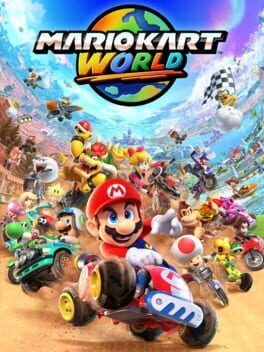

How Mario Kart World turned a strong 2025 launch into runaway momentum, what Nintendo’s new Switch Online icons and events reveal about its long‑term plans, and where it fits in the emerging Switch 2 competitive lineup heading into 2026.
Mario Kart World arrived in mid 2025 as the headline racer for Nintendo Switch 2, but its first six months have gone far beyond the usual “launch window” pop. In Japan, it has already turned into the defining competitive and party game of the new system, and Nintendo’s most recent moves on Nintendo Switch Online suggest the company is only just getting started on its long tail.
A dominant 2025 in Japan
Famitsu’s annual report on Japanese physical sales crowned Mario Kart World on Switch 2 as Japan’s best selling game of 2025. From December 30, 2024 through December 28, 2025, it shifted 2,668,381 boxed copies, putting it well ahead of other big hitters like Pokémon Legends: Z‑A across both Switch generations and Monster Hunter Wilds on PlayStation 5.
On the hardware side, Switch 2 led the Japanese market with 3,874,067 units sold in the same period, while the original Switch still managed more than 1.5 million. That combined footprint gave Mario Kart World an enormous audience to grow into, essentially inheriting the family and party crowd that kept Mario Kart 8 Deluxe in Japan’s top ten years after release.
What makes Mario Kart World’s rise more striking is that it did it in the most competitive Nintendo software year in a long time. New Pokémon, new party titles like Super Mario Party Jamboree and fresh first party releases such as Donkey Kong Bananza and Kirby Air Riders all landed within the same twelve month window. Even so, Mario Kart’s mixture of accessible racing and ruthless item chaos once again proved to be the one game almost every Switch 2 owner “had to have.”
From launch hit to platform pillar
There is a familiar pattern in how the series behaves on Nintendo hardware. Mario Kart 8 Deluxe started strong on the original Switch, then quietly turned into a library pillar that continued to chart for years. Famitsu’s 2025 tally still places that older game in Japan’s top ten, with lifetime physical sales climbing past 6.5 million.
Mario Kart World is already tracking to fill that same role on Switch 2, but with the advantage of being built from the ground up for the new hardware. Its core pitch of a vast interconnected “world” of courses and the new knockout tour structure gives Nintendo many different ways to keep players engaged without needing a rapid sequel. The game is designed to be the ongoing racing service for the platform, even while still leaning on local split screen and pick up and play sessions.
That long view is where Nintendo’s recent online support starts to matter. The company appears to be treating Mario Kart World less as a one off launch title and more as an evergreen live product that can anchor Nintendo Switch Online engagement for years.
What the new Switch Online icons really signal
In January 2026, Nintendo rolled out a fresh wave of Mario Kart World themed user icons for Nintendo Switch Online members. On the surface, that sounds like a small cosmetic drop, but the way it is structured hints at longer term planning.
The icon set is being distributed in five separate waves through the usual Missions & Rewards section of the Nintendo Switch Online hub. Players use their Platinum Points to redeem character portraits, background elements and frames based on Mario Kart World’s racers and course motifs, then attach them to their system profiles.
Treated in isolation, icon waves are simple profile flair. In context, repeated Mario Kart World icon campaigns serve several purposes for Nintendo. They keep the game’s key art and characters constantly surfacing on the system’s front end, they give active players a reason to check in even when they might not be racing every night, and they tie Mario Kart World directly to the value proposition of Nintendo Switch Online.
Community reaction also exposes where fans want Nintendo to go next. Coverage from sites that track these drops notes that some players are happy to hoard every wave, while others are asking for “more” than just static profile pictures. Common wishes include deeper crossovers, icons that reference memorable races or events, and rewards that connect more directly to in game achievements.
Even that feedback is useful for Nintendo. It suggests the audience expects Mario Kart World to keep evolving and wants the online service hooks to feel tied into the actual racing experience, not just the console menu.
Events and the shape of a long tail
Beyond icons, Mario Kart World’s design lends itself to seasonal activity and rotating events. The knockout tour mode with back to back courses and elimination rules is built for featured cups and competitive spotlights, while the free roam exploration spaces are ideal for limited time photo challenges and scavenger hunts.
Although Nintendo has not yet blown out a big, Battle Pass style roadmap, the foundation is there. High performing titles on Switch 2 such as Pokémon Legends: Z‑A have already shown that Nintendo is more willing to support large scale post launch updates, and Mario Kart is arguably the most natural fit for that treatment.
Smaller signals line up with that strategy. Mario Kart World remains a fixture in weekly Japanese charts months after release, in some weeks topping the list for the eighteenth time. It routinely sits alongside new Switch 2 releases rather than trailing behind them, which implies that new players are still buying the system and then immediately picking up Mario Kart World as their default multiplayer choice.
For Nintendo, that behaviour is an ideal scenario. Every new Switch 2 household that adopts Mario Kart World is a potential buyer for future course packs, event passes or expanded online modes, even if those plans are still under wraps.
The cornerstone of Switch 2’s competitive and party lineup
Viewed against the rest of the Switch 2 catalog, Mario Kart World occupies a crucial niche. On one side of the platform’s multiplayer offering you have more involved co op and action experiences, and on the other you have lightweight board game style releases like Super Mario Party Jamboree. World threads the needle between them as the instant recommendation for both casual parties and serious competition.
It does this by continuing the series’ layered skill curve. New players can jump in, rely on generous item balancing and auto steering assists, and still feel like they are in the race. Experienced players can experiment with drift timing, route choice in the new interconnected tracks, and calculated item usage to squeeze out wins even in the chaos. That versatility makes Mario Kart World the kind of game that shows up at family gatherings, college dorms and online lobbies alike.
Switch 2’s hardware also helps it feel like a natural evolution of the “couch competitive” idea Nintendo has been cultivating for years. Higher resolution output and smoother performance keep four player split screen readable, while modern online infrastructure and system level friend features make it easier to set up ad hoc tournaments or run elimination nights built around the new tour mode.
Looking ahead to 2026 and beyond
Heading into 2026, Mario Kart World sits at an enviable intersection. It is already the best selling game of the year in Japan, it continues to drive mindshare across both Switch generations, and Nintendo is using its ongoing popularity to enrich Nintendo Switch Online with themed rewards.
The next step will be how aggressively Nintendo leans into that success. More icon waves are all but guaranteed, but players are watching for meatier updates like new course regions for the world map, expanded free roam activities and fresh characters or vehicles to chase in game. If even a fraction of the long term DLC energy that went into Mario Kart 8 Deluxe is redirected toward World, Switch 2’s flagship racer could remain on the front line well into the middle of the generation.
For now, the message from Japan is clear. When players buy a Switch 2, they are buying Mario Kart World alongside it. The game has already secured its spot as the platform’s default party racer, and Nintendo’s steady online support suggests it is planning to keep the engines running for a long time to come.