
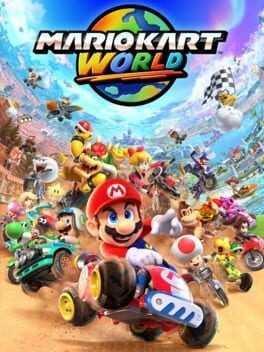
UK charts and Japanese Famitsu data show Mario Kart World exploding out of the gate on Switch 2 without knocking Mario Kart 8 Deluxe off the board. Here’s how its live‑service structure is taking shape and what that says about Nintendo’s first‑year Switch 2 strategy.
Mario Kart World has wasted no time becoming the defining software story of Nintendo’s Switch 2 launch window. Between UK retail charts and Japanese Famitsu data, the newest entry is already operating in that familiar Nintendo space where a Mario Kart is not just successful but foundational to the platform.
Yet what makes Mario Kart World’s first months especially interesting is that it is not replacing Mario Kart 8 Deluxe so much as sitting alongside it. In late‑December UK charts, two different Mario Karts are holding top‑five positions at the same time, while in Japan Mario Kart World has already cleared 2.5 million boxed units on Switch 2 alone. It is a rare moment where a platform holder is actively running two era‑defining evergreen racers concurrently.
Two Mario Karts in the UK Top 5
The UK boxed software chart for the week ending December 27, 2025, paints a clear picture of how Mario Kart World is performing in a crowded holiday market.
EA Sports FC 26 holds the top spot, but Mario Kart World is parked firmly at number 2 and has held that position week over week. The more surprising story is a few places down: Mario Kart 8 Deluxe climbs back into the top 5 at number 5, up from 6 the previous week.
Looking at Nintendo’s broader presence in that same chart, it is clear this is not a one‑off spike. Pokémon Legends: Z‑A, Donkey Kong Bananza, Nintendo Switch Sports and a grab bag of long‑tail hits like Animal Crossing: New Horizons and Super Mario Bros. Wonder all remain in circulation. Within that context, Mario Kart World’s ability to wedge itself near the very top while Mario Kart 8 Deluxe refuses to leave the stage shows the series’ unusual resilience.
Crucially, this is not a cross‑gen straddle in the usual third‑party sense. Mario Kart World is the native Switch 2 showcase, marketed around its new open‑world structure and upgraded presentation. Mario Kart 8 Deluxe, meanwhile, is an eight‑year‑old enhanced Wii U title that has already sold tens of millions of copies. The fact that boxed copies of both can coexist near the top of a mature market like the UK hints that Nintendo is viewing Mario Kart less as a single active product and more as a portfolio inside the platform.
Japan: Mario Kart World Turns Switch 2 Into a Runaway Train
If the UK charts show how the two games stack up side by side, Japan shows just how hard Mario Kart World is pulling the new hardware.
Famitsu’s sales data for the week of December 15 to 21, 2025, has Mario Kart World at number 1 in the Japanese packaged software chart with 115,729 units sold that week on Switch 2. That brings its physical lifetime total to 2,573,736 copies in Japan alone. This is half a year after launch, with digital sales and My Nintendo Store downloads not even counted in that figure.
On the hardware side for that same week, Switch 2 shifts 221,033 units, up from roughly 191,000 the week before. Legacy Switch models still move respectable numbers, but there is no question where the center of gravity now lies. The top 10 software list is stuffed with Nintendo titles or Nintendo‑adjacent staples like Minecraft, and Mario Kart World is sitting comfortably at the top of that pile.
The pattern looks familiar to anyone who watched Mario Kart 8 Deluxe on the original Switch, where a single racer quietly became a de facto pack‑in experience over the system’s lifespan. The difference this time is timing. Mario Kart World is arriving in the first year of Switch 2, when hardware momentum is still being built, rather than as a late‑cycle enhanced port. It is both driving adoption and anchoring the library from day one.
Coexisting With Mario Kart 8 Deluxe Instead of Replacing It
The central curiosity of this moment is not just Mario Kart World’s success but what Nintendo is choosing not to do. Mario Kart 8 Deluxe continues to be printed, promoted in value bundles and featured prominently in retail even as the new game takes over the Switch 2 marketing.
In the UK chart where both titles share the top 5, you can see how each fills a different role. Mario Kart World is clearly the system‑seller, the new hotness on the shiny console, linked to Switch 2 hardware displays. Mario Kart 8 Deluxe, by contrast, is the budget and back‑catalog classic, heavily discounted at times and attached to family‑oriented Switch 1 hardware bundles still moving through the channel.
There is a generational split as well. In Japan, Famitsu’s data shows a software lineup where most of the big new releases are clearly labeled for Switch 2, often with separate original Switch versions alongside. In the UK, the all‑formats chart lumps platforms together, but the continued presence of Mario Kart 8 Deluxe suggests Nintendo sees a long tail in serving legacy Switch owners with a cheaper, fully complete Mario Kart while positioning Mario Kart World as the premium future.
This dual‑track strategy lets Nintendo have it both ways. It can present Mario Kart World as the forward‑looking, technically ambitious flagship while still tapping the enormous install base of the original Switch through 8 Deluxe. Rather than forcing an upgrade path, Nintendo is effectively saying that as long as you are buying a Mario Kart, you are contributing to the broader ecosystem.
The Live‑Service Skeleton of Mario Kart World So Far
Part of what enables that coexistence is design. Mario Kart 8 Deluxe’s Booster Course Pass wrapped up with a complete track roster and a finite, clearly marketed DLC roadmap. Mario Kart World, by comparison, has been built to breathe over time.
Out of the gate, the game leans hard on its interconnected open world and the new knockout tour structure. Races flow into one another along continuous routes, and a dedicated free‑roam mode lets players peel off the track, drive scenic loops and collect photo opportunities with friends. The structure practically invites seasonal events and live updates, even if Nintendo has been characteristically conservative in how it describes them.
In its first months, that live‑service layer has been more about pacing than about monetization. Nintendo has rolled out new limited‑time tour routes, rotating spotlight tournaments and online challenges that reward cosmetics and kart parts rather than game‑breaking performance upgrades. These events have tended to sync loosely with global holidays or regional beats, keeping the in‑game world feeling slightly different every time you log on without overwhelming players with a battle pass style checklist.
What is notably absent so far is aggressive microtransaction design. There is no standalone season pass marketplace comparable to a typical Western live‑service racer. Instead, Mario Kart World’s roadmap resembles Splatoon’s model more than something like a mobile gacha game: large free content beats spaced out over the year, with expansion‑scale paid add‑ons still only hinted at in marketing language.
For Nintendo, this quiet, slow‑burn live‑service approach has two benefits. It keeps the game present in the weekly charts, as periodic content drops prompt fresh retail pushes, and it avoids cannibalizing Mario Kart 8 Deluxe by turning World into an immediate, monetization‑heavy replacement. The focus remains on World as a reason to buy Switch 2 hardware, not on extracting recurring revenue from every existing Kart fan on day one.
Shaping the First‑Year Story of Switch 2
The combined chart picture from the UK and Japan shows Mario Kart World doing more than simply topping a few lists. It is helping to define what Switch 2 is in its crucial first year.
In Japan, Famitsu’s numbers frame Switch 2 as a runaway success driven by familiar Nintendo strengths. The top 10 is filled with colorful, family‑friendly titles, and Mario Kart World sits comfortably at the top as the game everyone seems to buy with the console. Hardware is selling faster week over week, suggesting a feedback loop where word of mouth about the game fuels hardware demand, which in turn keeps Mario Kart World pinned near number 1.
In the UK, where multiplatform competition is stiffer and boxed retail is more contested by Western blockbusters, Mario Kart World still holds number 2 behind EA Sports FC 26 while sharing the spotlight with its predecessor. The result is a first‑year narrative where Switch 2 is not a risky new direction but a stronger continuation of the Switch era, led again by Mario Kart.
Mario Kart World also complements Nintendo’s broader software calendar. Titles like Pokémon Legends: Z‑A, Donkey Kong Bananza, Kirby Air Riders and Super Mario Party Jamboree fill out the release slate and keep different demographics engaged, but none has quite the same hardware‑agnostic presence as a Kart. Nintendo can afford for some of those experiments to ebb and flow in the charts because Mario Kart World offers a constant, predictable pillar of engagement.
What Comes Next for Nintendo’s Twin Karts
Looking ahead to the rest of Switch 2’s first year and beyond, the current sales data hints at a few likely paths.
First, Mario Kart World is well positioned to become the next multi‑tens‑of‑millions evergreen. If it can cross 2.5 million physical units in Japan alone within about half a year, and maintain top‑five placements in major Western markets while the install base is still growing, it is difficult to imagine a scenario where it does not track toward or beyond Mario Kart 8 Deluxe territory over the long term.
Second, the ongoing strength of Mario Kart 8 Deluxe suggests Nintendo may continue to view it as the definitive Mario Kart for the original Switch for years, even as World evolves into the live‑service flagship on Switch 2. Expect discounts, bundle deals and perhaps occasional minor updates to keep 8 Deluxe appealing to late adopters and families picking up older hardware at lower price points.
Finally, Mario Kart World’s modest but steady live‑service features give Nintendo a flexible tool for steering the platform’s rhythm. Seasonal tours, new open‑world regions and possibly future expansion‑scale add‑ons can be timed to bolster hardware pushes or to fill gaps between major releases, much like Splatoon content updates did for the original Switch.
For now, the message is simple. Switch 2’s first‑year story is being told at 150cc, and Mario Kart World is leading the pack without needing to knock its predecessor off the podium. Two Karts, one platform and charts on both sides of the world suggest Nintendo has found a way to let its most reliable series do double duty at the start of a new generation.