

Christopher Barrett says his lawsuit with Sony and Bungie is settled, with his original Marathon game director credit restored. The money, allegations, and impact on Bungie’s shooter revival remain unclear.
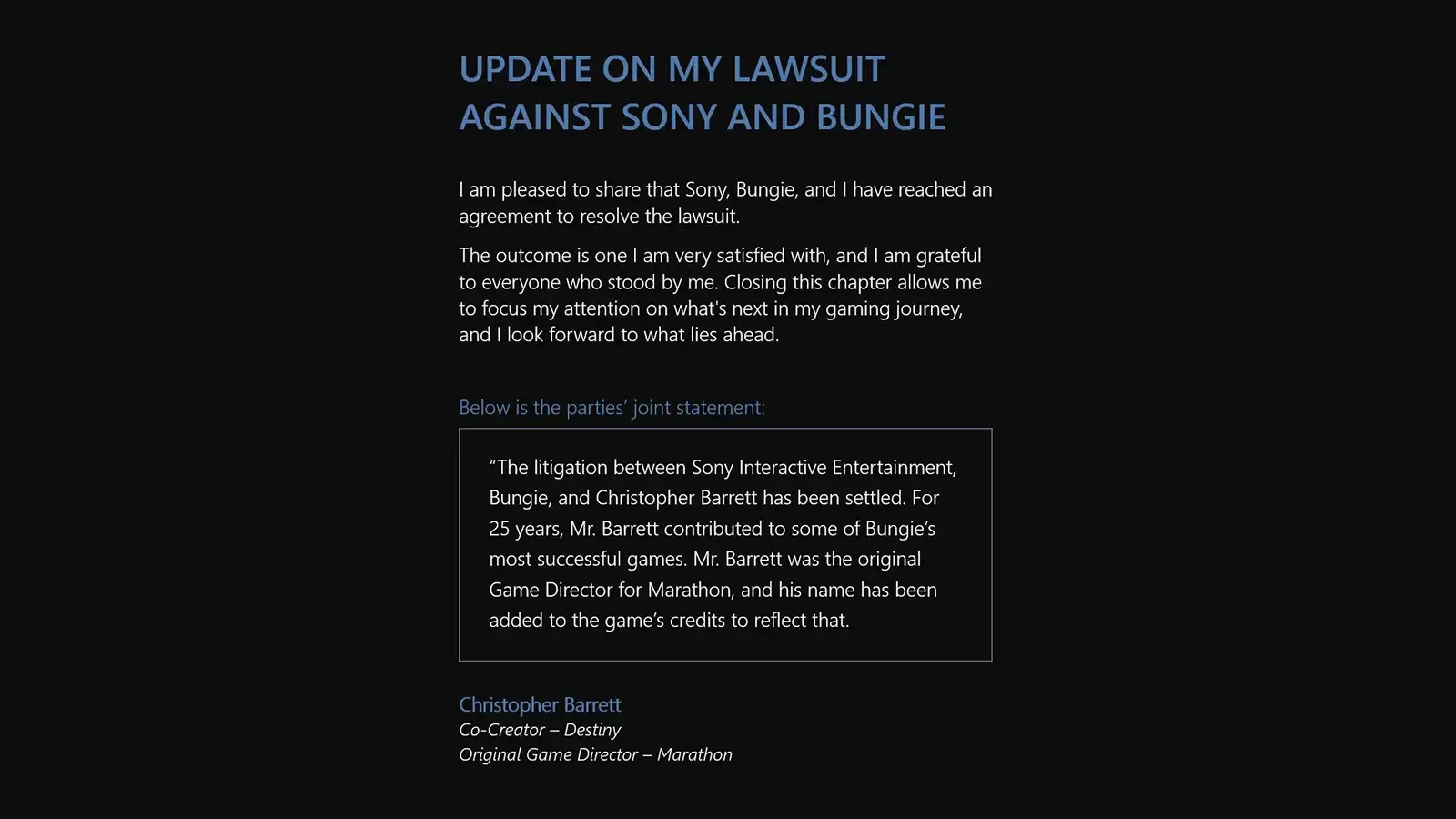
Image: thegamepost.com
Barrett’s name is back in Marathon, but the settlement leaves the biggest questions sealed
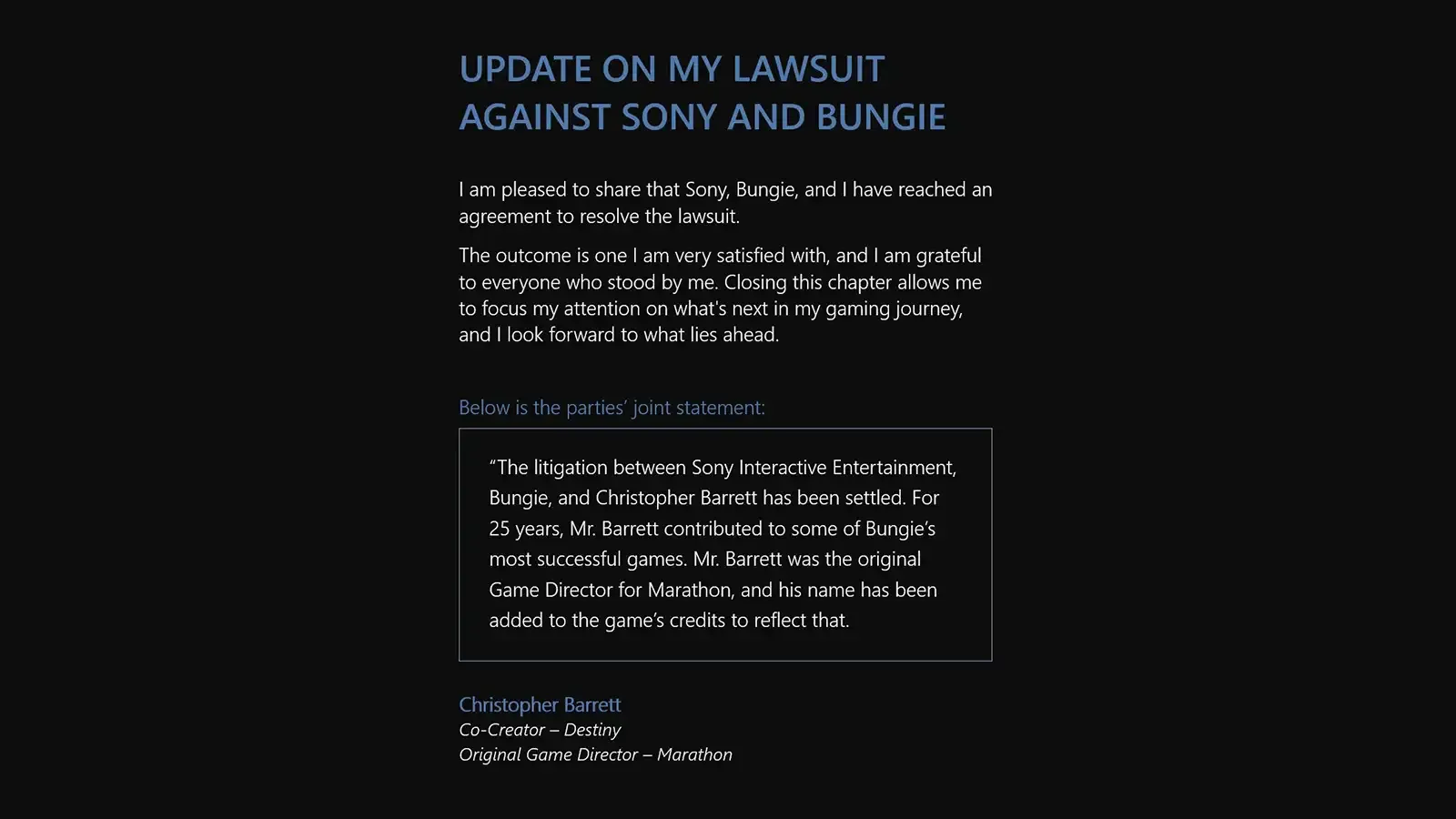
Christopher Barrett, the former Bungie veteran and original game director on Marathon, says he has settled his lawsuit with Sony Interactive Entertainment and Bungie. The concrete change players can actually verify is a credits update: a joint statement shared by Barrett says his name has been added to Marathon’s credits to reflect that he was the game’s original Game Director.
Barrett posted on X that Sony, Bungie, and he had “reached an agreement to resolve the lawsuit,” adding that he was “very satisfied with the outcome.” Video Games Chronicle, The Game Post, Kotaku, VGChartz, and PC Gamer all reported the settlement based on Barrett’s public statement. The joint note from the parties says Barrett contributed to some of Bungie’s most successful games over 25 years and identifies him as Marathon’s original Game Director.
That is the sharpest development in the Marathon director lawsuit because it is the only publicly confirmed remedy tied directly to the game itself. The settlement does not disclose whether Barrett received money, whether Sony or Bungie admitted fault, or whether any party changed its position on the misconduct allegations and contract claims that fueled the dispute. For Bungie’s shooter revival, the credits update closes one visible authorship issue while leaving the production and leadership questions around Marathon largely untouched.
The case started with a firing, bonus claims, and disputed misconduct allegations
The lawsuit followed Barrett’s 2024 exit from Bungie after more than 25 years at the studio. VGC reports that Bungie terminated Barrett’s employment in 2024 for misconduct. Kotaku, citing earlier reporting, says Barrett quietly left during Marathon’s development and that Bloomberg later reported he was terminated after a Sony investigation into messages sent to female employees. VGC says Sony alleged in court documents that Barrett sent inappropriate messages to female employees, while Barrett denied the claims and described the investigation that led to his firing as a “sham.”
Barrett then sued Bungie and parent company Sony Interactive Entertainment. The claims described across the source material include defamation and breach of contract, according to VGC, and wrongful termination, defamation, breach of contract, wage law violations, and FMLA-related claims, according to The Game Post. Sony and Bungie denied his claims, with The Game Post reporting that they argued he was fired for cause after an internal investigation.
The money attached to the dispute is messier than the clean “$200 million lawsuit” label suggests. The Game Post says Barrett filed a lawsuit seeking at least $200 million. Kotaku describes the suit as seeking $100 million and says Barrett claimed the firing was a breach of contract to avoid paying him over $80 million tied to Sony’s $3.6 billion Bungie acquisition. VGC reports that Barrett alleged Sony fired him to avoid paying more than $45 million in bonuses generated from the 2022 purchase. Those figures are not identical, so the safest read is that the case involved major acquisition-related compensation claims, with different outlets emphasizing different pleaded amounts or bonus estimates.
The credits issue is the settlement’s clearest public concession
The settlement statement does not read like a full history of Marathon’s development, but it does make one specific acknowledgement: Barrett was the original Game Director for Marathon, and his name has been added to the credits. The Game Post reports that when Marathon launched earlier this year, the game’s credits did not include Barrett’s name anywhere. That omission is the practical reason the credits update stands out from the rest of the settlement language.
Credits are easy to dismiss from the outside, especially in a shooter where most players are judging matchmaking, weapon feel, map flow, and whether the live game respects their time. Inside game development, credits are the permanent public record of who helped build the thing. For a director-level role on a major Bungie project, being absent from that record has career weight. It affects attribution, résumé clarity, and how a developer’s work is understood after a messy departure.
The wording also matters because it comes from a joint statement, not only from Barrett. Sony Interactive Entertainment and Bungie are identified in the statement alongside him, and the statement says his credit was added “to reflect” his original director role. That does not resolve the misconduct allegations. It does not say he directed the final shipped version. It does not say Bungie’s current leadership or design direction has changed. It does, however, establish that the parties agreed his original Marathon director credit belongs in the game.
The settlement changes Barrett’s public position, not the public record of the allegations
For Barrett, the settlement creates legal closure and restores a visible credit on Marathon. His own statement frames the outcome as a personal turning point, saying that closing the chapter lets him focus on what is next in his gaming journey. VGC notes that Barrett previously worked as an artist, art director, and game director on Halo and Destiny games, while PC Gamer’s coverage identifies him as a former Destiny 2 and Marathon director. The restored credit gives that career timeline a cleaner public endpoint than an omitted name in a shipped game’s credits.
What it does not create is a public ruling. The Game Post reports that the earlier Delaware Court of Chancery dismissal was for lack of jurisdiction, meaning the court did not rule on which side was right or wrong. The case was then refiled in Delaware Superior Court in January 2026, with Barrett requesting a 12-person jury trial, according to The Game Post. The new settlement stops the litigation before a public trial record could test the competing claims.
That distinction matters. Sony’s allegations, Barrett’s denial, his description of the investigation as a sham, and Sony and Bungie’s position that he was fired for cause all remain part of the reported dispute. The settlement statement shared publicly does not retract those allegations, explain the investigation, publish financial terms, or include an apology. It resolves the lawsuit, but it does not answer every question the lawsuit raised.
For Bungie, the legal noise fades while Marathon’s shooter questions remain
From a Marathon game news perspective, the settlement removes one legal fight from the background of Bungie’s revival, but it does not provide a new roadmap for the game. None of the provided settlement coverage includes changes to platforms, price, availability, technical targets, server plans, balance direction, or content timing. For players, the only confirmed game-facing update is Barrett’s addition to the credits.
That leaves Bungie in a familiar competitive shooter position: the conversation eventually snaps back to the product. Credits establish who helped start the project, but they do not explain how the shipped or live game is being steered now. Source coverage says Barrett was Marathon’s original director before leaving in March 2024, and VGC reports he was eventually replaced by a former Valorant game director. The materials provided do not include a current leadership statement about how that transition affected design, pacing, maps, weapon tuning, netcode, onboarding, or post-launch support.
For an FPS audience, that absence is important. Marathon lives or dies on the feel of fights and the trust players place in its systems. A settlement can clean up attribution and reduce corporate distraction, but it does not prove the game’s current direction is stable, responsive, or competitive. Bungie still has to answer those questions through patches, communication, and the way Marathon plays under pressure.
Readers should separate the confirmed credits update from everything still unanswered
The confirmed story is narrow but significant: Barrett says the Sony Bungie lawsuit settlement is done, he is satisfied with the outcome, and the joint statement says his Marathon credit has been added because he was the original Game Director. The Game Post reports the financial terms were not shared. VGC likewise says further details, including potential monetary relief, were not disclosed.
Anything beyond that should be treated carefully. The settlement does not publicly confirm a payout. It does not decide the disputed misconduct claims in open court. It does not clarify why the credit was absent at launch, beyond the fact that the parties now say it has been added. It does not announce a new role for Barrett at Bungie, and his own statement points instead toward whatever comes next in his gaming career.
For players tracking Bungie Marathon credits or searching for updates on the former Destiny 2 director’s dispute, the clean takeaway is this: the legal fight has ended in a settlement, and Barrett’s authorship as Marathon’s original game director is now reflected in the credits. For everyone waiting on the shooter itself, the competitive questions remain where they always were. Watch Bungie’s official updates, patches, and communication, because this settlement changes the credit roll, not the known state of Marathon’s gameplay roadmap.