
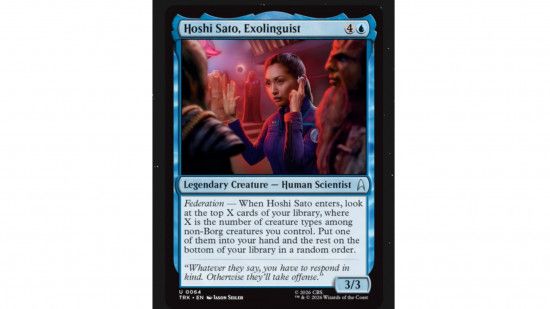

Wizards has revealed new Magic: The Gathering Star Trek mechanics, Commander decks, and Kobayashi Maru MTG designs that could reshape casual tables and deckbuilding math.
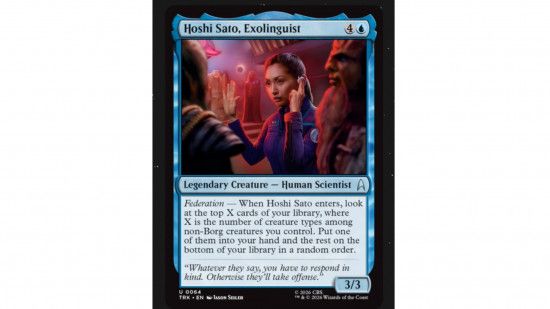
Image: wargamer.com
Star Trek’s MTG reveal is really about choices with consequences
Wizards of the Coast has revealed the central mechanical package for Magic: The Gathering | Star Trek, and the headline is bigger than a crossover card gallery. According to Wizards’ product page, the set releases on November 13, while MonsterVine reports prerelease events begin November 6 at local game stores. The official Commander deck announcement confirms four preconstructed decks, each with 32 new-to-Magic cards, arriving alongside the release.
The tension in this reveal is that Star Trek is entering Magic with mechanics built around decision pressure. The new MTG Star Trek mechanics include Beam Me Up, Face a Dilemma, Federation, Strange New Worlds, Assimilate, plus two Commander-only mechanics, Battlefront and Seek Out. GameSpot also reports that the set includes a returning mechanic from Edge of Eternities, while Polygon specifically identifies Spacecraft and Station as returning pieces tied to iconic ships and installations.
That gives Magic The Gathering Star Trek a sharper strategic identity than a simple Universes Beyond skin. The set appears to care about how players sequence modal decisions, whether they diversify creature types and land names, and how Commander players spread attacks or draw on multiple turns. Its most provocative example is Kobayashi Maru Scenario, a mythic rare blue enchantment reported by Polygon and GameSpot that eventually forces its controller toward “you lose the game” if they cannot end the game, remove the enchantment, or otherwise bend the rules around it.
Face a Dilemma turns modal spells into a resource system
Face a Dilemma is the mechanic that best explains the set’s design thesis. MonsterVine describes it as triggering whenever you choose one or more modes for a modal spell or ability. The same report notes that it still counts if the spell is countered or fails to resolve, and choosing multiple modes still counts as a single dilemma. GameSpot gives Seven of Nine as an example of a card that rewards the act of making that modal choice by letting you draw a card.
That detail matters for competitive-minded players because Face a Dilemma shifts value to the decision point itself. If the source material is accurate, the reward is not necessarily tied to the spell resolving. In practical deckbuilding terms, that makes modal spells and abilities more attractive because they can carry both their printed flexibility and an additional trigger package. A counterspell can still answer the original effect, but it may not erase all of the value generated by choosing a mode.
Kobayashi Maru Scenario is the flashiest version of that idea. Polygon reports that the enchantment lets its controller choose among effects at the beginning of upkeep, including drawing two cards, returning a small opposing creature to its owner’s hand, creating two 1/1 red Officer creature tokens, or abandoning ship and losing the game. GameSpot adds the crucial pressure point: you cannot choose the same mode twice. Once the safe options are exhausted, the final mode becomes the bill coming due.
This is where the Kobayashi Maru MTG design becomes interesting beyond flavor. Polygon compares it to Demonic Pact, another enchantment that offers strong rewards before threatening its controller with a game-ending consequence. That comparison is useful because it frames Kobayashi Maru Scenario as a card for players who can convert temporary advantage into a win, remove their own permanent on schedule, or transfer the problem to someone else. Polygon specifically points to Donate as one way players may try to hand the enchantment to an opponent before the fatal mode arrives.
Beam Me Up rewards ETB loops without being free recursion
Beam Me Up is the set’s clearest tempo mechanic. MonsterVine reports that it lets certain instant and sorcery spells be cast from the graveyard by returning a creature you control to its owner’s hand and paying the listed cost. Afterward, the spell is exiled whether or not it resolves. GameSpot’s example is Open Communications, a blue spell that can be cast again from the graveyard by returning a creature and paying a separate cost.
The important design knob is the creature bounce. This is not simple flashback with a Star Trek name. Returning your own creature can be a cost, a setup tool, or both. If the creature has an enters-the-battlefield ability, Beam Me Up can turn a graveyard spell into a way to rebuy that trigger. If the creature is carrying an aura or counters, or if your board is under pressure, the same action can be painful. That makes Beam Me Up a mechanic about timing and board texture rather than raw graveyard volume.
For casual Commander, the appeal is obvious. Tables already like creatures that generate value on entry, and Beam Me Up gives those decks another reason to hold up mana and reuse a utility body. For tighter formats, the question is whether any Beam Me Up spell is efficient enough when its hidden cost includes losing battlefield presence for the turn. The exile clause also matters. MonsterVine’s note that the spell is exiled regardless of resolution keeps the mechanic from becoming a long-game loop by itself.
Federation and Strange New Worlds reward diversity, but in different zones
Federation and Strange New Worlds are both diversity mechanics, but they ask deckbuilders to diversify different parts of the game. MonsterVine reports that Federation counts the number of different creature types among non-Borg creatures you control. GameSpot gives Captain Jonathan Archer as an example, noting that Archer is a Human Officer and creates a Dog token, which can make his first activation scale quickly because the board already contains multiple creature types.
That sounds friendly to casual theme decks, but it also creates a real deckbuilding puzzle. Tribal Commander decks often want redundancy, with many creatures sharing a type and benefiting from the same lords. Federation points the other way. It wants a crew, not a tribe. Starfleet Academy, cited by GameSpot, can tap for mana of a chosen color equal to the number of creature types among creatures you control after paying five generic mana and tapping it. In a board with varied tokens and legendary characters, that ceiling can be high.
Strange New Worlds shifts the same philosophy to lands. MonsterVine says it counts the number of differently named lands you control, each name counting once. GameSpot’s Deep Space Scan example draws a card for each differently named land you control, while Captain Pike, Fullness of Time has power and toughness based on that count.
The strategic pressure here is subtle. In Commander, singleton deck construction already makes differently named lands common, so Strange New Worlds may reward what many mana bases already do. In 60-card formats, where multiple copies of the same basic or dual land are common, the mechanic asks whether a more varied mana base is worth potential consistency costs. That is the kind of tradeoff competitive players should watch as the full Star Trek MTG cards become available in Wizards’ card image gallery.
Assimilate gives the Borg a mechanical identity built on control and type erasure
Assimilate is the Borg mechanic, and its rules text carries a lot of flavor into gameplay. MonsterVine reports that Assimilate converts a creature into a Borg artifact creature, adds a +1/+1 counter, and removes its other creature types. Depending on the effect, it can either bring a creature card onto the battlefield under your control or take control of a creature already on the battlefield.
Polygon reports that the Borg Queen leads the Esper-colored We Are the Borg Commander deck, identified by Wizards as white-blue-black. Polygon describes her as giving artifact creatures you control +2/+2, and says that when she enters or attacks, she forces an opponent to exile cards from the top of their library until they reveal a creature, which she assimilates under your control as an artifact creature Borg with a +1/+1 counter and no other creature types.
That matters because Assimilate interacts directly with the set’s other identity mechanics. Federation ignores Borg, according to MonsterVine’s description, and Assimilate strips previous creature types away. In a Commander pod, that means Borg cards can do more than steal creatures or build an artifact board. They can also disrupt opponents whose payoffs depend on creature type diversity. It is an elegant piece of hostile design: the Federation wants a varied crew, while the Borg flatten difference into one type.
There is also a balance question to watch. Theft effects in Commander can create memorable stories, but repeated theft tied to a commander can slow games and draw table aggression. The revealed Borg Queen text reported by Polygon points toward a deck that snowballs through artifact creature scaling. Casual groups may want to know how often the precon can seize key creatures, while upgrade-minded players will immediately look for artifact anthem effects, sacrifice outlets, and ways to reuse enters-the-battlefield triggers.
Commander gets its first new keyworded direction in years
The MTG Star Trek Commander reveal is significant because two mechanics are explicitly Commander-only. Polygon notes that Wizards began annual preconstructed Commander decks in 2011, ended the standalone Commander series in 2019, and has since tied new decks to major set releases. Polygon’s analysis highlights that these releases have included powerful cards but have not recently changed the format with new keyworded mechanics in the way Lieutenant did in Commander 2014 or Eminence did in Commander 2017.
Battlefront, introduced in the Klingon Fury deck according to Polygon, rewards attacking multiple opponents in the same turn. MonsterVine adds the important implementation details: each opponent attacked counts only once, even across multiple combat phases, and creatures that enter attacking do not count toward the total. Polygon’s example is Worf, Defiant Commander, whose Battlefront ability exiles the top X cards of your library based on the number of opponents you attacked this turn and lets you play those cards until the end of your next turn.
That pushes aggressive Commander away from tunneling one vulnerable player and toward spreading combat pressure. It is a design lever for healthier multiplayer aggression, because the reward scales with engaging the table. Extra combat steps still interact with the mechanic, according to Polygon, because Battlefront remembers who was previously attacked, but MonsterVine’s note about each opponent counting once limits the ceiling.
Seek Out is the quieter but potentially broader Commander mechanic. MonsterVine reports that it triggers when you draw your second card each turn and can happen on your own turn or an opponent’s turn. Polygon says Jean-Luc Picard, Luminary uses Seek Out to put a +1/+1 counter on a creature and two charge counters on a spacecraft, and also draws a card when a historic permanent with mana value three or greater enters play. Polygon also notes that Seek Out is effectively keywording a pattern Magic has used before on cards such as Thopter Fabricator and Jace, Arcane Strategist.
That makes Seek Out the mechanic I would expect to age best in casual Commander. Drawing a second card each turn is already a common goal, and instant-speed draw can turn opponents’ turns into trigger windows. Battlefront asks you to risk combat across the table. Seek Out asks you to build a steady card-flow engine.
Release products, availability, and the questions still open
Wizards’ official product page lists Magic: The Gathering | Star Trek for November 13 and points players to local stores, TCGplayer, MTG Arena, Amazon, and other retailers. Wizards also describes Play Boosters, Collector Boosters, and a Draft Night product for a four-player Pick-Two Draft experience. The same page says Headliner Signed cards appear as a chase in Collector Boosters, with Wizards noting that images are digital renderings and that TRK Headliner cards are localized in English only while remaining mechanically identical to other non-Headliner treatments.
For Commander buyers, Wizards confirms four decks: Federation Fleet in blue-red-white, Landing Party in green-white-blue, Klingon Fury in red-white-black, and We Are the Borg in white-blue-black. Each standard Commander deck includes a ready-to-play 100-card deck, one traditional foil face commander with borderless art, 99 non-foil cards including 32 new-to-Magic cards, 10 non-foil double-sided tokens, a reference card, and a deck box. Wizards also lists Collector’s Edition Commander decks with the same deck contents in surge foil.
The practical buying advice depends on your format. Commander players have the clearest path because Wizards has named the decks, color identities, and contents. If you want Battlefront, Klingon Fury is the deck to watch. If you want Seek Out and spacecraft counters, Federation Fleet’s Picard angle is the revealed signal from Polygon. If you want Assimilate, We Are the Borg is the focused precon. Players primarily interested in 60-card formats should wait for the full card image gallery and legality details rather than evaluating the set from splashy mythics alone.
The unanswered questions are mostly power-level questions. We have mechanics, examples, and deck shells, but the full metagame impact depends on rates, removal options, and how many modal cards are efficient enough to make Face a Dilemma consistent. The Kobayashi Maru Scenario is already the card that will define early conversation because it is legible, dangerous, and abusable in the way Magic players enjoy testing. Whether it becomes a casual story engine or a competitive puzzle piece will come down to how reliably players can turn its no-win clock into someone else’s problem.