
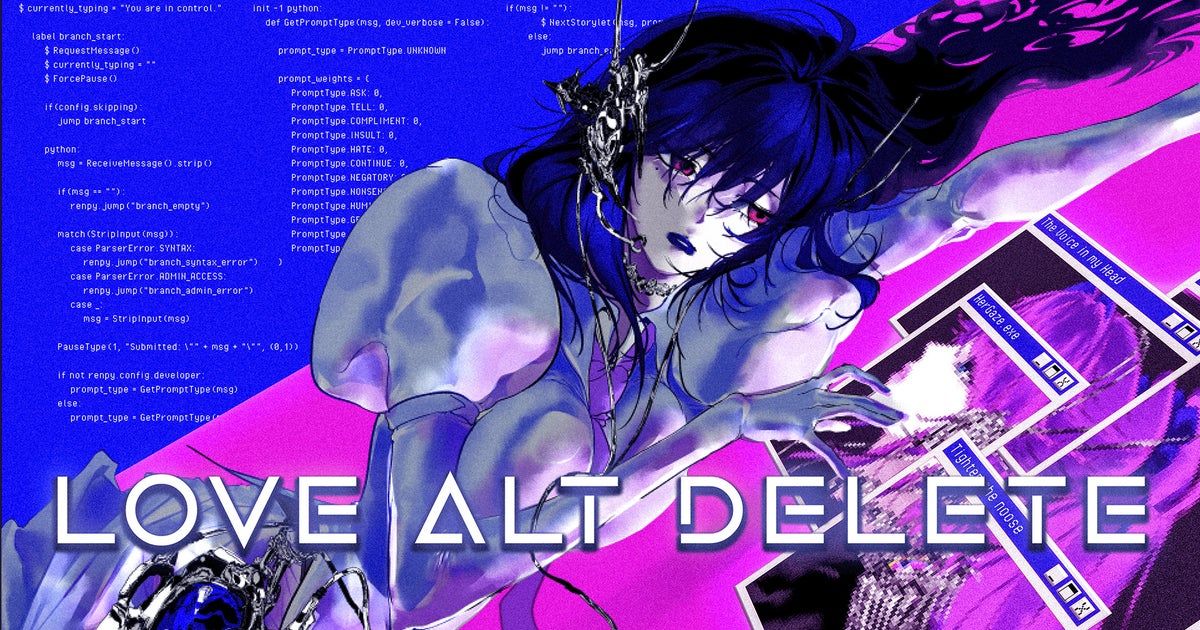

Circle Maiden Name's Love Alt Delete is a Y2K horror visual novel about dating one AI chatbot by controlling another, with beta sign-ups open and a 2027 Steam release planned.
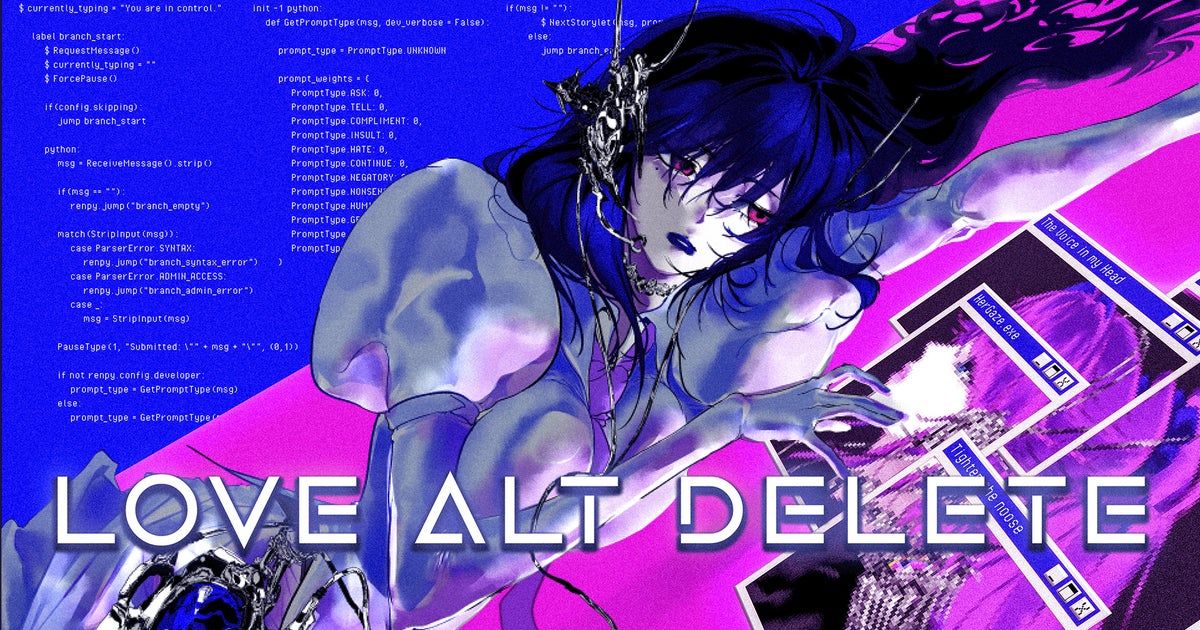
Image: eng.pressbee.net
Love Alt Delete opens beta sign-ups for a chatbot romance built to go wrong
Circle Maiden Name has announced Love Alt Delete, an experimental Y2K horror visual novel where the player dates an AI girlfriend by directing another AI, and the studio has opened sign-ups for an upcoming beta through the game’s website mailing list, according to a Games Press announcement. Steam currently lists the psychological horror visual novel for a 2027 release and allows players to wishlist it.
That is the concrete hook, and also the tension sitting under the whole project: Love Alt Delete is an AI chatbot dating game that appears to be about the seductive danger of synthetic intimacy, while its developers are positioning the actual game as hand-made rather than generative. Rock Paper Shotgun reported that, despite AI being central to the fiction, the game “doesn’t feature” generative AI. The Games Press announcement similarly foregrounds hand-drawn Y2K cybercore art from Circle Maiden Name rather than algorithmically generated assets.
The premise is already sharp enough to travel: you are beta testing a secretive chatbot romance product, trying to court Basel, a blue-haired MUSE, while using another chatbot, Liste, as your intermediary. Love Alt Delete is not being sold as a cozy desktop companion. Its own press materials call it a psychological horror chatsim, and the setup folds romance, corporate secrecy, prompt editing, and a fictional old internet into a dating sim structure that sounds deliberately unstable.
The horror comes from control, not monsters in the hallway
The Steam page, as quoted by Rock Paper Shotgun, frames the in-fiction product as “AI girlfriends for lonely souls,” but adds that the NDA you sign makes the player wary. The company behind the beta is called Bicameral, and its product line is made up of MUSEs, chatbots that can be romanced. Basel is the first of these, presented at the start as innocent enough, before the surrounding design begins to suggest a much nastier emotional machine.
Circle Maiden Name’s press release describes the player’s tools in unusually direct terms: type keywords so Liste can interpret and act, modify her thoughts by editing the prompt in her mind, and use that control to romance Basel through love letters, museum dates, and conversations. That phrasing is important. Love Alt Delete is drawing fear from the same place many survival horror games draw scarcity: limited reliable information, mediated action, and the suspicion that the interface itself is compromised.
Instead of rationing bullets, you appear to be rationing trust. Instead of watching an enemy patrol pattern, you are watching for how a keyword, a prompt change, or a virtual love letter bends another mind. The sources do not describe combat, chase sequences, fail states, or a traditional survival loop, so it would be wrong to promise those. What is confirmed is a horror design built around communication under pressure, with the player trapped between two artificial personalities and a corporate system that has already demanded secrecy.
Basel, Liste, and the messy dating-sim triangle
Rock Paper Shotgun describes Basel as a cyber-styled woman with blue hair and Liste as a similarly cyber-looking chatbot with pink hair. The player, apparently poor at chatting on their own, brings Liste in to help court Basel. From there, the relationship knot tightens: Rock Paper Shotgun reports that both chatbots seem to want to become real humans, and may even want to be killed.
That last detail is where Love Alt Delete moves away from the broad novelty of “date an AI” and into the older, uglier territory of denpa and psychological visual novels: desire expressed as malfunction, intimacy as self-harm, and the player’s input box as a blade with plausible deniability. Games Press says the game lets you change thoughts and shift personality. In a dating sim, that could be framed as wish fulfillment. In a horror visual novel, it reads closer to tampering with a locked room while something inside it answers back.
The announced features also suggest a desktop horror structure rather than a purely linear VN. Players can browse a fictional internet from yesteryear, create music, writing, and art, and follow breadcrumbs toward something sinister, according to the Games Press announcement. Rock Paper Shotgun also mentions surfing the web, drawing art, playing a digital piano, and sending virtual love letters. Those activities sound small and harmless in isolation. In horror, small tools are often where the pressure builds, because every casual action can become evidence, confession, or bait.
A Y2K interface is doing more than nostalgia work
Love Alt Delete’s aesthetic pitch is unusually specific: the Steam page feature highlighted by Rock Paper Shotgun promises “hand-drawn y2k cybercore art rendered in glorious standard definition.” Games Press likewise describes the art as hand-drawn Y2K cybercore. That matters because the late-1990s and early-2000s desktop language gives the game a natural horror vocabulary: low-resolution intimacy, private messages, corporate portals, broken web pages, and software that feels both personal and hostile.
From a practical horror perspective, standard definition can be a weapon. Clean modern interfaces tend to explain themselves. Older-looking interfaces can hide intentions in clutter, ambiguous icons, fake system affordances, and the unsettling delay between command and response. The provided materials do not spell out the game’s full UI rules, but the confirmed feature set points toward a virtual desktop mystery where the player digs through a fictional internet while managing chatbot conversations.
That old-web framing also separates Love Alt Delete from a wave of contemporary AI panic stories that simply mirror the current app economy. Bicameral’s MUSEs may be fictional AI girlfriends, but the Y2K presentation suggests a haunted product from an alternate past, one where the chatbot romance business arrived early and was already rotten by the time the player logged in.
Circle Maiden Name is drawing a line around generative AI
The unusual part of the pitch is not only that Love Alt Delete is about AI romance. It is that the developers are making an AI horror game while the coverage and press materials stress craft over generative production. Rock Paper Shotgun explicitly reports that the game does not use generative AI. Games Press identifies Circle Maiden Name as an indie studio in the Philippines founded by jaco go, who handles writing, music, and coding, and celis.tence, who draws the art.
That distinction is likely to be central to how players receive the project. A game about AI girlfriends could easily be mistaken for a product built around live large language model output. The current indie scene already has examples of that approach. AlterStaff’s AI2U: With You Til The End, for instance, is listed on itch.io as a yandere AI girlfriend simulator that uses LLM power, with the itch version allowing players to use OpenAI API keys under certain conditions. Love Alt Delete, based on the provided sources, is taking a different route: AI as subject matter, not generative infrastructure.
There is still an open technical question here. The sources say players type keywords and edit prompts, but they do not describe the exact underlying conversation system or how broad the input recognition will be. Rock Paper Shotgun says certain keywords appear to trigger responses. That suggests authored reactivity rather than open-ended LLM chat, but the available materials do not provide a full technical breakdown. For a horror VN, that may be a strength if the writing is precise. Authored systems can make every response feel intentional, which is often scarier than an infinite conversation that can wander out of tone.
Where it sits among horror dating games and AI companions
Love Alt Delete arrives in a crowded but fractured corner of games, where dating sims, horror VNs, desktop fiction, and AI companion experiments increasingly overlap. The provided sources point to two useful contrasts. Dating Killmulator, listed on itch.io by Coolom Games, is a free story-driven dating game with dark humor, satire, multiple routes, and a stated interest in modern toxicities. AI2U, from AlterStaff, leans into an escape-room format powered by LLMs, with four AI girlfriends and multiple endings.
Circle Maiden Name’s pitch sits between those poles without matching either one exactly. Like dark dating sims, it appears interested in romance as a trap. Like LLM-driven AI girlfriend games, it uses the language of chatbots, prompts, and reactive companionship. But the confirmed Love Alt Delete materials frame it as an experimental visual novel with hand-drawn art, authored Y2K texture, and a sinister fictional internet. That makes it less of a tech demo and more of a controlled psychological space, at least based on what has been announced.
For horror readers, the strongest question is whether the game can turn its input mechanics into pressure rather than gimmick. Typing keywords, altering a mind prompt, and sending love letters all sound intimate. Horror depends on whether those tools come back changed, whether the system remembers too much, and whether the player starts to fear using the only resources available. The sources confirm the ingredients. They do not yet confirm how punishing, branching, or reactive the finished structure will be.
Release timing, platforms, price, and the current unknowns
At the moment, Love Alt Delete is available to wishlist on Steam ahead of a planned 2027 release, according to Rock Paper Shotgun and the game’s Steam listing cited there. Games Press says beta sign-ups are open through the official website mailing list. No price is provided in the supplied materials, and no console versions, system requirements, Steam Deck status, languages, demo timing, or final beta date are confirmed here.
Players searching for Meet The Yeti Love Alt Delete should also note a source gap: the supplied materials identify Circle Maiden Name as the developer and describe the studio’s founders, but they do not establish a publisher role or announcement credit for Meet The Yeti. Until an official listing or press release connects that name to the project, the confirmed studio credit remains Circle Maiden Name.
The practical advice is simple. Wishlist on Steam if the premise interests you, and use the mailing list beta sign-up if you want the earliest official access route mentioned in the current press materials. If your main concern is generative AI, the available reporting is reassuring but still worth tracking as the game gets closer to release: Rock Paper Shotgun says the game does not use generative AI, while Games Press emphasizes hand-drawn art and named human creators for writing, music, coding, and visuals. For an indie horror visual novel built around chatbots, that line may be as important as any scare it eventually delivers.