
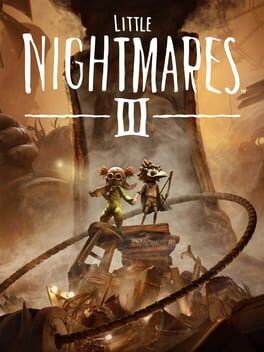

How The Backstage, the first DLC for Little Nightmares III, splits up its heroes, rewires the co-op formula with Dime’s Torch Hat, and quietly stretches the edges of the series’ shadowy universe.
The curtains have barely closed on Little Nightmares III and Bandai Namco is already dragging players somewhere darker. The Backstage, the first of three planned post-launch chapters, is out now and it wastes no time in pulling the rug from under the base game’s co-op dynamic.
Instead of being a side challenge or a throwaway bonus room, The Backstage feels like a focused character piece for Low and a proof of concept for how far Supermassive is willing to bend this sequel’s structure.
A new act behind the Carnevale curtain
The Backstage picks up in the twisted Carnevale, a location that already loomed large in the main story of Little Nightmares III. Rather than retreading familiar alleys and tents, the DLC dives down into the underbelly of the attraction, past the spotlights and into the machinery and forgotten corridors that prop the show up.
Almost immediately, Low and Alone are torn apart. Alone is dragged away into the dark, and Low is left scrambling through the bowels of the Carnevale to reach her. That separation is the emotional spine of the chapter. Where the base game built its identity around two kids leaning on each other, The Backstage opens by ruthlessly stripping that support away.
In Alone’s place steps Dime, a new companion who is less a replacement friend and more a temporary ally bound by survival. The story frames Dime as another lost child caught in the Spiral’s gravity, someone who knows these maintenance corridors and service shafts better than Low but is just as vulnerable to what stalks them.
The antagonist this time is The Puppeteer, a new Resident hunting the Carnevale’s underbelly for fresh material. She sees living bodies as raw canvas and the entire Backstage as a kind of workshop. Through environmental storytelling, half-finished mannequins, pinned silhouettes and looming frames, the DLC leans into the idea that Alone is being shaped into a grisly “masterpiece” unless Low and Dime can cut the strings in time.
Narratively, it is a simple setup, but the execution fits the series perfectly. There is almost no clean exposition, just glimpses of The Puppeteer’s work and the sick logic of the Carnevale seen from behind the curtain.
Dime’s Torch Hat and the shift in co-op rhythm
The biggest mechanical shake-up in The Backstage is Dime’s Torch Hat. Where Alone’s arrows in the base game gave you a way to interact with distant switches or distract enemies, the Torch Hat rewires that synergy around light and shadow.
The Torch Hat functions as both a directional spotlight and a fragile lifeline. In pitch-black service tunnels it is often the only thing stopping Low from disappearing into the void entirely. You will find yourself coordinating movement around its narrow cone, timing sprints between islands of visibility and carefully scanning walls for climbable paths or run-down signage that reveals the route forward.
The DLC uses this in several smart ways. Some rooms bristle with photophobic creatures that only retreat when pinned under the Torch Hat’s beam, turning Dime into an unwilling crowd controller while Low scrambles across vents and rickety scaffolding. In others, harsh work lights and dangling mirrors let you bounce or block illumination, creating makeshift safe zones and puzzle chains that are more about shaping light than pushing boxes.
Sneaking past The Puppeteer herself leans into this mechanic too. She is drawn to motion and glimmers, so there are tense stretches where you have to risk illuminating a path for Low while keeping the beam off reflective surfaces that might catch her eye. The familiar Little Nightmares rhythm of waiting, bolting and hiding is still here, but the light management adds a nervous extra layer of planning.
Played solo, Dime acts as an AI companion similar to Alone in the main game, responding to context-sensitive prompts and holding position when needed. Online co-op lets a second player drive Dime directly, which is where The Backstage really clicks. The banter of one player literally holding the light and the other risking everything in the dark replicates the precarious partnership that defines the series at its best.
Backstage spaces that feel distinct from the Carnevale
Visually, The Backstage carves out a clear identity inside the broader Carnevale. Instead of the gaudy neon and crooked carnival attractions from the main campaign, this chapter is all industrial guts and discarded glamour.
You move through prop warehouses thick with toppled stage pieces, costume rooms where masks sag from hooks like empty faces, and rigging chambers that stretch into the dark like a forest of chains. The set dressing constantly blurs the line between performance and reality: paper maché cliffs hiding real chasms, painted backdrops nailed over crumbling walls, and mannequins pinned mid-pose that might be stand-ins for children who did not make it out.
Even simple traversal sequences use this theatrical language. Catwalk chases play out across half-built sets, while maintenance lifts clatter past rehearsal spaces frozen in time. There is a sense that the Carnevale’s cheerful façade always depended on this forgotten army of workers, props and patched-together machinery, all of it now co-opted by The Puppeteer’s obsession.
Audio work does a lot of heavy lifting here. The muted thump of crowds somewhere overhead filters down through vents, occasionally clashing with the scratch of strings as The Puppeteer tunes some unseen marionette. When the chapter goes quiet and those distant sounds cut out, it feels like the rest of the Carnevale has stopped breathing just to listen to you.
How it hooks into the base game
Structurally, The Backstage is a standalone chapter that slots into the Secrets of the Spiral DLC roadmap, but it is tightly bound to the main campaign. It does not retell events you have already played. Instead it zooms in on the aftermath of Low and Alone getting separated, filling in emotional and thematic gaps rather than rewriting lore.
Players who remember specific set pieces from the Carnevale in the base game will recognize props, posters and silhouettes hinting at where this chapter sits on the broader timeline. Environmental callbacks, like torn banners that later appear intact in the main story or backstage corridors that line up with showpieces from the front of house, create a subtle sense of continuity.
On a character level, The Backstage gives Low more room to breathe. In Little Nightmares III proper, Low often feels like one half of a shared spotlight. Here he is forced into reactive decisions without Alone beside him. His animations in key moments, the way he hesitates before leaving Dime behind in risky sections or clutches certain objects a little longer than necessary, quietly shade him in as more than just the quieter half of the duo.
Dime, meanwhile, slots into the series’ tradition of side characters who feel fully realized despite minimal dialogue. You glimpse pieces of his past through props he lingers on and the places he seems to know by instinct. None of it is spelled out, but for a universe built on implication that restraint is part of the appeal.
Does The Backstage really expand the Little Nightmares universe?
The obvious addition is The Puppeteer herself. She fits neatly into the roster of grotesque Residents that define Little Nightmares, but she is more than a one-note slasher. Her whole domain is about control, curation and the illusion of choice. The way bodies and props are arranged in her workshop hints at a broader theme the series has always toyed with: children being posed and repackaged by forces far beyond them.
The chapter also digs deeper into the Spiral and the Nowhere without breaking their mystery. By exploring the Carnevale’s underbelly, you get a stronger sense of how locations in the Spiral interlock. This is not just a disconnected dreamscape but a network of spaces where power structures, like Residents, draw from shared systems and resources.
What it does not do is drop any explicit lore bomb about the origin of the Nowhere or definitive fates for returning characters. Instead, it extends the universe sideways, adding another pocket of horror that feels consistent with what you already know while nudging themes of performance, control and exploitation further into the light.
From a more practical perspective, The Backstage is a meaningful expansion because it tests a different kind of co-op dynamic without abandoning what makes Little Nightmares III tick. The light-focused puzzles, the vulnerable partnership built around Dime’s Torch Hat and the constant push-pull between visibility and safety all feel like they could inform where the series goes next.
Verdict: A tight, worthwhile first chapter
Measured purely as content, The Backstage is closer to a concentrated episode than a full second act. It is a few hours of new material built around a single strong mechanic and a sharply defined villain. If you are hoping for a radical reinvention, this is not that.
As an opening shot in the Secrets of the Spiral season, though, it hits the right notes. It manages to be mechanically distinct, visually memorable and thematically aligned with the base game, while nudging Low’s journey into slightly more personal territory.
For players already invested in Little Nightmares III, The Backstage is worth descending into. It will not answer every question you have about the Spiral, but it will leave you with a few new images you will not easily forget, and it proves that there is still plenty of nightmare to mine behind the scenes.