
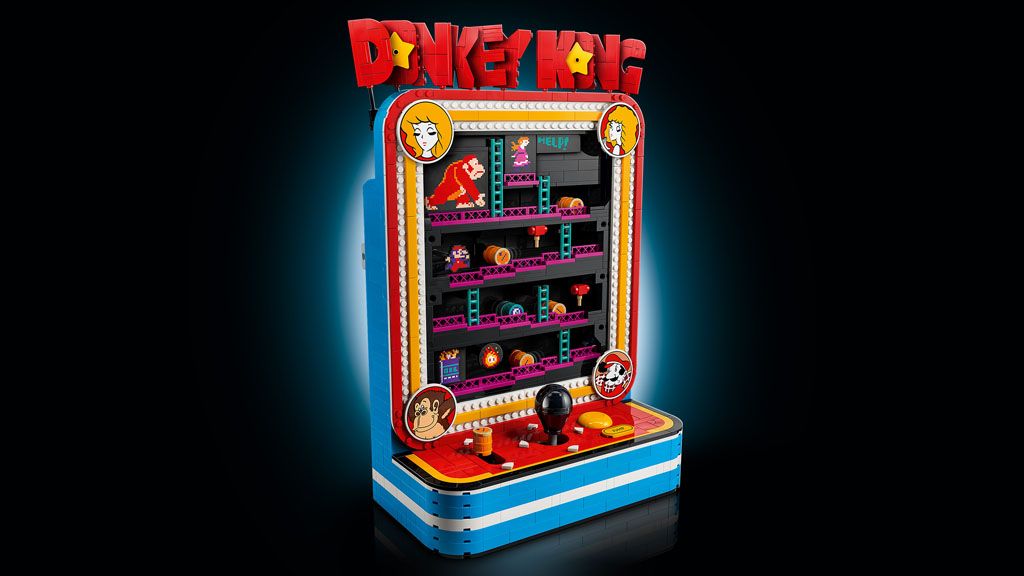

LEGO and Nintendo have officially revealed the LEGO Donkey Kong Arcade set for August 1, 2026, with working barrel play, a Steve Wiebe trailer cameo, and a few listing details collectors should watch closely.
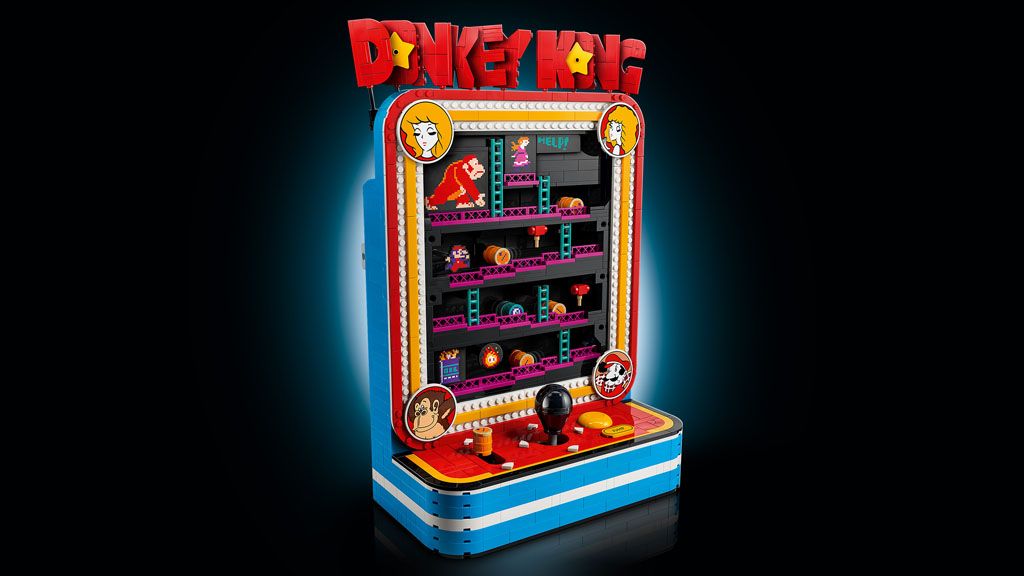
Image: thebrickfan.com
LEGO and Nintendo move Donkey Kong from leak to launch window
The LEGO Donkey Kong Arcade set is now official, with pre-orders live ahead of an August 1, 2026 release date. According to VGC, Nintendo revealed the set through a LEGO-created trailer shared by Nintendo of America, and LEGO is listing it at $199.99 / £149.99 with warehouse dispatch beginning August 1. Nintendo Life and IGN also report the same August 1 date and $199.99 / £149.99 pricing.
That confirmation matters because this set did not arrive cleanly. Nintendo Everything reported before the official reveal that a now-removed Argos UK listing had surfaced with images, price, release timing, and a lengthy product description. 9to5Toys also covered earlier leaked images and details, framing them at the time as unconfirmed. The official reveal now locks down the core pitch: a LEGO Super Mario adult-focused recreation of Nintendo’s original Donkey Kong arcade cabinet, built around the first-stage barrel chase rather than a static character display.
The immediate tension for collectors is that August 1 is close, pre-orders are already live, and a high-profile Nintendo LEGO arcade set tends to sit at the crossroads of several audiences at once: LEGO adults, retro Nintendo fans, Donkey Kong devotees, and arcade-history collectors. This is not a wait-and-see announcement with a vague season attached. It is a dated product with a premium price and a release window that could turn early allocation into the real game.
The set builds a playable slice of the 1981 arcade cabinet
Official product descriptions quoted by Nintendo Life and Nintendo Everything describe LEGO Donkey Kong Arcade, set number 72051, as an 18+ LEGO Super Mario build based on the original Donkey Kong arcade game. The model features Jumpman, Donkey Kong, and Lady, with scaffold, ladder, hammer, and barrel details recreating the construction-site stage that introduced Nintendo’s barrel-dodging rhythm to arcades.
The design focuses on the first level rather than trying to reproduce an entire cabinet at full fidelity. IGN describes the finished model as an interactive arcade-style display with a Donkey Kong logo at the top, character art around the display, a barrel-release lever, a joystick, and a Jump button. VGC says the set shows the first level surrounded by a marquee similar to the original coin-op cabinet.
The central mechanic is the barrel run. VGC reports that builders can load the set with 21 barrels, then pull a lever to release one barrel at a time as if Donkey Kong had thrown it. The barrel rolls toward Jumpman, while the joystick and button let the user move and jump him over the hazard. Nintendo Everything’s quoted Argos description adds that the build includes a mechanism to circulate barrels in a continuous loop. IGN similarly says a behind-the-set mechanism returns barrels from the bottom of the model back to the top.
For a LEGO interpretation of an arcade game, that is the crucial design choice. The build is trying to capture Donkey Kong’s pace, not only its silhouette: the threat starts high, travels downward, and forces a jump at the right moment. In game-design terms, the set’s whole drama is the oldest action-game set piece in Nintendo history, compressed into a hand-operated loop.
A small but important discrepancy: 1,367 pieces or 1,371 pieces
Most available reporting points to 1,367 pieces. Nintendo Everything’s Argos-based report lists 1,367 pieces. Nintendo Life’s quoted LEGO description says the set contains 1,367 pieces, although the article’s own summary line also says 1,371 pieces. IGN lists 1,367 pieces. Shane the Gamer also identifies it as a 1,367-piece set.
VGC, meanwhile, reports that the set contains 1,371 pieces. Because the provided source material includes both numbers, the safest reading is that there is a live discrepancy in reporting or listing text rather than a confirmed change in the physical product. The official product-description language quoted by Nintendo Life supports 1,367, but VGC’s article uses 1,371 while also linking to LEGO’s pre-order page.
For buyers, four pieces will not decide the value of a $199.99 display-and-play model, but the mismatch is still worth noting because LEGO collectors often care about exact specifications, inventory, and set databases. Anyone ordering for archival completeness should verify the final piece count on the regional LEGO store page, the box, or LEGO’s downloadable instructions once available.
Steve Wiebe’s cameo turns the trailer into an arcade-history signal
LEGO and Nintendo’s reveal trailer stars Steve Wiebe, which is a very specific choice. VGC reports that the set was officially revealed first on Nintendo of America’s X account in a LEGO-created trailer featuring Wiebe. Nintendo Life also notes that LEGO and Nintendo called on the legendary Donkey Kong player to promote the set.
Wiebe is best known to a broad gaming audience through The King of Kong, the 2007 documentary about the battle for the Donkey Kong high-score record. VGC describes Wiebe as the documentary’s main focus, portrayed as the wholesome “good guy” attempting to beat Billy Mitchell, another high-score veteran depicted as his rival. VGC also notes that the documentary’s popularity, including its “normal guy trying to become a hero” arc and the memorable kill screen scene, renewed interest in the competitive Donkey Kong high-score scene.
That context gives the trailer a second audience. The set itself references the 1981 arcade game, according to IGN, where Jumpman would later evolve into Mario and Lady would later be known as Pauline. Wiebe’s appearance references the later culture that grew around the cabinet: scoreboards, tape reviews, public rivalry, and the fascination with mastery over a deceptively simple screen of ladders and barrels.
VGC adds that neither Wiebe nor Mitchell currently sits in the top 10 leaderboard, but their King of Kong association keeps them among the most recognizable names connected to competitive Donkey Kong. That distinction is useful. The cameo is not a claim that this set is tied to the current competitive leaderboard. It is a nod to the documentary-era mythology that made many modern players care about Donkey Kong as a living arcade challenge rather than only a museum piece.
Where it fits in Nintendo’s expanding LEGO collector line
VGC places the Donkey Kong Arcade set within LEGO’s adult-aimed Super Mario collector subset, alongside previous releases such as a giant Bowser, a Question Block containing a Super Mario 64 diorama, a Piranha Plant, an NES, a Game Boy, and large-scale Mario Kart models of Mario and Luigi. That lineup explains the price and age rating better than the Donkey Kong name alone.
This is being positioned as retro decor and a premium build, not as a starter playset for younger Super Mario LEGO owners. Nintendo Life’s quoted product description calls it a building set for adults and says it is intended as playful retro decor for an entertainment room or home office. IGN likewise identifies it as part of LEGO’s broader adult-oriented range because of the subject matter and moving-part complexity.
The cabinet framing is also important because LEGO and Nintendo have already proven that their adult line can treat old hardware and old game imagery as buildable objects. The NES and Game Boy sets leaned into physical memory: screens, cartridges, buttons, and the shape of the machine. Donkey Kong Arcade extends that approach to the coin-op cabinet era, but adds a mechanical action loop that mirrors the game’s first-screen pressure.
That makes it a different proposition from a character statue. A Bowser model asks whether the sculpt and shelf presence justify the space. This asks whether the small machine works as a kinetic display. The value hangs on how well the lever, joystick, Jump button, and barrel circulation hold up after repeated use, something the current source material describes but does not independently test.
Collectors should treat August 1 as a real checkpoint, not a vague window
The confirmed release timing is August 1, 2026. VGC says LEGO is set to dispatch the set from its warehouse from that date, while Nintendo Life and IGN report that pre-orders are live ahead of release. The listed price is $199.99 in the U.S. and £149.99 in the U.K. across VGC, Nintendo Life, and IGN’s reporting.
There is no source-supported evidence here of limited-edition status, a timed exclusive, a gift-with-purchase offer, or expected sellout. Collectors should avoid treating those as facts unless LEGO or Nintendo announces them. The reason to watch the August 2026 release closely is more practical: this is a premium Nintendo LEGO set tied to a recognizable arcade cabinet, revealed after leaks, and aimed at several overlapping collector groups.
If you already collect the adult Nintendo LEGO line, the August 1 date is the point to check regional pricing, shipping estimates, and whether LEGO’s own store differs from Amazon or other retailers in availability. IGN reports pre-orders at LEGO and Amazon, while VGC and Nintendo Life point to LEGO’s store. If you care about exact inventory details, verify the piece count on the product page before buying, given the 1,367-versus-1,371 reporting discrepancy.
If you are mainly an arcade-history fan drawn in by Steve Wiebe’s cameo, the decision is different. The trailer’s casting is a smart cultural nod, but the object you are buying is a LEGO Super Mario display model with hand-operated mechanics, not an electronic mini-cabinet and not a playable ROM device. Based on the available descriptions, its appeal is in building and physically staging the barrel-jump sequence that made Donkey Kong iconic. For the right shelf, that may be exactly the set-piece you want. For anyone hoping for lights, sounds, score tracking, or a digital game inside the cabinet, none of the provided official descriptions confirm those features.