
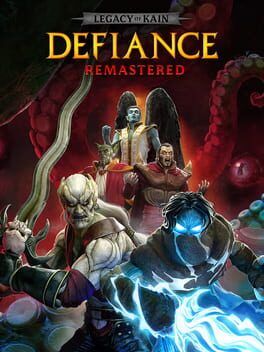

How Defiance Remastered’s visual overhaul, camera rework, restored content and delayed Switch launch show where both Nosgoth and modern remasters go next.
A cult classic returns in a very different remaster landscape
When Legacy of Kain: Defiance first released in 2003, it was both a culmination and a cliffhanger. The tangled fates of Kain and Raziel hit their operatic peak, then the series went silent. For two decades, Legacy of Kain lived on through fan wikis, forum theories and a loud but niche demand for preservation.
Legacy of Kain: Defiance Remastered finally answers that call, but it does so in a very different era. We now live in a world where remasters and remakes are not just preservation projects, but a central pillar of publisher strategy. Silent Hill 2, Resident Evil, Dead Space and even Tomb Raider have all been rebuilt or refreshed for new audiences. That context matters, because Defiance Remastered is less a simple up-res and more a statement of intent about what Crystal Dynamics wants Legacy of Kain to be in 2026 and beyond.
From barebones ports to prestige preservation
In the early HD era, a remaster often meant higher resolution and maybe a new texture pass. The original Legacy of Kain games mostly missed even that wave, languishing on aging hardware and digital storefronts that did little to keep them feeling current. By contrast, Defiance Remastered arrives after a successful effort to modernise Soul Reaver 1 and 2, and it clearly takes notes from some of the better recent remasters.
The headline is visual parity with contemporary expectations without discarding the game’s identity. Character models and environments have been pushed into HD, lighting has been tuned to make Nosgoth’s gothic architecture read more clearly, and texture work sharpens details that were once left to the imagination. Importantly, this is all built around a toggle that lets players switch between classic and updated presentation on the fly.
That instant comparison does two things. It acts as a built-in Digital Foundry feature, underlining how much work has gone into the remaster. More importantly, it respects the original art direction. Where some remasters sand off their own edges, Defiance Remastered lets you keep the early-2000s grit if that is the version of Nosgoth that lives in your head.
This approach reflects a broader industry shift. The best modern remasters, from Metroid Prime Remastered to the recent Riven, understand that nostalgia is not just about resolution, it is about texture, color grading, even the timing of animations. Defiance Remastered’s visual philosophy sits comfortably in that lineage: a careful restoration first, an upgrade second.
Fixing the camera that once defied its players
If there was one aspect of the original Defiance that felt most of its time, it was the camera. Built around fixed and semi-fixed viewpoints, it framed scenes cinematically but could make combat and navigation feel stubborn by today’s standards.
The remaster directly addresses that. A fully modern third-person camera has been added, giving players greater control over angle and distance and smoothing out moment-to-moment exploration. You can still revert to the original camera if you prefer, but the default experience now plays much closer to contemporary action games.
This is more than a quality-of-life tweak. Modern remasters are increasingly judged on whether they are comfortable to play, not just faithful to look at. Control schemes that made sense on PS2 hardware, or in an era before analog camera expectations solidified, can become a barrier for new audiences. By rethinking the camera and refining controls across both Kain and Raziel, Defiance Remastered is trying to bridge that gap without rewriting the game from scratch.
There is a design tightrope here. Overhauling a camera can subtly change difficulty, timing and how readable enemy attacks are. Doing it well is a sign that a remaster is being treated like active game development rather than a purely archival task. Defiance Remastered falls into the camp of remasters that update feel and readability as aggressively as they update pixels.
Extra content and the new value proposition
Modern remasters are expected to justify their existence with more than a resolution bump, and Defiance Remastered leans hard into added value. Long-rumoured lost levels and unreleased content have been restored, slotting into the campaign as a mix of curios and connective tissue for the story. For a series where every line of dialogue and environmental detail has been pored over for decades, this kind of archival excavation is catnip.
The Deluxe Edition goes further with the inclusion of a playable demo slice of Legacy of Kain: Dark Prophecy, the cancelled follow-up that until now existed mostly as concept art and fragmented anecdotes. That single addition reframes the remaster as a partial museum exhibit, providing a tangible link to the future the series almost had.
Layered on top of that are things that have become expected in 2020s re-releases: a photo mode that lets players frame Nosgoth’s spires and cathedrals as virtual photography subjects, alternate character skins pulled from series lore, and an in-game lore reader that functions as both recap and encyclopedia. Where earlier generations relied on external wikis, this package rolls that archival instinct into the game itself.
Taken together, it is a snapshot of how remasters have evolved. The goal is no longer just to give an old game a new coat of paint, but to wrap it in context: development history, cut content, transmedia tie-ins like digital comics. Defiance Remastered’s Heart of Darkness Collection, which bundles the Deluxe Edition with the new 2D spin-off Ascendance, reads like a small-scale franchise relaunch in a box.
Where Defiance sits in today’s remaster trendline
All of this lands in a market already crowded with nostalgia. What makes Defiance Remastered stand out is that it is part of a long-dormant IP, not a constantly active one. When Capcom remasters another Resident Evil, it is adding to a series that never truly left. Nosgoth, by contrast, has been in stasis.
That context turns Defiance Remastered into a test case. Recent successes like the System Shock remake and the Tomb Raider remasters show there is room for carefully handled revivals of older, story-heavy franchises. Crystal Dynamics appears to be following a similar playbook: establish technical competence with earlier remasters, then pick a key entry and surround it with archival and bonus material that signals long-term commitment.
The inclusion of Ascendance as a companion title is particularly telling. Instead of putting all their weight on a single 2003 game, the studio is experimenting with a different genre and format for the world of Nosgoth, in parallel with the remaster. That mirrors strategies seen with series like Castlevania or Prince of Persia, where side projects and smaller experimental titles keep a universe alive between or alongside mainline releases.
If Defiance Remastered finds an audience in this landscape, it is not hard to imagine the series following a similar trajectory: more restored releases, more spin-offs, perhaps eventually a fully new 3D entry. The remaster is both a product and a probe, testing how much appetite there really is for Kain’s world in 2026.
The Switch delay and what it signals
One wrinkle in this otherwise carefully orchestrated launch is that the Nintendo versions have slipped. Just days before release, Crystal Dynamics confirmed that both the Nintendo Switch and Nintendo Switch 2 editions are delayed, with a new date still to be announced. Other platforms are unaffected.
On the surface, this is a straightforward technical delay, the sort of thing that has become increasingly common as games target a wider range of hardware. Underneath, it highlights a key pressure point in the modern remaster boom: parity across devices that are wildly different in power and architecture.
Bringing a 2003 game up to 2026 standards is one task; making sure those standards hold on a handheld hybrid and its successor is another. Defiance Remastered’s richer lighting, sharper asset work and redesigned camera all have implications for performance on less powerful hardware. If Crystal Dynamics is unwilling to ship a compromised version there, that in itself is a statement about how seriously they are treating this revival.
For Nintendo players, the delay is frustrating, especially when the Switch audience has proved enthusiastic for carefully updated classics. But in the longer view, a later, better-performing port is preferable to a launch that risks souring newcomers on the series. The fact that the companion title Legacy of Kain: Ascendance is still planned for a late-March release on Nintendo platforms suggests scheduling and polish, not a loss of faith in the audience, are driving the decision.
In the broader industry, these staggered launches are also a way for publishers to manage risk. Core console and PC versions land first, establishing reception and ironing out last-minute issues. Portable and secondary platforms follow once the technology is proven. For a cult franchise trying to rebuild its reputation, that caution may be warranted.
What Defiance’s return could mean for Legacy of Kain’s future
The most interesting question is not how Defiance Remastered plays today, but what its existence implies. Crystal Dynamics has not promised a brand-new Legacy of Kain, but every aspect of this release is engineered like a soft relaunch.
There is the obvious: an accessible way to play the series’ climactic chapter on modern hardware, with enough control and camera improvements that newcomers are not bounced off archaic frustrations. There is the archival layer: restored levels, Dark Prophecy’s demo and a lore reader that lets anyone catch up on a famously dense narrative. And there is the experimental wing: Ascendance, a separate but connected 2D action platformer that explores a different slice of Nosgoth’s history.
Taken together, it feels less like closing a book and more like reopening it carefully. If sales and engagement numbers justify it, Crystal Dynamics now has several paths forward. They could continue the remaster pipeline, bringing the rest of the series to the same standard, or take bolder steps toward a new mainline game that builds on modern action design while respecting the story’s tangled roots.
What matters is that Defiance Remastered proves the series can exist in the modern remaster economy on its own terms. It is not a mode-swapped mobile port or a barebones collection. It is a considered update to a game that always punched above its technical weight, wrapped in a package that speaks directly to both preservationists and players who have never met Kain or Raziel before.
Nosgoth has slept for a long time. Defiance Remastered is not yet a full awakening, but it is a clear sign that Crystal Dynamics is testing the light on the horizon.