
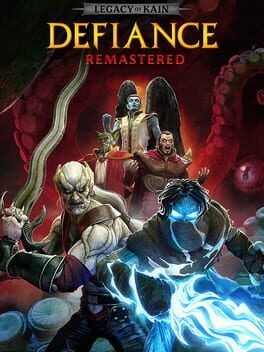

Crystal Dynamics is reviving Legacy of Kain with Defiance Remastered and a playable slice of the canceled Dark Prophecy, while new 2D action game Ascendance hints at a broader future for Nosgoth.
Legacy of Kain has spent two decades in what might as well be the spectral realm, present in fan petitions and forum threads but absent from actual release schedules. With Legacy of Kain: Defiance Remastered, Crystal Dynamics is finally pulling Nosgoth back into the material world, and the way it is doing so says a lot about how the studio sees the franchise’s past and future.
Defiance Remastered is not a quick port with a resolution bump. It arrives as a deliberate preservation project for the 2003 finale of the Kain and Raziel saga, while quietly doubling as a testbed for what a modern Legacy of Kain might look and feel like. Paired with the simultaneous reveal of the new 2D action game Legacy of Kain: Ascendance, it hints at a two-track strategy that both protects the series’ history and experiments with how it can evolve.
A modern vessel for a 2003 cult classic
Originally released in 2003, Legacy of Kain: Defiance was the narrative convergence of the series’ sprawling timeline, intertwining Kain and Raziel as playable protagonists in a single game. It wrapped the arcs that began in Soul Reaver and Soul Reaver 2, but has been relatively inaccessible for years, especially on modern hardware.
Defiance Remastered addresses that with a full suite of technical and quality-of-life upgrades, designed to keep the identity of the original intact while smoothing away the rougher edges that even nostalgic fans remember.
Crystal Dynamics is touting upgraded visuals with an instant toggle between remastered and original graphics. This kind of side-by-side comparison has become a hallmark of respectful remasters, but it matters especially for Defiance. Nosgoth’s towering cathedrals, decaying citadels, and warped geography were always ambitious, but on early-2000s hardware they were constrained by muddy textures and limited resolution. The remaster sharpens those surfaces, cleans up character models, and modernizes lighting and effects while still letting players flip back to see exactly what has changed.
The result is more than just a facelift. Defiance was always trying to sell the feeling of a doomed world bound by prophecy and paradox, and the extra clarity helps the art direction land the way it was originally imagined.
Controls and camera brought into the present
If there was one consistent critique of the original Defiance, it was the camera. On PS2 and Xbox, tight indoor arenas and fixed angles could make platforming and combat feel like fights against the viewpoint as much as against the Sarafan.
Defiance Remastered tackles this head-on with camera improvements that bring the game closer to modern third-person standards. The revised camera aims for better framing in combat, smoother tracking when shifting between exploration and platforming, and more responsive control when maneuvering through Nosgoth’s vertical spaces.
Alongside the camera work, the game modernizes controls for current hardware. Gamepads benefit from refined analog movement, more readable lock-on behavior, and layouts that better match contemporary action games, while PC players can expect more robust support and cleaner mapping compared with the original’s era-appropriate but clunky options.
Between the overhauled camera and updated controls, Defiance Remastered is positioned as the most approachable version of the game to date, especially for players who discovered the series through the more recent Soul Reaver remasters.
Beyond a remaster: extras, lost content, and series lore
Crystal Dynamics is also treating Defiance Remastered as an archive of sorts. In addition to the campaign, the package includes character skins, a photo mode, and a trove of supplemental material like lost levels, concept art, and lore articles.
The skins and photo mode are the obvious crowd-pleasers. Skins give returning players new ways to inhabit familiar characters, while photo mode finally lets fans frame the series’ distinct gothic architecture and elaborate animations with modern tools. For a world as visually dense as Nosgoth, that is no small thing.
The deeper cut is the inclusion of lost levels and lore content. Legacy of Kain has always been defined by dense storytelling, tangled timelines, and material that was trimmed, reworked, or left on the cutting room floor. Giving players a curated look at that history turns Defiance Remastered into a lightly interactive museum exhibit, one that contextualizes where this concluding chapter sat within the broader, often tumultuous development of the series.
Crystal Dynamics has also been explicit in positioning this remaster as the “proper” way to experience the finale that started in Soul Reaver and Soul Reaver 2. In other words, this is meant to be the canonical, accessible version of the story’s endpoint, a narrative keystone that finally matches the standards of modern platforms.
The Dark Prophecy demo is a rare look into a canceled future
The Deluxe Edition of Defiance Remastered goes further, and this is where the package shifts from preservation to something close to historical excavation. It includes a playable demo of Legacy of Kain: The Dark Prophecy, the sequel to Defiance that was deep into development before being canceled and effectively lost.
For years, The Dark Prophecy existed mostly as rumor, pitch documents, and scattered concept art. The chance to explore even a slice of it in playable form is unusual, both for this series and for canceled games in general. Publishers rarely surface partially finished sequels like this, and when they do, it is usually through art books or postmortem talks rather than something players can actually control.
Details on the demo’s scope are still closely held, but its inclusion suggests more than a simple bonus. It gives fans a glimpse of the direction the narrative and design might have taken after Defiance, and it acknowledges the long-standing curiosity around one of the most mythologized “what if” chapters in the franchise’s history.
On a practical level, the Dark Prophecy demo is also a subtle test. Crystal Dynamics can watch how intensely players engage with it, how loudly they talk about its ideas, and whether there is appetite for revisiting those concepts in some future project. As an artifact, it is a rare piece of video game history. As a data point, it may help shape what Legacy of Kain becomes next.
Ascendance and the experimental future of Nosgoth
The other half of Crystal Dynamics’ new push for the franchise is Legacy of Kain: Ascendance, a 2D retro action platformer set to arrive shortly after Defiance Remastered.
Ascendance trades fully 3D environments for pixel art and a focus on quick, vertical movement and responsive combat. It taps into the modern taste for “retro” action games, but it is drawing directly from Nosgoth’s fiction rather than simply wearing a nostalgic aesthetic. The game spans fractured timelines and leans into vampiric powers, suggesting a structure that may let the series explore side stories, alternate perspectives, or corners of the world that the mainline 3D entries never had room to visit.
With animated cutscenes, an original score from Celldweller, and returning voice talent, Ascendance also shares production DNA with the remaster effort. It feels conceived as a companion project rather than a smaller spin-off, meant to exist alongside Defiance Remastered rather than simply ride on its marketing.
Importantly, a 2D action game is cheaper and less risky than a full-scale new 3D epic. That makes Ascendance a smart laboratory for new mechanical ideas, pacing experiments, and tonal swings that could inform any future flagship entry. It is easier to iterate on and can establish what a new generation of Legacy of Kain players respond to without asking Crystal Dynamics to immediately commit to another giant single-player adventure.
A two-pronged strategy for reviving Legacy of Kain
Taken together, Defiance Remastered and Ascendance read like a coordinated strategy to revive the IP without rushing into a brand-new blockbuster sequel.
On one side, the remaster is about preservation and validation. It modernizes a key story chapter, wraps it in archival material, and even surfaces the lost Dark Prophecy demo. For long-time fans, it is a signal that Crystal Dynamics understands the emotional and historical weight of the series, and is willing to invest in presenting its legacy properly.
On the other, Ascendance is about experimentation and outreach. It offers a lower barrier to entry, a distinct visual identity, and a gameplay style aligned with a thriving genre on modern platforms. For players who have never touched Blood Omen or Soul Reaver, a sharp 2D action platformer is an easier sell than a 2003 action-adventure, even in remastered form.
This two-pronged approach mirrors what other legacy franchises have done, but there is a particular resonance for Legacy of Kain. The series has always been about duality and intertwined destinies, and Crystal Dynamics is effectively applying that theme to its release strategy: one path looking backward to secure the past, the other probing forward to see what Nosgoth can become.
If Defiance Remastered reconnects players with Kain and Raziel’s finale, and if Ascendance finds an audience for new stories in the same world, the table will be set for a true new chapter. In the meantime, the remaster’s upgraded visuals, cleaned-up controls, and remarkable inclusion of The Dark Prophecy demo make it much more than a simple nostalgia trip. It is a statement that Legacy of Kain is no longer content to haunt the spectral realm of memory.