
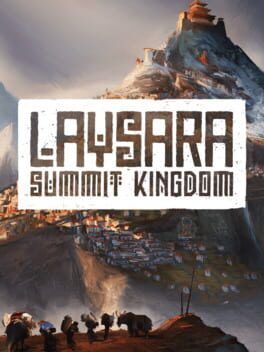

How Laysara: Summit Kingdom’s 1.0 launch brings mountain-top city-building, cascading disasters, and intricate logistics to both PC and Nintendo Switch.
City-builders and survival sim fans are used to taming rivers, forests, and deserts. Laysara: Summit Kingdom asks a sharper question: what if your entire settlement clings to the side of a mountain, with gravity and avalanches as your main enemies instead of raiders or pollution?
With its 1.0 launch on PC and Nintendo Switch, Laysara: Summit Kingdom is stepping out of Early Access as a fully formed, terrain-first city-builder that marries methodical planning with constant environmental risk. If you have spent years min-maxing grids in Anno, Banished, Frostpunk, or Against the Storm and you crave something mechanically familiar yet spatially fresh, this is worth a serious look.
Building a kingdom on the knife-edge of a mountain
The core premise sounds simple: you are rebuilding a displaced mountain civilization, peak by peak. In practice, every decision is warped by verticality. Your land is limited to steep slopes, thin ridges, and tiny plateaus, so there is no comfortable flat starting province where you drag a road and spam houses. Instead, every stretch of path threads across precarious ledges.
Terrain and elevation are not cosmetic. Crops and production buildings are tied to altitude bands, which forces organic zoning. Lower slopes are friendlier to agriculture and early industry. Mid-level terraces start to favor more advanced production and housing. Near the summit, harsh conditions limit what you can place but often reward you with high-yield resources.
Because of this, settlement design starts to feel like a puzzle. You are always asking how to squeeze one more warehouse into a safe pocket, whether a single extra path tile is worth the travel time, and if it is smarter to expand around a peak or reach for a new one entirely. It pushes you away from symmetric city blocks and into improvised, almost handcrafted layouts that still need to function under pressure.
Disasters as a constant design constraint
The standout system in Laysara: Summit Kingdom is how it turns the mountain itself into your main antagonist. Avalanches are not rare, scripted events. Snow accumulation, slope angle, and how you carve paths through the snowpack all factor into risk. Overbuild on a dangerous flank and you are essentially begging the next winter to erase months of planning.
Resilience becomes part of your city blueprint. You will deliberately plant forests as natural barriers, use specialized avalanche protection structures, and route major roads along safer ridges even if it compromises efficiency. When a slide hits, it tears through buildings and infrastructure, forcing rapid triage. Do you restore a key production chain first, or rebuild homes before citizens freeze and starve?
Beyond avalanches, cold and limited arable land keep pressure on your supply chains. Stockpiles, redundancy, and backup routes matter as much as raw production capacity, especially on maps where a single destroyed road can isolate half your city.
Logistics between peaks turns the whole range into your map
Many maps in Laysara: Summit Kingdom expect you to manage several peaks at once. Instead of one giant sprawl, you orchestrate a cluster of smaller settlements that lean on each other. One might specialize in mining, another in timber, another in high-altitude crops.
The connective tissue between these peaks is where the game leans hard into logistics. Moving goods along narrow, winding routes is slow, so you are always refining path layout, building warehouses at smart choke points, and deciding which peak should be self-sufficient and which should rely on imports. Distance is expensive, and the mountain makes every inefficiency hurt.
That tension will feel familiar if you enjoy optimizing production chains in Anno or Against the Storm, but here your constraints are physical first and economic second. You are not only managing throughput and ratios but also questioning whether the terrain can support your preferred layout at all.
Survival city-building with a caste-based society
Underneath the mountain theatrics sits a classic survival city-builder where population satisfaction keeps the whole machine running. Laysara divides your citizens into three castes, each with its own expectations and role in the economy. As you progress, higher castes demand more complex goods and better living standards, which forces you to extend and diversify your industrial web.
Every new chain piles onto your already tight terrain budget. Building that one extra workshop or temple is not trivial when the only available space is on an exposed slope you know could be swept away. The social ladder and survival layer enhance the natural tension of the map rather than overshadowing it.
The game offers both structured scenarios and more open play, so you can either tackle handcrafted challenges that emphasize particular mechanics or gradually perfect your own multi-peak empire in sandbox sessions.
What the 1.0 PC version brings to the table
On PC, Laysara: Summit Kingdom arrives at 1.0 as a substantially expanded version of its earlier builds. The campaign now strings together distinct peaks and objectives into a more coherent progression, gradually rolling out mechanics like advanced avalanche mitigation, high-altitude industries, and more intricate caste demands.
Quality-of-life work has targeted common city-builder pain points. Camera controls and terrain readability have been refined to make it easier to judge slope safety and available building space. Visual feedback on avalanche risk and route congestion is clearer, making it less likely that a hidden vulnerability undermines an otherwise solid plan.
Performance optimizations support more complex late-game settlements, even on maps where you are juggling several peaks and thick transport networks. The result is a PC experience that is closer to a finished, systems-rich city-builder than an experimental concept or a thin survival sandbox.
How the Nintendo Switch version stacks up
The Switch release arrives alongside the PC 1.0 launch, and it is not a cut-down spin-off. You are getting the full mountain city-building experience, with the core campaign, multi-peak logistics, and disaster systems intact.
The biggest differences are in how you interact with the game rather than what content you see. Controls have been adapted to a gamepad-first layout, with radial menus and context-sensitive shortcuts that let you jump between building types, roads, and demolish tools without wrestling a cursor. In handheld mode, the zoom and pan speeds are tuned so you can comfortably hop from valley to summit while still reading terrain detail.
Interface elements have been reworked for the Switch’s smaller display. Text size, icon clarity, and in-world markers for avalanche risk and pathing are designed to stay legible in handheld play. Menus and overlays are a bit more consolidated compared to the PC UI, which favors mouse precision and wide screens, but the same underlying data and options are present.
Graphically, the Switch version retains the stylized look of the PC original, with readable building silhouettes that make it easy to distinguish your production chains at a glance. Visual effects are dialed back slightly in busy scenes to keep performance stable during large avalanches and late-game traffic, but the overall aesthetic and terrain detail that underpin the design are preserved.
Feature parity is the intention here. You get the full suite of mountain maps, campaign challenges, and sandbox options, not a simplified or mission-only port. If you prefer to build on the couch or experiment with different peak layouts during commutes, the Switch version supports that without stripping away the depth that makes the PC edition compelling.
Why city-builder and survival-sim fans should pay attention
Laysara: Summit Kingdom is not trying to out-complex the heaviest resource-management titles on the market. Its edge is how aggressively it leans into terrain and environmental risk as first-class mechanics. Every road, warehouse, and upgrade sits in conversation with slope angle, snow load, and transport distance.
For players who enjoy slow-burn optimization and organic city shapes, this shift in perspective is refreshing. It scratches the familiar itch of balancing supply chains and citizen needs but locates that challenge on cliffs and cornices instead of grids and coastlines.
If your favorite moments in other city-builders come from improvising around a nasty map seed, weather disaster, or terrain quirk, Laysara: Summit Kingdom takes that feeling and builds an entire game around it, now fully realized on PC and neatly adapted to Nintendo Switch.