
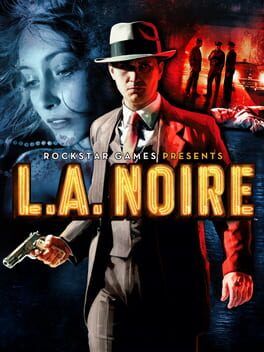

Take-Two’s CEO is suddenly willing to talk about L.A. Noire again. There is no sequel in development, but the cautious shift in tone hints at how Rockstar, or another studio, might one day justify returning to 1947 Los Angeles.
There is no L.A. Noire 2.
That point is worth getting out of the way early. No trailer, no press release, no teaser tweet. Yet in recent interviews, Take-Two Interactive CEO Strauss Zelnick has decided to stop shutting the door on the idea entirely. Asked directly about a sequel, he trotted out the classic non‑answer that suddenly sounds a little less final: “You never know.”
Coming from most executives, that would be meaningless hedging. Coming from the boss of Rockstar’s parent company, a man famously comfortable saying a flat “no” when something is not on the table, it lands differently. It does not confirm anything, but it invites a question the publisher has largely ignored for more than a decade: what would it actually take for L.A. Noire to return in today’s market?
Why Take-Two Is Leaving The Door Open Now
Reading between the lines of Zelnick’s comments, the shift is not about nostalgia. It is about portfolio thinking in a very different industry climate.
First, Take-Two has become increasingly open to mining its back catalog in flexible ways. The company has greenlit remasters like L.A. Noire: The VR Case Files and the GTA trilogy, pushed live service experiments, and leaned on evergreen giants like GTA Online. In that context, even a comparatively niche success like L.A. Noire starts to look like an asset worth reconsidering.
The original game sold solidly and has maintained a modest but stubborn afterlife on streaming platforms and social media, where its interrogation scenes and uncanny facial performances still circulate. A publisher chasing durable IP can see the value in a brand that has cultural recognition, even if it never approached GTA or Red Dead numbers.
Second, the broader market has validated slower, more methodical narrative games again. Immersive sims, detective adventures, and narrative‑driven indies have found dedicated audiences, and the success of prestige crime dramas on television has kept noir storytelling in the mainstream. A modern L.A. Noire would no longer be the odd one out in a landscape dominated entirely by twitch shooters and cover‑based action.
Finally, expectations around platform life spans and content cadence have changed. With GTA 6 consuming Rockstar’s near‑term focus and development timelines stretching longer than ever, keeping “possible” projects on the table makes strategic sense. Saying “never” forecloses an option that could be valuable five or ten years down the line.
So Zelnick does not promise anything and is careful to say that a sequel is not in development. But he also knows that a little oxygen around L.A. Noire keeps the IP quietly warm, ready to be used in whatever form makes sense next.
What A Modern L.A. Noire Sequel Would Need To Justify Its Return
The reason Take-Two has not rushed back to 1947 Los Angeles is simple. A sequel could not just be another mid‑budget experiment with fancy tech. The original was famously expensive, technologically ambitious, and logistically fraught. To justify a second outing, three things would have to be clear inside the company.
The first is identity. L.A. Noire would need a sharper, more communicable hook than “open‑world detective game with great faces.” In 2011 that novelty was enough. Today a sequel would have to explain, in a sentence, why players should care again. Is it a systemic detective sandbox where every clue and lie can be approached multiple ways? Is it a prestige crime anthology that changes era and city with each case? Is it an ongoing platform for new mysteries released episodically?
The second is structure. One of the biggest critiques of the original was that it sat awkwardly between linear, case‑based storytelling and an open city that did not offer much to do between investigations. A modern sequel would likely need either a tighter, more focused structure that leans fully into authored investigations, or a truly systemic approach where the city itself supports emergent cases, repeatable procedures, and meaningful side work for detectives.
The third is sustainability. That goes beyond raw budget. Motion‑capturing dozens of actors for hyper‑detailed interrogations was a technical marvel in 2011, but it came at a massive production cost. A new game would have to leverage advances in performance capture, machine learning, and animation tools to achieve similar emotional nuance without multiplying the schedule and headcount. If Take-Two returns, it will be because the cost curve for this specific kind of game has finally bent in its favor.
How The Original’s Investigative Design Holds Up
Stripped of its marketing bullet points, L.A. Noire’s enduring strength is its commitment to process. You drive to the crime scene, walk the perimeter, tilt an object in your hand, cross‑reference an address, then sit across from a suspect and watch them squirm. It was not about fast reflexes but slow, deliberate observation.
In today’s market, that core still feels surprisingly fresh. Modern players are more accustomed to games that respect their curiosity and patience. Successful detective titles and narrative puzzlers thrive on letting players piece things together with minimal guidance. L.A. Noire was often more restrictive, funneling you toward a correct answer or punishing you for reading a performance the “wrong” way, but the fantasy at its heart still has power.
Where it shows its age is in how little it trusts the player. Failure states can feel arbitrary. Some cases hinge on interpreting facial tics that are not as clear as the design assumes. The city is atmospheric but thin as a playground for investigation. A sequel could learn from the last decade of deduction design by tracking the player’s reasoning more flexibly, supporting alternative theories, and making your case work feel like investigation rather than a multiple‑choice quiz.
The other lesson is that procedure itself can be the star. Police paperwork, interview prep, evidence cataloging, and legwork that once seemed too mundane for games have become fertile ground for tension and role‑play. A new L.A. Noire could embrace that, turning the rhythms of 1940s detective work into a satisfying loop instead of a backdrop to gunfights.
The Legacy And Limits Of L.A. Noire’s Facial Tech
In 2011, the game’s performance capture was its calling card. Team Bondi’s use of the MotionScan system produced faces that were uncannily expressive compared to the flat, mask‑like models common at the time. Interrogation sequences lived or died on those micro‑expressions. You were not just listening to what a character said, you were reading the twitch in their cheek and the dart of their eyes.
From a 2026 perspective, that tech sits in a strange place. On one hand, it has been surpassed by modern performance capture pipelines that integrate facial and body acting in a single pass and by real‑time engines that can render subtler expressions at higher fidelity. On the other hand, it carved out an identity that few games have seriously chased since.
The legacy is not that everyone copied MotionScan. It is that L.A. Noire made a strong, risky bet on the idea that reading a character’s face could be core gameplay, not just a cinematic flourish. For a sequel to matter, it would need a similarly bold thesis about performance as mechanics.
Advances in machine‑learning‑driven facial animation, procedural lip sync, and emotion modeling could help. Instead of capturing every line as an isolated performance, a modern pipeline might blend high‑end capture for key scenes with systems that generate convincing variations in real time. That could let interrogations react more dynamically to the player’s questions, tone, and evidence, rather than snapping between a handful of canned animations.
Crucially, though, Take-Two would need to resist the temptation to chase realism for its own sake. In an era where photorealistic faces are more common, what would make L.A. Noire stand out is not “better graphics,” but a stronger link between what you see in a character’s expression and what you can do with that information.
Who Makes It, If It Ever Happens?
Any conversation about L.A. Noire 2 runs into a practical problem. Team Bondi, the original developer, no longer exists. Rockstar absorbed some of its staff and retains the IP, but the specific studio that built the game’s technology and pipeline is gone.
That leaves three theoretical paths. Rockstar could take the project in house, folding it into one of its core studios. Take-Two could partner with an external team that has a strong track record with narrative investigations and cinematic storytelling. Or the company could treat L.A. Noire as a smaller‑scale experiment again, perhaps as an anthology‑style spin‑off that does not carry the weight of a full numbered sequel.
Zelnick’s cautious wording suggests that no such decision is currently in motion. From an industry perspective, though, those are the levers Take-Two would eventually pull if it chose to test the waters. The success of any sequel would hinge not only on design vision but on whether a studio with the right culture and technical chops is available at the right moment.
A Door Ajar, Not A Promise
For now, L.A. Noire occupies a curious space in Take-Two’s library. It is not forgotten, but it is not an active pillar of the business. The CEO’s recent comments do not change that status in any concrete way. There is no sequel in development, no secret project waiting to be revealed.
What his remarks do signal is that the company views L.A. Noire as a piece of its long‑term strategic puzzle rather than a closed chapter. If production technology continues to improve, if the market keeps rewarding thoughtful narrative crime games, and if the right creative team aligns, the calculus could shift.
Until then, fans are left where they have been for years: replaying cases, sharing interrogation clips, and imagining what a return to a meticulously recreated, morally murky Los Angeles might look like on modern hardware. The only new development is that, at the highest level of Take-Two, no one is saying “never” anymore. In this industry, sometimes that small change is how comebacks start, even if they take years to arrive.