
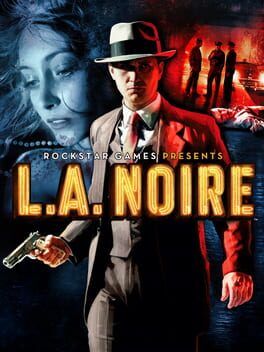

L.A. Noire writer Daniel McMahon says Jon Hamm was discussed for Cole Phelps before Aaron Staton took the role. The choice would have changed the pressure, pace, and fragility of Rockstar and Team Bondi’s detective drama.
Image: IGDB
Store links: L.A. Noire on Steam
Jon Hamm was discussed for Cole Phelps, but the role went another way
A newly surfaced L.A. Noire casting detail has reopened one of the sharper creative questions around Rockstar and Team Bondi’s 2011 detective game: what happens if Cole Phelps enters 1947 Los Angeles with Jon Hamm’s authority instead of Aaron Staton’s anxious precision?
Daniel McMahon, a writer brought onto L.A. Noire to join director and writer Brendan McNamara for additional writing, said in a new interview with Cade Onder that Hamm was originally proposed and discussed as a possibility for the role of Cole Phelps. IGN reports that McMahon confirmed Hamm was on the team’s radar, while VGC quotes McMahon recalling that he shared images of Hamm in a suit and hat from Mad Men with the team and argued, in effect, that the actor visually fit the world.
The confirmed fact is narrow but compelling: Hamm was considered for Cole Phelps. The sources do not say he was formally cast, signed, or offered the role. The part ultimately went to Aaron Staton, Hamm’s Mad Men co-star, who played Ken Cosgrove on the AMC series. Hamm, of course, was Mad Men’s Don Draper, a role already loaded with mid-century iconography by the time L.A. Noire was in development.
McMahon’s hindsight is the real story. He told IGN and VGC that Hamm is “a wonderful actor,” but “he’s not Cole Phelps.” In McMahon’s view, Staton was the better match because Cole needed fragility, uncertainty, and youth under pressure. That assessment cuts straight to why L.A. Noire works when it works. Cole is not a noir superman walking into crime scenes with total command. He is a decorated veteran, a rising detective, and a man whose confidence often outruns his judgment.
The casting director connection explains the Mad Men overlap
The Hamm detail is not a random celebrity what-if. According to IGN and GameSpot, McMahon said Mad Men and L.A. Noire shared the same casting director, which helps explain why Team Bondi’s game ended up with several faces familiar to viewers of the series. Staton became Cole Phelps, giving L.A. Noire a lead who could stand still under MotionScan’s unforgiving close-ups and still look like he was losing control behind the eyes.
That shared casting pipeline matters because L.A. Noire was built around performance in a way few big-budget games were in 2011. The game’s interrogation system depended on reading faces, judging pauses, and deciding whether a suspect was lying, withholding, or telling the truth. Its proprietary MotionScan technology, described in public material around the game and summarized in reference listings, captured actors’ facial expressions from multiple angles so that those micro-performances could drive investigation scenes.
A famous face can be an asset in that setup, but it can also bend the frame. Hamm would have arrived with Don Draper’s silhouette already attached: the suit, the hat, the controlled voice, the practiced stare. McMahon said he could see the appeal at the time. The photos made Hamm look like he belonged in L.A. Noire’s world. The later judgment, though, is that looking right for the genre is different from being right for Cole.
That distinction is especially important for a Rockstar detective game that was always balancing genre fantasy against procedural friction. L.A. Noire lets players drive across a recreated Los Angeles, chase suspects, trade gunfire, and climb through a police career, but its most distinctive rhythm is slower and more uncomfortable. It asks players to look at a person across a desk and risk being wrong. A lead actor who projects too much control could change that rhythm before the first clue is picked up.
Cole Phelps needed pressure, not polish
McMahon’s explanation, as reported by IGN, VGC, and GameSpot, centers on Cole’s fragility. He described Cole as very smart but young, inexperienced, and often “flapping around” while trying his best. That is a blunt but useful read on the character. Cole’s badge gives him authority, yet his story is built around the gap between authority and self-knowledge.
L.A. Noire follows Phelps through LAPD bureaus including Patrol, Traffic, Homicide, Vice, and Arson. The player sees him rise through the institution while cases expose a city of corruption, violence, ambition, and postwar rot. The game also frames Phelps as a World War II veteran whose past does not stay buried. Public descriptions of the plot identify Jack Kelso, an estranged former comrade, as a major figure later in the story, with the two men drawn into a larger conspiracy involving prominent Los Angeles figures.
Staton’s performance gives Cole a clipped, procedural drive that can curdle into panic. In action scenes, he can sprint, shoot, and take charge like a conventional adventure protagonist. In interrogations, he can feel brittle. The game’s infamous swings between doubt, accusation, and overreaction are partly mechanical, but they also fit a man who wants certainty more than he earns it.
Hamm would likely have shifted the emotional weight. That is interpretation, not a reported production fact, but it follows directly from McMahon’s own comparison. Hamm’s screen presence, particularly in the Don Draper era that made him an obvious visual candidate, leans toward command under strain. Put that energy into Cole and the detective can start to feel like a man concealing mastery rather than a man trying to manufacture it. L.A. Noire’s tragedy depends on the latter.
McMahon thinks Hamm fit Jack Kelso better
The most revealing part of McMahon’s comment is not that Hamm was expensive or famous. It is that McMahon named a different L.A. Noire role where Hamm might have made more dramatic sense. He told IGN and VGC that Hamm would have been “a much better Jack Kelso,” describing Kelso as a character of power and control, someone who knows what he is doing and gets things done.
That comparison sharpens the casting argument. Jack Kelso is not the same kind of noir figure as Cole. Cole is institutional ambition under stress. Kelso is a steadier counterweight, a man whose confidence lands differently because the story positions him outside Cole’s crumbling self-image. McMahon’s hindsight suggests Hamm’s natural authority could have served the game better if it arrived later, when the narrative needs a firmer hand to pull at the conspiracy.
There is no confirmation in the provided reporting that Hamm was considered for Kelso, and ComicBook notes that McMahon did not confirm such consideration. The reported claim is McMahon’s retrospective casting opinion. Still, the Kelso point explains why the original Cole discussion feels so consequential. Casting is not decoration in L.A. Noire. The game’s cases are paced around who gets to control a room, who loses control, and who can survive the truth once the evidence is on the table.
With Hamm as Cole, the early desks might have played with a smoother, darker confidence. With Staton, the player gets a detective whose competence is always brushing against insecurity. That makes the climb through the LAPD feel unstable even before the script starts stripping Cole’s life apart.
The choice also says something about Rockstar’s performance strategy
GameSpot identifies L.A. Noire as a 2011 detective game developed by Team Bondi and published by Rockstar Games for PS3, Xbox 360, and PC, with later Switch, PS4, and Xbox One versions arriving in 2017. VGC also notes that L.A. Noire: The VR Case Files followed in 2017, developed by Video Games Deluxe, a studio founded by L.A. Noire director Brendan McNamara. GameSpot’s supplied text lists The Case Files as arriving in 2019, so the available sources conflict on the VR release timing. What is consistent is that the game did not receive a full sequel after its original launch.
That history makes the L.A. Noire casting discussion feel like a snapshot from a very specific moment in Rockstar’s wider approach to actors. ComicBook argues that Rockstar’s major roles often go to performers who are not household names, despite celebrity cameos appearing elsewhere in the company’s catalog. The Hamm possibility would have pushed L.A. Noire closer to a prestige television crossover at the center of the game, rather than around its edges.
McMahon also said Hamm would have been “expensive,” a practical note repeated by VGC, IGN, and GameSpot. The sources do not provide a budget figure or any negotiation detail, so the cost angle should be treated as McMahon’s recollection and assessment, not a documented production ledger. Even so, the remark points to a real casting tradeoff for performance-heavy games: a recognizable star can market the project, but the performance still has to serve the system, the camera, and the player’s relationship with the character.
In L.A. Noire, the player spends a long time watching Cole think he is in command. The game then spends a long time proving that command was fragile. Staton’s casting keeps that arc visible from the beginning.
Sequel hopes remain separate from the casting revelation
The Jon Hamm detail arrives during another period of renewed L.A. Noire conversation, but it does not signal a new game. Fans have asked for a sequel for years, and GameSpot reports that Take-Two boss Strauss Zelnick said earlier this year that the company is considering future projects for all of its franchises, including L.A. Noire. IGN’s version of Zelnick’s comment is more careful: he said there was nothing to announce on L.A. Noire specifically, and that if there were, Rockstar would be the one announcing it.
That distinction matters for readers searching L.A. Noire Jon Hamm or L.A. Noire casting news and hoping it connects to a revival. The confirmed news is about a past casting discussion. There is no announced L.A. Noire 2, no confirmed platform list, no release window, and no pricing information for a future entry.
The franchise’s path after 2011 was complicated. VGC says a planned spiritual successor, Whore of the Orient, was announced months after L.A. Noire’s release and cancelled five years later. GameSpot reports that Team Bondi shut down amid controversy, after accusations of hostile working conditions prompted an International Game Developers Association investigation, and that the studio was reportedly $1.4 million in debt when it closed. VGC further reports that Rockstar acquired Video Games Deluxe last year and renamed it Rockstar Australia, after that studio worked on L.A. Noire VR and later handled mobile versions of Grand Theft Auto: The Trilogy - The Definitive Edition, then stepped in to correct the critically panned console versions developed by Grove Street Games.
For now, the practical guidance is simple: anyone curious about this casting road not taken should treat it as production history, not sequel evidence. L.A. Noire remains available through its later console versions, and the conversation around Hamm clarifies why the existing game has the shape it does.
A different face would have changed the noir, not only the poster
The most tempting version of this story is the clean alternate timeline: Jon Hamm wears the hat, L.A. Noire gets a bigger star, and Cole Phelps becomes a more iconic Rockstar lead. McMahon’s account pushes against that easy read. The writer’s own conclusion is that Hamm would have been incredible, but likely too expensive and probably not as strong for Cole as Aaron Staton.
That is a rare kind of casting hindsight because it does not diminish either actor. It identifies the load-bearing quality in the role. Cole Phelps has to be credible as a detective, but also exposed as a man who mistakes advancement for redemption. The player needs to feel his drive in a foot chase, his arrogance in an interview room, and his private collapse as the cases start circling back toward him.
Hamm’s presence would have made L.A. Noire feel more controlled at the center. Staton’s performance leaves more air for doubt to creep in. In a game built on reading faces, that difference is enormous. Team Bondi’s L.A. Noire is remembered for its technology, its interrogations, its lavish 1947 Los Angeles, and its uneven but fascinating experiment with detective work inside a blockbuster action-adventure shell. This new casting detail adds another layer: one of its defining choices may have been resisting the face that seemed perfect for the poster, then choosing the actor who better matched the fracture underneath.