
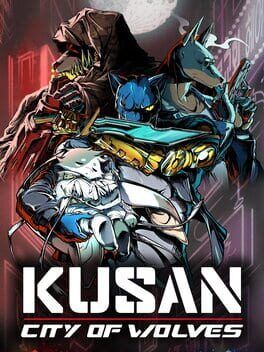

Kusan: City of Wolves has a 30/40 Famitsu score as developer CIRCLEfromDOT frames death, retries, weapons, and upgrades as the core of its action design.
Image: IGDB
Store links: Kusan: City of Wolves on Steam
Famitsu puts a number on Kusan’s brutality
Kusan: City of Wolves has landed a 30/40 in the latest Famitsu review scores, with Nintendo Everything reporting the magazine’s four-reviewer breakdown as 7/8/7/8 for the week of August 2, 2026. That score arrives just after the game’s July 30, 2026 release date listed by Metacritic and OpenCritic, giving action fans an early benchmark for a game that is openly built around failure, repetition, and refinement.
The timing is useful because CIRCLEfromDOT, the Korean indie studio behind Kusan: City of Wolves, is not presenting death as an accident of tuning. According to HappyGamer’s report on the developer’s survival guide, CEO and game designer Jake Yeom told players to expect enemies that do not hold back and a structure where each death is meant to teach something: a missed pattern, a weak point, or a weapon combination that did not occur to the player on the last attempt.
That creates the first real tension around the Kusan City of Wolves release window. Famitsu’s 30/40 is solid, but it is not the loudest score in the week’s slate. Nintendo Everything lists Beast of Reincarnation at 8/9/9/9 and Moomintroll: Winter’s Warmth at 8/8/8/8 above it. Kusan’s pitch, meanwhile, is sharper and less broadly comfortable: a top-down action game where the player is expected to die, study, and return with better timing.
Death is being sold as a design tool, not a fail state
The most revealing detail from the developer side is how directly Kusan: City of Wolves talks about failure. HappyGamer reports that Yeom’s message to players is blunt: they will die, and that is part of how the game is supposed to work. The article describes CIRCLEfromDOT’s design philosophy as learning through failure, with players encouraged to stay aggressive, experiment, and treat unsuccessful runs as information rather than a wall.
That framing matters for anyone looking at the Kusan City of Wolves death mechanic through the lens of action pacing. In a game like this, death is not only a punishment for slow reactions. It is a cut, a reset, a chance to re-time the scene. The player enters a room, reads enemy positions, tests a weapon, gets punished, and comes back with a cleaner route. The rhythm is less about surviving a long uninterrupted campaign and more about editing each encounter until the violence snaps into place.
Several reviews gathered by aggregators line up with that reading, though they differ on how smoothly the design lands. Push Square’s PS5 review calls Kusan: City of Wolves extremely challenging and says the game can cause frustration, but also says clearing a stage is satisfying and that boss fights act as tests of skill. Movies Games and Tech similarly describes the game as difficult, reaction-heavy, and punishing, while saying its frustration sits alongside an addictive, rewarding quality. Those are review judgments from those outlets, not confirmed design facts, but they reinforce the expectation set by CIRCLEfromDOT’s own comments: this is aimed at players who are comfortable being beaten into competence.
Jin’s arsenal points to a game about tempo changes
Kusan: City of Wolves stars Jin, described by HappyGamer as an ex-soldier turned gun-for-hire drawn into a conspiracy tied to a mysterious girl fitted with a city-grade atomic weapon. Movies Games and Tech also identifies Jin as a gun-for-hire trying to save a powerful child while confronting someone he once trusted. Across the available source material, the premise is consistently framed as noir-stained sci-fi action with comic-book presentation rather than a quiet character drama.
The combat kit is where the developer comments get more practical. HappyGamer reports that Yeom detailed six weapon types for Jin: the Quantum Knife, War Hand, Pistol, Revolver, Shotgun, and Crossbow. The point, according to that report, is that there is no single correct answer for every situation. Different enemies and bosses run on different rhythms, and a setup that clears one room may fall apart against a different encounter.
That is the part action fans should watch closely. A six-weapon spread can make a top-down shooter feel expressive, but only if the game gives each tool a distinct tempo. A knife asks for commitment. A shotgun wants proximity and timing. A crossbow suggests precision. A revolver and pistol sit in that middle range where ammo, aim, and speed become the argument. Push Square’s review says the game rewards time, combo, and attack variety at the end of stages, while HappyGamer reports an SS rank system tied to efficient play. Taken together, the confirmed developer comments and early reviews suggest Kusan is designed less around merely clearing rooms and more around replaying them until Jin moves through them with intent.
Techtrix makes the first build choice part of the pressure
The other major developer detail concerns Techtrix, the upgrade system. HappyGamer reports that players unlock Techtrix early in Kusan: City of Wolves, using it to enhance weapons, equip skills, and shape Jin’s build. The early options named in the report are Quick Step, Auto Recovery, and Counterstrike, and Yeom reportedly emphasized that the first pick can be significant for the run.
Push Square’s review describes a module-based upgrade system installed onto a grid-like panel, where upgrades take up space and the grid can be expanded by spending in-game currency. Movies Games and Tech also says upgrades are important and notes that enhancing tools requires unlocking space and spending different currency, which it characterizes as requiring a fair bit of grinding. Those two reviews describe the same broad idea with slightly different emphasis: one highlights the satisfaction of building out the toolkit, the other flags the work needed to expand it.
For players, this is where the death loop becomes more than reflex training. If early Techtrix choices shape how Jin moves, heals, or counters, then retries are also tests of build logic. Quick Step sounds like a mobility answer, Auto Recovery suggests survivability, and Counterstrike points toward a more timing-heavy approach. The sources do not provide exact stats or upgrade trees, so the safest read is that Kusan wants players to commit to an approach early and then learn whether their hands can support it.
Early review signals agree on speed, style, and friction
The Kusan City of Wolves Famitsu review score is only one piece of the early critical picture. Metacritic lists the game as “Generally Favorable,” with its page showing six critic reviews overall and a spread of positive and mixed coverage at the time captured in the source material. OpenCritic lists 13 critic reviews and shows a 100 percent critics-recommend figure, with visible scores including Push Square at 7/10, PPE.pl at 8.5/10, Capsule Computers at 8.5/10, Gamer Social Club at 9/10, and several others in the 80 percent or 4-out-of-5 range.
The tone across the quoted reviews is consistent, even when the scores vary. Metacritic excerpts describe fast, visceral gameplay, strong aesthetic identity, sound design that supports the action, and occasional visual clutter. Another Metacritic excerpt praises the story’s moral gray areas and Jin’s turmoil. A third explicitly compares the game to Hotline Miami, while saying Kusan scratches that long-running itch rather than fully breaking the mold. OpenCritic’s quoted reviews similarly call it brutal, challenging, stylish, replayable, and suited to players chasing mastery and high scores.
The caveats are important because they are the difference between a recommendation and a warning. Push Square says parrying can feel stiff and the control window is not always clear, while also saying the narrative can be tricky to follow at first. Movies Games and Tech says success depends heavily on reactions and memory, to the point that anything short of near-perfect execution can lead to failure. Metacritic’s excerpt from GameBlast notes occasional visual clutter amid the chaos. These are not universal deal-breakers, but they define the audience: Kusan appears built for action players who enjoy a punishing loop, not for anyone looking for a relaxed power fantasy.
Platform and price listings still leave some practical gaps
The clearest release fact across the supplied listings is the date. Metacritic lists Kusan: City of Wolves as released on July 30, 2026, and OpenCritic lists the same date. Movies Games and Tech identifies the game as developed by CIRCLEfromDOT and published by PQube Limited, and OpenCritic lists the creators as CIRCLEfromDOT and PQube.
Platform information is less tidy across public listings. OpenCritic lists PlayStation 5, Xbox Series X/S, Nintendo Switch, and Nintendo Switch 2 for the July 30 release. Metacritic’s captured page includes platform-specific critic pages for PC, PlayStation 5, Xbox Series X, and Nintendo Switch, while its visible “where to buy” section lists PlayStation 5 at $34.99 on GameStop and Nintendo Switch at $39.99 on GameStop. That does not prove other versions lack retail or digital availability; it only shows what those captured listings display.
For buyers, the practical guidance is to check the specific storefront for your platform before assuming parity in price or availability. The sources here confirm broad multi-platform coverage through review aggregators, but they do not provide a complete store matrix, PC price, Xbox price, Switch 2 price, performance targets, upgrade path, or technical breakdown. If you are deciding between platforms, the available source material supports the game’s release and reception, but not a definitive performance recommendation.
Expect a blade-clean action game that asks for patience
The clearest picture of Kusan: City of Wolves is of a game that knows the bargain it is asking players to accept. CIRCLEfromDOT’s reported developer guidance says death is part of the process. Famitsu’s 7/8/7/8 score suggests a respectable but measured reception from that magazine. Aggregator excerpts and individual reviews point toward a fast, stylish, punishing top-down shooter with comic-book presentation, Korean hip-hop influence noted by Push Square, and a structure built around mastery.
That combination should narrow the audience in a helpful way. If you enjoy action games where a room becomes a choreography problem and a death screen is part of the rehearsal, Kusan’s weapon variety, SS ranking pursuit, and Techtrix builds sound aligned with that appetite. If stiff parry feel, visual clutter, grinding for upgrades, or narrative opacity tend to sour you on hard games, the early criticism gives you reason to wait for more platform-specific impressions or a sale.
Kusan: City of Wolves is positioning death as instruction, and the early score landscape frames that as both its identity and its risk. The city may be neon, violent, and stylish, but the real test is colder: whether each failure teaches enough to make the next run feel sharper.