
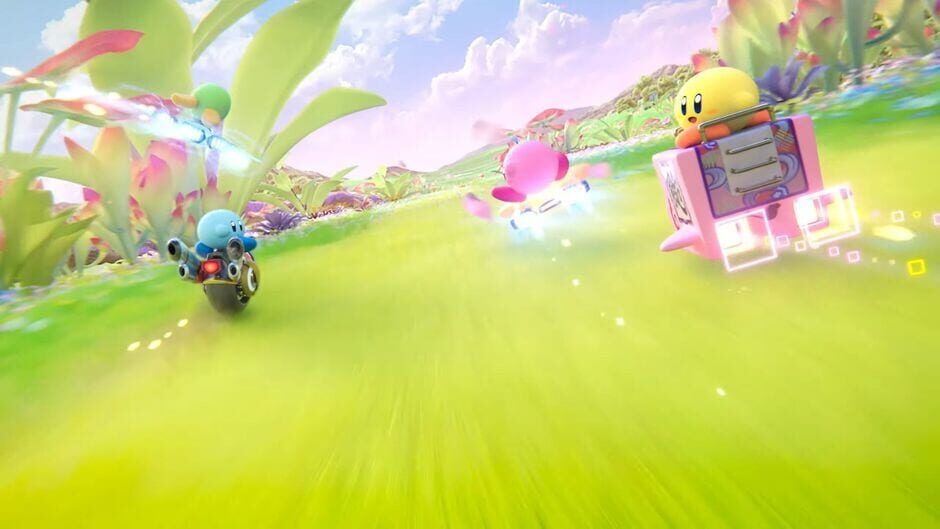

Breaking down Kirby Air Riders’ massive 1.2.0 balance update, why Sakurai says the team is disbanding and updates are ending, and how this “final form” patch will shape the long‑term meta on Switch 2.
Nintendo and Masahiro Sakurai have drawn a clear line in the sky for Kirby Air Riders. Version 1.2.0 is not just another early balance pass. It arrives alongside Sakurai’s confirmation that the core development team is being disbanded and that support will effectively end after, at most, one more small balance patch.
For a Switch 2 racer that has already sparked a fast‑growing competitive scene, this turns 1.2.0 into something bigger than a routine update. It is the patch that will define how Kirby Air Riders is played for years.
What Version 1.2.0 Actually Changes
On paper, 1.2.0 looks like a typical “month‑one” balance update: a big list of stat tweaks, physics corrections and bug fixes. In practice, it quietly rewrites how you’re allowed to push the game’s movement system.
The design throughline is simple. The patch makes walls act like real obstacles again instead of speed tech. For both City Trial and Air Ride, the top‑tier machines that could happily scrape geometry at absurd angles without losing momentum now pay a real tax for sloppy driving.
Across the board, wall‑related collisions have been tuned to strip more speed. Warp Star and Winged Star suffer stronger deceleration when riding along walls, Shadow Star loses more velocity when it collides almost head‑on, and machines like Slick Star, Turbo Star, Jet Star and Vampire Star all now bleed off more speed when they use walls as pivot points.
Machines that could previously abuse Quick Spin to pinball off corners and keep their velocity get hit especially hard. The patch notes make it explicit that all machines have had the “backlash” from Quick Spinning into a wall weakened, and that several specific machines can no longer maintain high speed as easily after a Quick Spin wall bounce.
It is a direct nerf to the highest‑apm, geometry‑abusing lines that early grinders were already routing into muscle memory. You can still be aggressive, but your routing has to respect the track.
City Trial’s New Power Structure
City Trial is where the changes are sharpest and most important for competitive play, because the entire mode is built around stat growth and machine types.
Star‑type machines, which were the flexible default for a huge portion of the playerbase, now start with lower Defense. Bike‑ and Chariot‑type machines see their Defense growth cut. Tank‑type machines, by contrast, gain both higher initial Defense and stronger Defense growth.
Layer those global type changes on top of the individual machine tweaks and the picture is clear. The days of durable, all‑purpose Star builds dominating every random lobby are over, and the game is trying to carve out a genuine frontline role for Tanks.
Tank Star picks up higher Top Speed growth in City Trial, and Bulk Star’s Defense growth is buffed, while wall collision deceleration is increased for most of the speed‑oriented stars. Slick Star and Turbo Star get tempting Top Speed growth buffs but see their ability to abuse walls sharply reduced.
The short‑term outcome is a more honest City Trial where your machine choice and item routing matter more than your willingness to smash yourself into architecture at full speed. In the long term, it is a quiet invitation for tournaments to explore builds that were written off as too slow or too fragile in the launch meta.
Air Ride And Top Ride: Tightening The Lines
In standard Air Ride and the more chaotic Top Ride, the theme is similar but the stakes are different. Match flow here is defined less by wild stat growth and more by how far top players can push the game’s handling model.
By increasing deceleration on near‑perpendicular wall crashes for machines like Formula Star, Bulk Star, Battle Chariot, Tank Star, Bull Tank and Rex Wheelie in Top Ride, 1.2.0 punishes the riskier “ride the edges” lines that speedrunners were gravitating toward. The same applies in Air Ride, where Jet Star’s changes tell the story best: stronger wall deceleration and improved braking once it surpasses maximum speed.
Jet Star, Turbo Star, Vampire Star and other high‑ceiling machines still have enormous potential in skilled hands, but they no longer let you erase your mistakes with physics quirks. Optimal lines shift a few feet away from the walls, and players who master braking, feather inputs and corner anticipation will gain an edge over those who simply slam Quick Spin on every turn.
Rick’s Nerf And Character Balance
On the rider side, the patch singles out one very clear offender. Rick, whose absurd survivability and powerful Rip‑Roaring Rick Special made him an early terror in City Trial and Air Ride, has had his HP, Defense and Special power reduced.
This is the classic Sakurai pattern. Rather than shaving a little off the entire roster, the patch identifies the very top outlier and pulls him back toward the pack. Rick will still be playable, but he loses his automatic “stat check” advantage. In organized play, this opens space for more creative rider choices instead of defaulting to the most efficient pile of numbers.
Combined with the machine and type tweaks, competitive balance now leans less on a single overbearing rider or archetype and more on how well players can synergize their rider pick with a particular machine’s strengths and weaknesses.
Quality‑of‑Life Changes That Quietly Help Competitive Players
While the competitive community will remember 1.2.0 for its balance changes, several quality‑of‑life features are quietly built for serious players.
The ability to test courses while searching for Online Matches means you can lab lines and tech between ranked races instead of sitting idle in a matchmaking queue. In City Trial, being able to free‑ride Skyah once you have at least one matched opponent makes online practice loops much less painful.
Spectate and replay upgrades are arguably the most important community tools in the patch. You can now scrub within replay videos on the Spectate menu and replays uploaded by players will randomly play on the paddock monitor. That means it is easier to study top runs, show off new tech and use match footage for VOD reviews, which is crucial for serious teams.
Amiibo support, which lets you race against figure players, may not sound like a tournament‑level feature. But it gives solo competitors another tool to simulate pressure for specific routes and setups when human practice partners are not readily available.
Taken together, 1.2.0 makes Kirby Air Riders more watchable, easier to practice and more maintainable as a “solved” competitive game.
Sakurai Confirms The Team Is Disbanding
The flip side of all these welcome changes is the bigger news: Sakurai has stated that the Kirby Air Riders development team will soon be disbanded, and that 1.2.0 should be considered one of the final major updates.
From Sakurai’s own comments and reporting across Japanese and western outlets, the reasons are straightforward. Kirby Air Riders was never pitched as a live service. It was structured as a complete boxed game with some early balance follow‑ups and bug‑fix support. As those goals wrap up, the small Sora‑led team is moving off the project instead of being maintained long‑term.
He hints at the possibility of one more minor update focused on cleaning up remaining bugs such as the Gummies menu crash and the rare checklist completion issue, but stresses that large‑scale rebalancing or ongoing content drops should not be expected.
In other words, 1.2.0 is the “final form” of Kirby Air Riders as a competitive product. Any future change is likely to be surgical rather than systemic.
Why That Matters For A Switch 2 Meta
For Switch 2 owners, that finality changes how tournaments, leagues and communities should approach the game.
Instead of waiting for monthly rebalances, TOs can start treating 1.2.0 as something close to a ruleset baseline. Stages, machine bans, rider soft bans and format experiments can be built around a stable environment rather than constantly being reset by patches.
The downside is obvious. If a truly degenerate strategy emerges months from now, there is no guarantee that a developer‑side fix is coming. The upside is that the entire competitive ecosystem gains predictability. Players can invest in deep mechanical labbing knowing their discoveries will not be invalidated overnight.
In practical terms, here is how the long‑term meta is likely to evolve on Switch 2 under a mostly locked patch:
City Trial will probably settle into a triangle where Tanks serve as durable frontliners, buffed speed machines like Slick Star and Turbo Star occupy the high‑risk, high‑reward role and the once‑dominant Star‑type all‑rounders get pushed into a more balanced midrange niche. Build routing and event priority will matter more than ever, because defensive stat lines can no longer be taken for granted.
Air Ride will favor players who treat it like a true racing game rather than a sandbox for physics exploits. Track knowledge and braking discipline will outweigh wall‑tech muscle memory. Machines with strong mid‑corner stability that are less dependent on scraping geometry should rise in popularity as the meta matures.
Top Ride, often treated as the “party” mode, gains surprising depth from its tightened wall interactions and tank buffs. On smaller courses where one mistake can cost an entire run, the heavier deceleration on perpendicular crashes sharply increases the value of consistent, low‑risk lines in tournament play.
Because the game will not be endlessly rebalanced, each of these trends can be codified into long‑term strategies, matchup charts and machine tier lists that will actually mean something two years from now.
Community Rule‑Making Will Replace Balance Patches
With updates winding down, the burden of fine‑tuning Kirby Air Riders for competition will shift toward community rules rather than developer patches.
If a specific machine, route or interaction becomes oppressive, it will likely be addressed through stage bans, machine restrictions or custom formats. That is a model Smash players are already used to, and it is easy to imagine Kirby Air Riders following a similar path, especially given Sakurai’s own history with competitive Smash.
Replay tools and spectator features added in 1.2.0 will help that process. As more tournaments upload sets and tech videos, it becomes easier to identify problem strategies and gather consensus on how to handle them without waiting for an official fix.
In the absence of major new content, players will also drive the game’s longevity through self‑imposed challenges, City Trial variants and custom league rulesets that emphasize particular machines or riders. With core mechanics now largely locked, those experiments will sit on a solid foundation.
A Stable Ceiling For A High‑Skill Racer
Kirby Air Riders’ Version 1.2.0 patch is doing two things at once. It cleans up early launch wildness, bringing wall tech and character outliers in line, and it quietly locks in a ruleset that the competitive scene will be living with for the rest of the Switch 2 era.
Losing active support this early will disappoint players who hoped for years of DLC and sweeping reworks. But from a competitive standpoint, there is something valuable about knowing exactly what game you are signing up for.
Now the race is not just against other riders. It is against the clock, against the tracks and against a meta that, for the first time, has a clearly defined ceiling. Kirby Air Riders may not change much from here, but how players push against that ceiling is where the next era of the game will be written.