
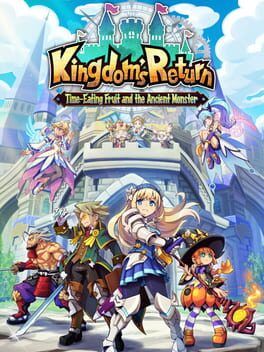

A first-look preview of Inti Creates’ kingdom-rebuilding action RPG, breaking down its time-rewind loop, how it diverges from the studio’s usual 2D action formula, and where it might slot into the growing Switch and Switch 2 lineup.
Inti Creates has built its reputation on razor-sharp 2D action, from Azure Striker Gunvolt to the Gunvolt Chronicles and Bloodstained: Curse of the Moon spin-offs. Kingdom’s Return: Time-Eating Fruit and the Ancient Monster is something different. It keeps the studio’s side-scrolling combat roots, but wraps them in a longer arc about rewinding a ruined realm and slowly bringing a dead kingdom back to life.
This is still a game where hitboxes, invincibility frames and tight platforming matter, yet the real hook is what happens after the fighting is done. Every foray into the field feeds into a broader city-building meta layer, and that loop of run, rebuild and retool is what gives Kingdom’s Return a shot at becoming a word-of-mouth favorite on both Switch and the upcoming Switch 2.
A fallen kingdom, a hungry fruit and a looping future
Kingdom’s Return sets you in a world already lost. The titular kingdom has collapsed, and your only shot at setting things right lies in the power of a mysterious time-eating fruit and the threat of an ancient monster looming over what is left of civilization. Inti Creates is leaning into a mix of melancholy and hope here: the land is broken, but every expedition yields a few more resources, a little more knowledge and a slightly brighter horizon on the next loop.
Moment to moment, you are working through 2D side-scrolling stages. These are the familiar Inti Creates playgrounds filled with enemies, hazards and secrets. The twist is that everything you haul back is important beyond immediate progression. Materials and spoils are the backbone of the reconstruction effort, feeding directly into the rebirth of the capital and indirectly into your character builds.
Rather than a linear march from stage one to credits, the structure suggests a rhythm of repeated ventures into old and new zones to squeeze out just enough materials to raise another building or push a class a bit deeper down its skill tree. The time-fruit concept underpins this cadence. Failure or retreat is not a hard stop, it becomes just another iteration in a long chain of rewinds as you nudge the kingdom and your party toward a better timeline.
The core loop: fight, harvest, rebuild, power up
The heart of Kingdom’s Return is a loop that constantly bounces you between the battlefield and the town screen. You dive into an action stage as one of four distinct classes, clear enemies, track down materials and then carry everything home. That haul then feeds into two crucial systems: physical reconstruction of the kingdom and the growth of your chosen class.
City-building is not presented as a separate management sim so much as a strategic layer on top of the action. You use materials to place structures around your hub, and those buildings do more than fill in empty space. Each one comes with tangible gameplay effects, from stat boosts to functional facilities that support your next outing. The decision of what to build next is therefore a question of playstyle as much as aesthetics. Do you shore up offense ahead of a tough area, or add survivability to help you explore deeper in a single run?
On top of that sits character progression. You earn CP through your exploits and spend it on the Class Circle, a web of skills and upgrades unique to each archetype. This is Inti Creates taking the crunchy side of RPGs and layering it over their usual action design. Instead of a simple linear upgrade line, the Class Circle invites experimentation, letting you veer toward specific weapons, utility skills or finishers that fit how you personally like to approach a map.
The key is how interdependent all of this becomes. A good run gives you more materials and CP, which leads to better buildings and stronger skills, which in turn open up harder areas that yield rarer resources and so on. The time-rewind framing naturally fits that compulsion loop: each cycle is a chance to tweak one more variable in your growing kingdom and see how the next future plays out.
Four classes, four ways to reclaim the future
Inti Creates is opening the game up with four playable characters that double as classes: Imperial, Alchemist, Wizard and Zipangu. This is where the studio can flex its long experience with character-driven action.
Imperial looks set to be the frontline all-rounder, the class most likely to appeal to players who enjoy close combat and reliable fundamentals. Wizard pushes in the opposite direction with a toolkit of ranged magic and likely crowd control, rewarding spacing and situational awareness.
The recent gameplay trailer has focused heavily on the Alchemist. Described as a trickster type, this class revolves around noxious potions and status-driven battlefield control. You soften groups of enemies with lingering hazards, then cash out with high impact Class Circle skills like Chemical Blaster Omega. It is a style that suggests a lot of creativity in how you set up encounters, in contrast with the more direct aggression of the Imperial.
Zipangu hints at a more exotic style rooted in the game’s fantasy take on eastern martial traditions. While details are still relatively light, this fourth class rounds out the roster with a likely emphasis on agility and unique movement options, offering yet another way to navigate the side-scrolling layouts.
What all four share is a deepening through the Class Circle system. Inti Creates’ usual approach to character differentiation, based on precise movesets and weapon feel, is now backed by a more explicit build layer. Players who love squeezing out optimizations or building themed loadouts will have fertile ground to dig into, which dovetails nicely with the replay-friendly structure of repeated expeditions.
How Kingdom’s Return breaks from Inti Creates tradition
On the surface Kingdom’s Return still looks like an Inti Creates game. The 2D perspective, sprite work flavor and snappy combat animations are all present. The difference is in pacing and scope.
Previous hits like the Gunvolt series or the Bloodstained offshoots are largely stage based. You choose a level, blaze through it in a few minutes once mastered, grab your rewards and move on to the next. Character progression is present, but mostly in the form of straightforward unlocks that sit in the background of a very action-forward experience.
Kingdom’s Return, by contrast, positions the stages as one part of a larger timeline. The city-building and time-fruit loops mean that what you do in one mission can meaningfully change the context of the next. Raising specific buildings or investing in certain Class Circle paths is not just about raw power, it shapes the kinds of challenges you are comfortable taking on and the routes you want to chase.
This introduces a more strategic, almost sim like layer the studio has typically avoided. Instead of speedrunning for rank and score alone, players are encouraged to plan their long game. When is it worth grinding a safer area for materials to unlock a crucial building? When should you push into a new zone despite being underbuilt, gambling that the payoff will tilt the future in your favor?
Structurally, it also nudges the experience toward something closer to a light action RPG with persistent hub growth. That puts it at an interesting crossroads between Inti Creates’ own catalog and titles like ActRaiser or more modern hybrid action city-builders, without fully committing to being a management sim.
Fitting into the Switch and Switch 2 landscape
Slated for April 23, 2026 on Switch, Switch 2, PS5, Xbox Series and PC, Kingdom’s Return is landing in a very different Nintendo ecosystem than the one that buoyed early Gunvolt releases. By then, Switch 2 will likely have a healthy slate of large scale RPGs and tentpole action titles, and late era Switch support will skew toward cross gen projects that can cater to both audiences.
That might actually be to Kingdom’s Return’s advantage. Inti Creates has always thrived in the space just off center from the mainstream. Their games rarely dominate sales charts on day one, but over time they build a dedicated following that appreciates tight mechanics and replayability.
For players eyeing the Switch 2 launch window, Kingdom’s Return could serve as the kind of comfort game that sits alongside a bigger purchase. The cross gen release means it should run on an existing Switch without being left behind on the newer hardware, while the side scrolling art direction makes it easier to scale nicely on both handheld and docked modes.
More broadly, there is room in the upcoming lineup for something that blends quick, skillful stages with a longer term town and character building arc. Fans of titles like Dragon’s Crown, Odin Sphere or smaller scale action RPGs on portable systems often look for games they can chip away at over weeks. The time rewind loop and four class roster position Kingdom’s Return well for that niche, especially if Inti Creates nails the balance between grind and satisfying power spikes.
A sleeper hit in the making?
A lot will hinge on execution. The city-building layer needs to feel meaningful without becoming a drag, and the Class Circle must avoid hollow incremental upgrades in favor of genuinely transformative skills. If those pieces come together, Kingdom’s Return has the ingredients to outgrow its initial reveal trailer buzz.
The premise of a time eating fruit and a looping effort to rebuild a shattered kingdom gives the game a strong thematic spine. Paired with Inti Creates’ seasoned 2D action chops, it is easy to imagine players trading stories about clever class builds or the moment a new building finally tipped a brutal stage in their favor.
In a crowded 2026 calendar for Switch and Switch 2, that slow burn, word-of-mouth momentum is often what separates a footnote from a cult classic. Kingdom’s Return: Time-Eating Fruit and the Ancient Monster is not trying to be the biggest release on the platform, but its hybrid of precise action and rewinding kingdom sim just might make it one of the most enduring.