
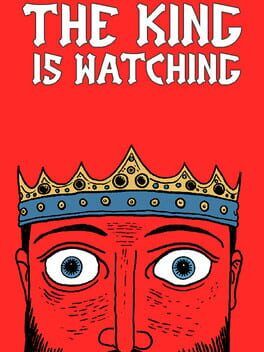

The King is Watching comes to PS5, Xbox Series X|S, and Nintendo Switch on July 29, 2026, bringing its gaze-driven kingdom management loop to consoles after a strong PC run.
Image: IGDB
Store links: The King is Watching on Steam, The King is Watching: Crowns of History on Steam
A console date turns a PC cult strategy hit into a controller test
The King is Watching is coming to PlayStation 5, Xbox Series X|S, and Nintendo Switch on July 29, 2026, publisher tinyBuild and developer Hypnohead have announced, according to Gematsu, Niche Gamer, Gaming Debugged, CDKeyPrices, and other outlets covering the release date reveal. Gematsu also reports that the PC version will arrive on the Microsoft Store alongside the console launch, after first releasing on Steam on July 21, 2025.
That makes this a straightforward date announcement, but the interesting pressure point is platform fit. The King is Watching is a strategy roguelite console release built around active supervision rather than broad empire planning. Buildings only work when the king is looking at them, so every second spent watching wheat fields, barracks, workshops, or magical infrastructure is a second not spent watching something else. On PC, that kind of attention-routing naturally leans on pointer speed and quick scanning. On consoles, it has to survive the move to gamepads without losing the snap that makes the economy stressful.
The official platform list in the available reporting does not include PlayStation 4, Xbox One, or a Switch 2-specific version. The confirmed console targets are PS5, Xbox Series X|S, and Nintendo Switch. Gaming Debugged also lists “Xbox on PC,” while Gematsu specifies Microsoft Store for PC, which is the clearer store-level detail. No provided source confirms cross-save, cross-buy, cloud saves between Steam and Microsoft Store, resolution targets, frame-rate targets, or platform-specific features.
The whole economy runs on attention, not automation
The King is Watching is described via its Steam page, as quoted by Gematsu and Niche Gamer, as a roguelite kingdom builder where players defend a castle against increasingly difficult waves of enemies while prioritising production and army training. Its central rule is unusually literal: the royal gaze determines which buildings produce resources. Look at wheat fields and peasants harvest. Look away and production stops. Shift focus to barracks or a mage guild and those systems begin working instead.
That premise is why this kingdom management game may land well with strategy fans who want pressure without committing to a sprawling campaign. The strategic question is not whether to annex a province, manage a diplomacy web, or optimize a 40-hour tech tree. It is whether the next few seconds are better spent producing food, training troops, generating spells, trading resources, or keeping the defensive chain alive before the next wave hits.
CDKeyPrices’ report expands that loop into the broader production layer, saying players build production chains, extract rare materials, trade resources, and study ancient magic to unlock stronger buildings, reinforce defenses, and improve the army. iXBT similarly frames success around production chains, rare materials, trading, and magic research. The important design distinction is that those systems are gated by focus. In many strategy games, once a supply line exists, the player can let it tick in the background. Here, idle production is conditional. Your build order is only as good as your attention budget.
That creates a compact form of economic triage. Farms are not passive food income. Barracks are not passive recruitment. Spell generation is not a background cooldown if the mage guild is outside the gaze. The game’s pressure comes from the cost of looking elsewhere, which is a clean fit for short roguelite runs and a risky fit for players who prefer slow, expansive kingdom planning.
Roguelite structure gives the small board a longer tail
The console release is being sold on a repeatable run structure rather than a single large campaign. Gaming Debugged reports that each playthrough can involve different rulers to unlock, including King Leo the Wise, who grants building blueprints to loyal subjects, King Spellus, who uses arcane crystals for spells, and King Alucard, who raises fallen soldiers as undead fighters. The same report says runs combine blueprints, spells, and artefacts in different ways and feature different villainous bosses, from goblin warlords to dragons.
Niche Gamer and Gematsu, quoting the game’s Steam overview, also point to deck customization as a core feature. Players can build and customize a building deck to suit their preferred strategy, which matters because the gaze system makes every addition to the economy a potential attention sink. A building that looks efficient on paper may become a liability if it demands too much supervision during enemy pressure. A leaner deck could be safer than a greedier one if the run is already asking the player to split focus between food, troops, spells, and walls.
This is where The King is Watching’s roguelite identity matters for strategy players. The metagame is not only about unlocking stronger tools. It is about learning which tools can be supported within a limited attention economy. A ruler who changes army sustain, spell production, or blueprint access changes the value of each glance. In a conventional city-builder, expansion often increases output. In this design, expansion also increases cognitive load.
Gaming Debugged says Threat Levels can be layered on top for additional challenge. AllKeyShop reports that a free Shifting Sands update, deployed before the console launch and integrated across platforms, replaced Threat Tiers with 36 Danger Modifiers that can alter difficulty through effects such as reduced unit health, lightning strikes, or resurrecting enemy units. Because that detail comes through AllKeyShop’s reporting rather than the other supplied console-date articles, it should be treated as a reported update detail unless confirmed directly through the game’s own patch notes or store page by the reader.
Console appeal depends on speed, readability, and control feel
For The King is Watching PS5 Xbox and Switch players, the biggest practical question is not genre definition. It is whether the gaze mechanic feels precise on a controller. AllKeyShop reports that Hypnohead focused on translating the fast-paced resource management to standard gamepads and describes the console versions as having optimized controller support. No provided source gives hands-on impressions for these ports, so the quality of that translation remains an open question until console players and reviewers test it.
The design has some obvious strengths for console play. Runs built around waves and tight economic decisions are easier to fit into living-room or handheld sessions than a huge grand strategy campaign. The visible-board nature of the gaze system could also make decision-making clearer than nested menus, provided the UI communicates production status, enemy timing, and building coverage cleanly. On Switch in particular, the premise sounds well matched to portable play if performance and interface scaling hold up, though no source material confirms Switch performance details.
There is also a real risk. Strategy games that rely on rapid selection and camera movement can feel very different once the mouse is gone. If the console interface makes it slow to redirect the king’s attention, the game may become frustrating for the wrong reason. If it over-assists the player, it could soften the tactical squeeze that defines the PC version’s identity. The best-case console port keeps the punishment attached to bad prioritization, not to fighting the cursor.
That distinction will shape the long-term console meta. If controller input encourages broader, slower attention sweeps, players may favor simpler production chains, more resilient defensive builds, or rulers that reduce the need for constant micro. If the ports allow quick, accurate targeting, the higher-pressure builds reported in the PC version’s roguelite structure should translate more directly.
PC reception is strong, though reported sales figures differ
Several supplied sources frame the console launch as the next step after a successful PC debut, but they do not all use the same sales figure. Gaming Debugged says The King is Watching has shifted over 600,000 units on PC. AllKeyShop also reports more than 600,000 units sold, citing a Games Press item. CDKeyPrices, by contrast, says the game has sold over 500,000 copies. Those figures are not necessarily incompatible if they were captured at different times, but the source material does not provide a single publisher-issued sales number in the excerpts. The safest reading is that the game passed at least 500,000 reported PC sales, with some outlets reporting a higher 600,000-plus figure.
CDKeyPrices adds two useful pieces of context: The King is Watching was a finalist for “Strategy/Simulation Game of the Year” at the 29th Annual D.I.C.E. Awards, and it reached a peak of 17,988 concurrent players, described as the highest concurrent player count in tinyBuild’s publishing history. Those are significant signals for a small strategy game, especially one that began life as a Ludum Dare project.
CDKeyPrices reports that The King is Watching originated at Ludum Dare 54 in October 2023, where it placed third overall, and that tinyBuild discovered the game in February 2024 before a publishing contract followed in March. The same source identifies Hypnohead as a Serbian indie studio led by founders Semyon Itmanyuk and Maxim, with another programmer. For a design this focused, that origin story tracks with the final product described by the store overview: one sharp rule, then layers of economy, defense, and roguelite variation built around it.
Hypnohead studio head Semyon Itmaniuk, quoted by Gaming Debugged and CDKeyPrices, said, “The King is Watching has had a wonderful reception on PC, but don’t get too comfortable, console players: we’ve got our eye on you too.” It is a light promotional line, but the reception claim is backed by the reported sales, award recognition, and concurrency figures supplied by the sources.
Who should play at launch, and who should wait
The King is Watching console release looks most attractive for strategy players who enjoy build-order pressure, roguelite adaptation, and compact resource puzzles. If your favorite part of strategy is deciding which system gets fed first under time pressure, the gaze mechanic is the hook. If you prefer broad empire growth, diplomacy, long-form campaign persistence, or a relaxed city-builder rhythm, this may feel restrictive by design.
AllKeyShop reports that the console version will cost just under $16. That price is not repeated across every supplied source, so buyers should check the PlayStation Store, Microsoft Store, and Nintendo eShop listings in their region before launch. The confirmed date across the reporting is July 29, 2026, with PS5, Xbox Series X|S, Nintendo Switch, and Microsoft Store PC availability. Steam is already listed as the original PC platform, with Gematsu giving July 21, 2025 as the Steam launch date.
If you are buying on console primarily for handheld play, wait for Switch-specific performance impressions unless the price and concept are enough for you. If you are choosing between Xbox and PC, check whether the Microsoft Store version offers the ecosystem features you care about, since the supplied source material does not confirm cross-save, Play Anywhere entitlements, or parity with Steam. If you already own it on Steam, the console version’s value will depend on control feel and portability rather than new content, unless the reported Shifting Sands update is the piece you have been waiting to revisit.
The cleanest expectation is this: The King is Watching is not arriving on consoles as a sprawling strategy epic. It is arriving as a compressed attention economy where every glance is a production order and every distraction has a cost. That is exactly the kind of pressure a strategy roguelite console audience may want, provided the ports make the king’s gaze feel as sharp on a stick as it did on PC.