
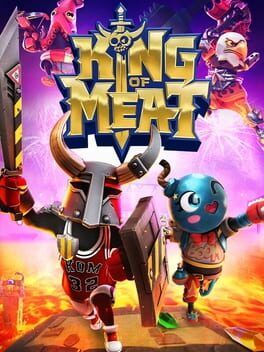

Amazon and Glowmade’s UGC‑driven co‑op dungeon brawler King of Meat is shutting down less than a year after launch, with full refunds for players. Here’s what the game was trying to do, how Amazon is sunsetting it, and what the closure signals for Amazon Game Studios’ live‑service and UGC strategy.
Amazon and Glowmade are shutting down King of Meat on April 9, 2026, ending the co‑op dungeon brawler’s run barely six months after release. It is another short‑lived experiment in Amazon’s first‑party portfolio, but it also reflects a more specific problem the company continues to grapple with: how to build and sustain live‑service and user generated content driven games at scale.
What King of Meat Tried To Be
King of Meat launched in October 2025 on PC, PlayStation 5, and Xbox Series X|S as a brightly colored, game show styled co‑op dungeon crawler. Up to four players dropped into trap stuffed arenas, solved light puzzles, and hacked through cartoonish monsters while chasing loot and cosmetics.
Structurally, it sat in the growing space between co‑op action games and creator platforms. Official dungeons were meant to coexist with community made runs, with progression and unlocks carrying across both. Glowmade’s pitch leaned on that blend of party game chaos and UGC driven longevity, trying to turn bite sized runs into something that could support a live calendar of events, seasons, and new building blocks for creators.
On paper, that positioned King of Meat alongside games like Fortnite Creative and Roblox style experiences, but focused around a specific cooperative combat loop rather than a generalized sandbox. Its success depended not just on players showing up to run dungeons, but on enough of them sticking around to build new ones, iterate, and keep the library feeling fresh.
A Quiet Audience And A Rapid Sunset
That critical mass never materialized. Steam data shows a peak of roughly 320 concurrent players, with review counts that suggest an extremely small paying audience. Polygon’s launch coverage described struggling to fill four player lobbies even during opening weekend. For a co‑op title trying to sell itself as a raucous game show, playing with partial teams or bots undercuts the whole premise.
Amazon’s shutdown statement leans on familiar language, stressing Glowmade’s creativity and innovation while citing the game’s inability to find the audience they had hoped for. There are no public hints of contentious fallout between publisher and developer. From the outside, this looks less like drama and more like a cold numbers decision on a service that could not justify continued investment.
How Amazon Is Handling Refunds And The Wind Down
On the player side, Amazon is treating King of Meat’s closure as a full unwind rather than a partial scale back. Servers will remain live until April 9, 2026, with all existing content available through the final day. There is no shift to an offline mode or pared down version.
Crucially, Amazon is issuing full refunds to anyone who purchased King of Meat. That includes copies bought on console stores and PC storefronts. Combined with continued access through shutdown, this approach mirrors how some publishers are beginning to handle early live‑service closures where the runway between launch and sunset is measured in months instead of years.
Refunds do not erase player disappointment, but they do set a precedent for how Amazon is willing to own short lived experiments. For a company that is still trying to build trust as a long term game maker, the difference between quietly sunsetting a product and openly unwinding it with refunds matters.
Another Data Point In Amazon’s Live‑Service Struggle
Viewed in isolation, King of Meat is a modest project from a mid size studio. Within Amazon’s broader track record, it slots into a pattern that has become difficult to ignore.
Crucible launched, was pulled back into closed beta, and ultimately canceled. Breakaway never made it past prolonged public testing. A previous Lord of the Rings MMO collapsed in development. Even New World, Amazon’s most visible internal success story, is already scheduled to shut down in 2027 after struggling to retain its early surge of players.
King of Meat underscores that the issue is not limited to a single genre. Amazon has tried competitive shooters, sports brawlers, full scale MMOs, and now a co‑op dungeon crawler with UGC ambitions. Across these projects, the recurring challenge is not shipping a game at all, but sustaining the population needed to justify live‑service support.
The UGC Challenge: Critical Mass Or Bust
User generated content is often framed as a solution to live‑service fatigue, a way to keep games fresh without relying only on developer produced content. In practice, it behaves more like a multiplier. When a platform has a large, engaged base, UGC can extend retention and diversify experiences. When the base is small, the same systems can highlight just how empty a game feels.
King of Meat landed in the latter category. With low concurrent players, the pipeline of new community dungeons was never going to keep pace with what a modern co‑op audience expects. That creates a feedback loop: thin content slows engagement, which further depresses the community’s appetite to create.
For Amazon, this is a design and portfolio problem, not just a marketing one. Live‑service UGC titles need both a strong default experience and a clear creator fantasy that resonates quickly. King of Meat shipped with a defined core loop, but its game show framing and progression did not generate the early gravity needed to pull players into long term building and experimentation.
Where This Leaves Amazon Game Studios
Despite a run of short lived projects, Amazon is not stepping away from large scale online games. The company continues to publish external MMOs like Lost Ark and Throne and Liberty, and it has another Lord of the Rings MMORPG and multiple Tomb Raider projects in development. In that sense, King of Meat is less a turning point and more another feedback point in an ongoing strategy.
The lesson from this closure is less about Amazon’s appetite for games and more about its fit with certain types of live‑service design. So far, Amazon has found more traction when it acts as a publisher for already established or clearly scoped online projects, rather than as the primary shepherd of experimental, community driven services.
If Amazon wants its next in house live‑service or UGC driven game to avoid King of Meat’s fate, it will need to solve two problems simultaneously. First, it has to launch into a world where audiences are already saturated with ongoing games, which means sharper positioning and stronger reasons to move from existing favorites. Second, it has to treat UGC not as a safety net that will rescue a thin core loop, but as an amplifier that only pays off once the fundamentals of play and population are already there.
King of Meat did not get the time or the audience it needed to reach that point. The refunds and relatively transparent shutdown at least limit the damage, but for Amazon Game Studios, it is another reminder that shipping a live‑service experiment is only the beginning of the hard work, not the end.