
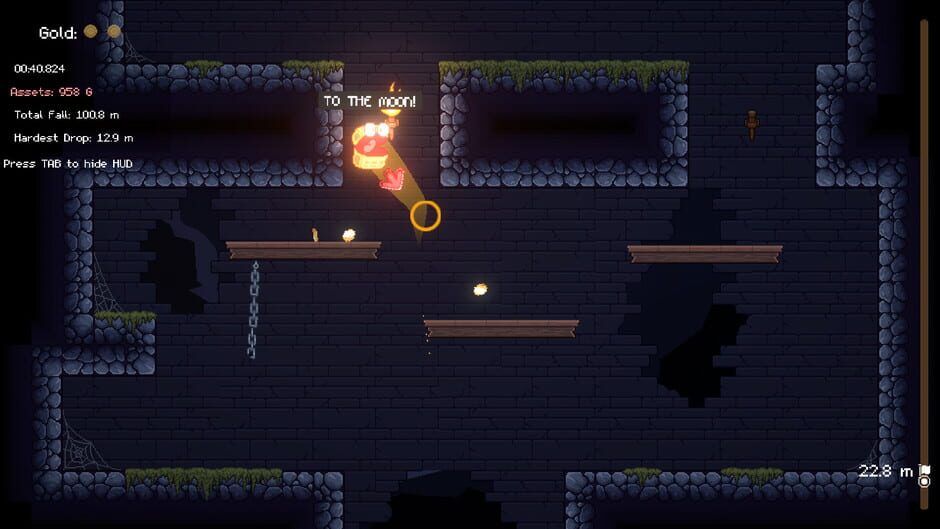

We break down the new Jump Broke Steam demo and examine how its coin-fueled recoil jumps, brutal falls, and resource-focused design position it for a potential breakout among hardcore precision platformer fans.
A Mimic, No Legs, And A Pocket Full Of Pain
Jump Broke does not ease you in. The Steam demo drops you into the tiny wooden body of a legless mimic with one way to move: fire your own coins at the ground to rocket yourself into the air. Every leap costs one coin, every correction costs another, and every mistimed blast risks sending you tumbling down several screens of progress.
It is a clean pitch for the hardcore platformer crowd. Take the minimalism and punishment of Getting Over It or Only Up, then graft it to a single, expressive input that handles movement, aiming, and resource drain all at once. The result in the demo is a traversal system that feels both instantly readable and surprisingly deep.
Coin-Blasting As A Traversal Hook
At the core of Jump Broke is recoil. You point a reticle, press jump, and your mimic fires a coin in the opposite direction. The kick sends you flying, with height and arc entirely determined by your angle and timing. Because one coin equals one jump, skinny platforms and narrow ledges become multi-layered decisions instead of simple timing checks.
The key is that the coin is both fuel and projectile. Want a tiny adjustment to avoid spikes? That is another coin. Need to correct mid air after overcommitting? Another coin. You are constantly weighing the safety of an extra blast against the reality that your purse is not bottomless.
Within a few minutes the demo forces you to internalize this system. Low, conservative blasts feel safe but may not clear gaps. Aggressive, high angle blasts chew through coins but open up shortcuts and trickier routes. Because the mechanic never changes, your improvement comes from learning nuance rather than unlocking new movement toys.
Punishing Vertical Design
Level design in the demo leans hard into verticality and punishment. You are always climbing, and the camera keeps much of the path you just cleared in view. When you miss a landing you rarely die outright. Instead you drop. Sometimes a screen. Sometimes several. The cost is not just the lost ground, but the coins you had already spent to get there.
This turns each section into a mental push and pull. Do you take the longer, safer staircase of platforms that offers more landing spots but demands more jumps, or do you gamble on a higher risk angle that might land you near a checkpoint in half the coins? Failure never feels random. The geometry is simple, the hitboxes are readable, and the challenge comes from your own greed or impatience.
There are clear echoes of games like Jump King or Pogostuck, where a single mistake can erase minutes of progress. The difference is that Jump Broke layers an economy on top of those failures. You are not just falling. You are watching the memory of wasted coins play back in your head, already calculating how much more careful you need to be on the next ascent.
Teaching Through Failure
The demo uses its limited runtime to establish a strong difficulty curve. Early segments let you experiment with shallow angles and let you learn how much height you get for various inputs. Soon after, the game introduces tighter platforms, spike hazards, and awkward wall shapes that punish lazy arcs.
Importantly, the game rarely explains anything through text. Instead it builds short sequences that force you to apply a new idea, like chaining low blasts along a wall or using rapid-fire small jumps to inch up a shaft without overshooting. When you misfire you tend to know exactly why, which is key for keeping frustration in the productive zone rather than the quit-and-refund zone.
This clarity is helped by readable pixel art. The mimic chest is small but distinct, the coins pop against the backgrounds, and hazards are visually loud. Combined with snappy sound effects on coin shots and landings, you get a crisp feedback loop that makes repeating the same climb dozens of times feel like practice rather than punishment.
Hardcore Hooks And Indie Identity
For a certain audience, Jump Broke checks a lot of boxes. Single, demanding movement mechanic. High-skill ceiling with near endless room for optimization. Vertical stages that can support speedrunning and challenge runs. A simple, immediately understandable failure state that makes every recovered fall feel heroic.
The coin economy in particular has strong potential for meta-play. It is very easy to imagine community challenges forming around low-coin clears, no-correction runs, or optimized routes that minimize both time and currency spent. The fact that every jump consumes a fixed amount at all heights keeps the ruleset clean enough for players to strategize without arcane math.
Aesthetically the game leans into a scrappy indie feel. The mimic-as-protagonist sells the title’s theme of spending your wealth just to move forward, and the placeholder soundtrack work in the demo already gives climbs a tense, almost lonely energy. If the final version can expand on this atmosphere and avoid cluttering the screen, it should stand out in store pages and thumbnails.
Will Jump Broke Break Out?
Whether Jump Broke can break through the noise of other brutal platformers will come down to execution over a full campaign. The demo makes a strong first impression, but a game built on a single movement verb lives or dies by how many interesting situations the designer can build around it.
So far the signs are promising. The coin recoil hook is immediately unique, and the demo proves the team understands how to extract tension out of vertical climbs and costly errors. There are no filler mechanics muddying the core, and every section you clear feels like a direct test of your growing mastery.
For players who love Celeste’s precision but crave the cruelty of Jump King, Jump Broke’s Steam demo suggests a potent middle ground. It will not convert anyone who bounces off punishment and loss of progress, but it does not seem to be trying to. This is laser targeted at the hardcore, and that clarity of intent may be exactly what gets it noticed.
If the full release can scale its ideas without resorting to cheap tricks, Jump Broke has every chance to become the next speedrun and streamer staple in the precision platformer scene.